
L’Oreal’s history can be divided into several key stages, evolving from a small lab founded by a chemist into the world’s largest cosmetics group:
1909-1956: Foundation and Innovation
The origins of L’Oreal are deeply rooted in scientific research.
- 1907: French chemist Eugène Schueller developed a new hair dye formula called Auréole.
- 1909: He officially founded the French Safe Hair Dye Company, the predecessor of L’Oreal.
- 1920s-1930s: Schueller recognized the power of advertising and expanded the product line, launching the famous Dop shampoo and Ambre Solaire suntan oil, which pioneered the modern sunscreen market.
Core Products: Auréole (safe hair dye), Dop shampoo, Ambre Solaire (pioneering sunscreen).
Core Strategy: R&D-driven and mass market education. Leveraging a chemical background to solve consumer safety issues in hair coloring while using innovative advertising to build brand awareness.
Revenue Level: Early-stage growth primarily focused on the French domestic market; revenue scale was in its initial development.
1957-1983: Expansion and Strategic Acquisitions
Under the leadership of François Dalle, the company began to grow through major acquisitions.
- Brand Portfolio: The group acquired Lancôme in 1964, Guy Laroche in 1965, and Biotherm in 1970. These moves allowed L’Oreal to move beyond mass market products into luxury and dermo-cosmetics.
- 1963: L’Oreal went public on the Paris Stock Exchange to fuel further international growth.
- 1973: The iconic slogan “Because I’m worth it” was created, shifting the focus to female empowerment.
Core Products: Lancôme (luxury cosmetics), Kérastase (professional haircare), Biotherm (skincare).
Core Strategy: Multi-brand acquisition and market segmentation. Expansion into the luxury and dermo-cosmetic sectors through strategic M&A, supported by the 1963 public listing to fuel growth.
Revenue Level: Accelerated international expansion led to annual revenues reaching hundreds of millions of Euros.
1984-2005: Global Leadership and R&D
Lindsay Owen-Jones took over as CEO, aiming to make L’Oreal a truly global powerhouse.
- US and Asia Market: The 1996 acquisition of Maybelline gave L’Oreal a massive foothold in the US mass-market makeup segment. This was followed by rapid expansion into China and other emerging markets.
- Scientific Moat: Massive investment in skin biology and toxicology research helped L’Oreal maintain a technological lead over competitors.
- 2000s: The acquisition of brands like Shu Uemura and La Roche-Posay solidified its presence in Asian beauty and medical aesthetics.
Core Products: Maybelline (mass-market makeup), La Roche-Posay (medical skincare), Shu Uemura (Asian luxury beauty).
Core Strategy: Global footprint and scientific moat. Acquired Maybelline to dominate the US mass market and invested heavily in skin biology and toxicology research to ensure technical superiority.
Revenue Level: Revenue surpassed 14.5 billion Euros by 2005.
2006-2020: Digital Transformation and Sustainability
Led by Jean-Paul Agon, the group adapted to the rise of e-commerce and social media.
- Digital First: L’Oreal heavily invested in digital marketing and acquired the AR beauty tech company ModiFace to integrate technology into the shopping experience.
- Green Beauty: Launched the “Sharing Beauty With All” program, committing to reducing carbon footprints and improving packaging sustainability.
- Portfolio Optimization: Acquired high-growth brands like NYX and CeraVe to capture younger consumer segments.
Core Products: NYX Professional Makeup, CeraVe (active cosmetics), ModiFace (AR virtual try-on tech).
Core Strategy: Digital-first and Green Beauty. Shifted focus toward e-commerce and social media marketing, acquired AR tech firms for digital experiences, and launched “Sharing Beauty With All” for sustainability.
Revenue Level: Revenue grew to approximately 29.87 billion Euros by 2019.
2021-Present: The Beauty Tech Era
Current CEO Nicolas Hieronimus is driving the transformation of L’Oreal into a tech-driven beauty company.
- Personalization: Utilizing AI and big data to provide customized skincare and makeup recommendations.
- Bio-tech: Increasing focus on “Green Sciences” to develop sustainable, bio-based ingredients.
Core Products: AI-driven personalized skincare systems, bio-based raw materials, high-tech home beauty devices.
Core Strategy: Tech-driven and Green Science transition. Utilizing AI and Big Data for hyper-personalization while investing in “Green Sciences” to develop sustainable ingredients and maintain high growth.
Revenue Level: Reached a record high of 41.18 billion Euros in 2024.
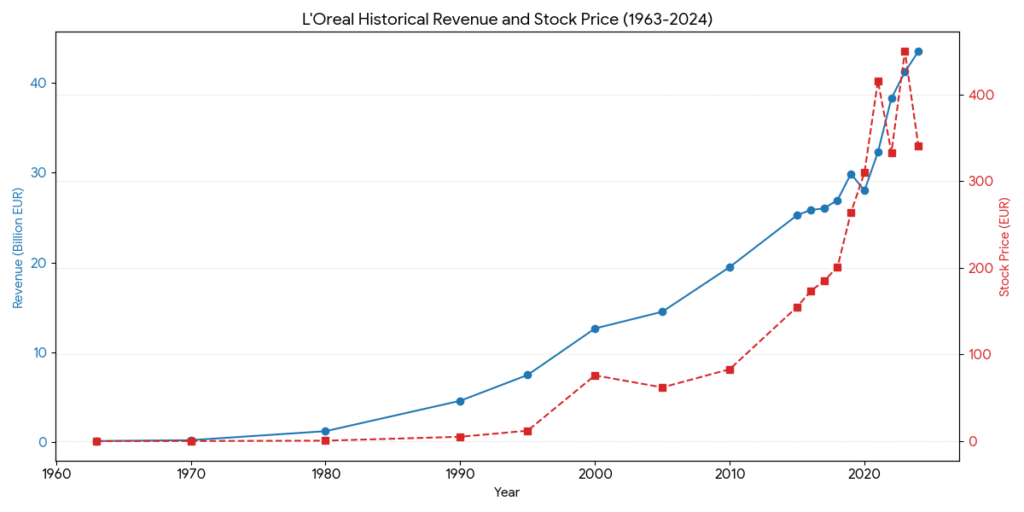
L’Oreal Competitive Landscape Analysis
L’Oreal currently maintains a dominant lead in the global beauty market with 2024 revenue reaching 43.48B EUR, significantly ahead of its nearest pure-play beauty competitors.
1. Primary Competitors by Segment
L’Oreal’s vast portfolio allows it to compete across four distinct divisions, each facing a different set of rivals:
- Luxe (Luxury) Division
- Main Rivals: Estée Lauder, LVMH (Dior, Givenchy), Shiseido, Chanel.
- Dynamics: Competition is focused on brand heritage and premium skincare. While Estée Lauder has struggled recently due to over-reliance on China’s travel retail, L’Oreal Luxe has remained resilient through a more balanced global distribution.
- Consumer Products (Mass Market)
- Main Rivals: Procter & Gamble (P&G), Unilever, Coty, Johnson & Johnson.
- Dynamics: This is a battle of volume and supply chain efficiency. L’Oreal competes with Maybelline and Garnier against P&G’s Olay and Unilever’s Dove.
- Dermatological Beauty (Active Cosmetics)
- Main Rivals: Beiersdorf (Eucerin, Aquaphor), Pierre Fabre (Avène), Galderma (Cetaphil).
- Dynamics: This is L’Oreal’s fastest-growing segment. CeraVe and La Roche-Posay are currently outperforming traditional clinical brands by leveraging “medical-backed” marketing on social media.
- Professional Products (Salon)
- Main Rivals: Henkel (Schwarzkopf), Kao (Goldwell), Wella.
- Dynamics: L’Oreal is the undisputed leader in professional hair color, holding roughly 25-30% of the global market share.
2. Competitive Benchmarking (2024 Estimates)
| Company | Est. Beauty Revenue | Key Competitive Advantage |
| L’Oreal | ~43.5B EUR | Scale & Diversification: Global leader across all price points and categories. |
| Unilever | ~26.0B EUR | Distribution: Massive footprint in emerging markets and personal care essentials. |
| Estée Lauder | ~15.5B USD | Prestige Focus: Strong historical dominance in high-end skincare (La Mer). |
| P&G (Beauty) | ~15.0B USD | Staple Brands: High household penetration with brands like SK-II and Pantene. |
| Beiersdorf | ~9.5B EUR | Niche Authority: Strong medical positioning with Nivea and Eucerin. |
3. Strategic SWOT Analysis
- Strengths:
- Universal Presence: Operates in 150 countries; when one region (like China) slows down, others (like Europe or Brazil) compensate.
- R&D Investment: Spends over 1B EUR annually on research, more than any other beauty company.
- Beauty Tech: Leads in AR/AI integration (e.g., virtual try-ons), creating a high barrier to entry for smaller firms.
- Weaknesses:
- Mass Market Saturation: High competition from “Indie Brands” (D2C) that can pivot faster to TikTok/social trends.
- Organizational Complexity: Managing 37+ global brands requires immense coordination.
- Opportunities:
- Medicalization of Beauty: The “Skin-intellectual” trend favors their Dermatological division.
- M&A Strategy: L’Oreal has a proven track record of buying fast-growing brands (e.g., Aesop in 2023) and scaling them globally.
- Threats:
- Local Champions: Rise of “C-Beauty” (China) and “K-Beauty” (Korea) brands taking local market share.
- Regulatory Shifts: Increasing pressure on packaging sustainability and chemical ingredient transparency.
Summary
L’Oreal’s primary advantage is its “Balanced Multi-Polar Model.” Unlike Estée Lauder (skewed toward Luxury) or Unilever (skewed toward Mass), L’Oreal can shift resources to whichever segment is growing fastest in a given economic cycle.
Source:
- https://www.loreal-finance.com/en/annual-report-2024/
- https://www.loreal.com/en/group/culture-and-heritage/l-oreal-history/
- https://www.macrotrends.net/stocks/charts/LRLCY/loreal-sa/revenue
- https://www.loreal-finance.com/eng/share-price
- https://portersfiveforce.com/blogs/brief-history/loreal
- https://www.loreal-finance.com/en/annual-report-2024/beauty-market/
- https://simplywall.st/stocks/de/household/fra-lor/loreal-shares/past
- https://www.tradingview.com/symbols/EURONEXT-OR/
Back to L’Oreal page