
The history of Johnson & Johnson (J&J) spans over 135 years, evolving from a small surgical dressing supplier to a global healthcare leader. It can be divided into five major phases:
1. The Foundation and Sterile Revolution (1886–1910)
Founded by brothers Robert Wood Johnson, James Wood Johnson, and Edward Mead Johnson, the company was inspired by Joseph Lister’s theories on antiseptic surgery.
- 1887: The company introduced the first commercial first-aid kits.
- 1888: Published Modern Methods of Antiseptic Wound Treatment, which became the industry standard.
- 1894: Launched Johnson’s Baby Powder, establishing the consumer health segment.
Core Technologies:
- Industrial Steam Sterilization: J&J pioneered a process using pressurized steam to mass-produce sterile surgical dressings and sutures, replacing inconsistent chemical methods.
- Sterile Catgut Sutures: Developed the first ready-to-use sterile sutures, drastically reducing post-operative infection rates.
Revenue Level:
- Startup Scale: Began with 25,000 USD in capital. By 1910, it had grown into a multi-million dollar business with 14 buildings and hundreds of employees, dominating the surgical supply market in the US.
2. Diversification and Our Credo (1910–1950)
During this period, J&J expanded its product line and formalized its corporate philosophy.
- 1921: Invention of BAND-AID Adhesive Bandages by employee Earle Dickson.
- 1943: Robert Wood Johnson II wrote “Our Credo,” a document outlining the company’s responsibilities to patients, employees, communities, and shareholders.
- 1944: The company went public on the New York Stock Exchange.
Core Technologies:
- Adhesive Technology: The 1921 invention of BAND-AID utilized advanced adhesive coating processes to create the first convenient home wound care product.
- Automated Mass Production: Implemented high-speed machinery for mass-producing sanitary napkins (Modess) and maternity kits, making professional healthcare standards accessible to households.
Revenue Level:
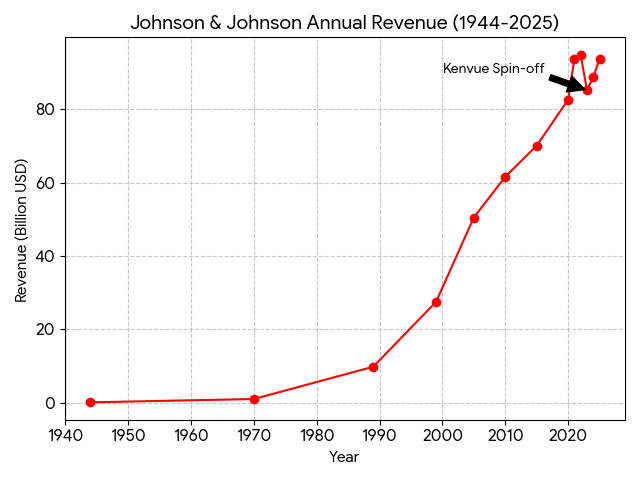
- Growth to Public Status: By the time J&J went public in 1944, annual sales reached 93.6 million USD (roughly 1.6 billion USD in today’s value).
3. Expansion into Pharmaceuticals (1950–1990)
J&J transformed into a diversified conglomerate through strategic acquisitions and global expansion.
- 1959: Acquired McNeil Laboratories, bringing Tylenol into its portfolio.
- 1961: Acquired Janssen Pharmaceutica, significantly boosting its drug research capabilities.
- 1982: The Tylenol Crisis occurred. J&J’s transparent response and introduction of tamper-resistant packaging became a landmark in corporate ethics.
Core Technologies:
- Analgesic Innovation: Launched Tylenol (Acetaminophen), a safer alternative to aspirin for pain and fever relief.
- Neuroscience and Anesthesia: Acquired Janssen Pharmaceutica, gaining expertise in antipsychotic drugs (Haldol) and fentanyl-based anesthesia.
- Disposable Contact Lenses: Developed stabilization and molding techniques for Acuvue, the world’s first disposable contact lens.
Revenue Level:
- Billion-Dollar Milestone: Revenue crossed the 1 billion USD mark in the early 1970s. By 1989, sales reached 9.8 billion USD.
4. High-Tech Medical Devices and Biotech (1990–2020)
The company pivoted toward high-margin medical technology and specialized biotechnology.
- 1990s: Acquired brands like Neutrogena and DePuy (orthopaedics).
- 2012: Completed the acquisition of Synthes for 19.7 billion dollars, the largest in its history at the time.
- 2017: Acquired Actelion to expand into treatments for rare diseases.
Core Technologies:
- Monoclonal Antibodies (Biologics): Developed Remicade for autoimmune diseases, marking J&J’s entry into precision biotechnology.
- Drug-Eluting Stents: Created the CYPHER stent, which releases medicine to prevent arteries from re-closing after surgery.
- Orthopaedic Implants: Specialized in advanced materials (titanium and ceramics) for joint replacement and spinal fusion through the acquisition of Synthes.
Revenue Level:
- Global Conglomerate: Revenue jumped from 29 billion USD in 2000 to over 82 billion USD in 2019.
5. Modern Restructuring: Focus on Innovation (2021–Present)
To drive growth in specialized sectors, J&J underwent its most significant structural change.
- 2021: Developed the single-shot Janssen COVID-19 vaccine.
- 2023: Spun off its Consumer Health business into a new, independent company called Kenvue.
- Current State: J&J now focuses exclusively on two segments: Innovative Medicine (formerly Janssen) and MedTech.
Core Technologies:
- Robotic-Assisted Surgery: Developed the OTTAVA and MONARCH digital platforms, integrating AI and robotics for minimally invasive procedures.
- Cell and Gene Therapy: Launched Carvykti (CAR-T therapy) for multiple myeloma, representing the cutting edge of cancer treatment.
- mRNA and Viral Vector Platforms: Developed the Janssen COVID-19 vaccine during the global pandemic.
Revenue Level:
- Post-Spin-off Revenue: After spinning off Kenvue (Consumer Health) in 2023, J&J reported 85.2 billion USD in revenue for 2023.
- Current Guidance: For 2025, revenue is projected to reach approximately 93.5 billion to 93.9 billion USD, with R&D spending exceeding 17 billion USD annually.
Sources: