
The Evolution of Intuit: A Four-Phase History
Intuit’s journey reflects the broader evolution of the software industry—moving from desktop tools to cloud services and now to an AI-driven global platform.
Phase 1: Solving Personal Pain Points (1983–1991)
The core focus during this period was simplifying tedious financial processes for individuals.
- The Origin Story: In 1983, Scott Cook watched his wife struggle to balance the family checkbook. He teamed up with Tom Proulx to co-found Intuit.
- The Flagship Product: Launched Quicken in 1984. Its success stemmed from “ease of use,” leveraging Cook’s experience at P&G to focus on user intuition rather than technical complexity.
- Market Foundation: Quicken quickly became the leader in personal finance software during the early days of personal computing.
Phase 2: SMB Expansion and Diversification (1992–2002)
Intuit noticed small business owners were using Quicken to run their companies, leading to a massive pivot toward the commercial market.
- Dominating Small Biz: Launched QuickBooks in 1992. It revolutionized accounting for small businesses by requiring no professional accounting knowledge, quickly monopolizing the US SMB market.
- IPO and Key Acquisition: Went public on the Nasdaq in 1993. That same year, it acquired Chipsoft, bringing TurboTax into the fold and securing its position in the tax prep market.
- Defeating Microsoft: Microsoft tried to compete with Microsoft Money, but Intuit’s superior user connection and marketing won out. A 1994 attempt by Microsoft to acquire Intuit was blocked by the DOJ on antitrust grounds.
Phase 3: The Cloud Transition and Ecosystem Integration (2003–2018)
As the internet matured, Intuit shifted from a software-in-a-box (on-premise) model to a Cloud/SaaS model.
- Cloud First: Launched QuickBooks Online (QBO) in 2003. While the transition was painful and caused short-term losses, it successfully built a stable, recurring subscription revenue stream.
- Platform Shift: Accelerated SaaS transformation from 2013 onwards. It acquired Mint.com in 2009 to bolster personal finance and famously sold off its “origin” product, Quicken, in 2016 to focus entirely on its cloud core.
Phase 4: The AI-Driven Expert Platform (2019–Present)
Intuit’s current goal is to become a global fintech platform connecting customers, data, and experts.
- Multi-Billion Dollar M&A:
- 2020: Acquired Credit Karma for $7.1B, entering the personal credit and consumer finance space.
- 2021: Acquired Mailchimp for $120B, integrating marketing tools into QuickBooks to help small businesses find and retain customers.
- AI Empowerment: Between 2023 and 2025, the company rolled out Intuit Assist (a GenAI assistant), leveraging decades of financial data to automate analysis and tax advice. It also launched the Intuit Enterprise Suite to move up-market toward mid-sized companies.
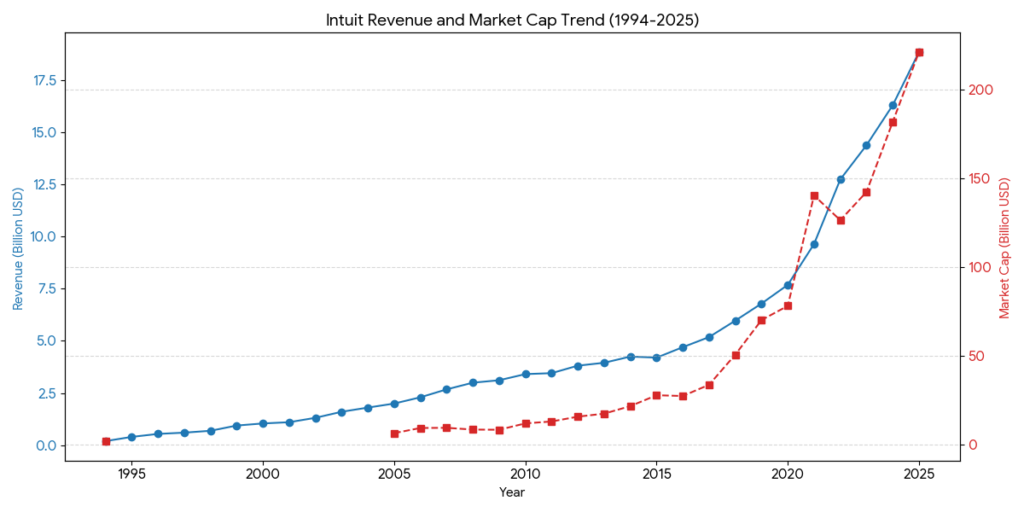
Competitive Landscape Analysis 2026
As of early 2026, Intuit faces a complex competitive environment across its four primary pillars: Accounting, Tax, Marketing, and Credit/Financing. The company’s primary strategy focuses on its “AI-driven expert platform” (Intuit Assist) to create a moat that single-point competitors struggle to match.
Intuit Business Pillar & Competitive Matrix
| Segment | Intuit Product | Top Competitors | Core Battleground |
| Accounting | QuickBooks | Xero, Sage, Zoho Books, FreshBooks | Cloud automation, API ecosystems, Mid-market penetration |
| Taxation | TurboTax | H&R Block, TaxAct, FreeTaxUSA | Expert-assisted filing (Live), Pricing transparency |
| Financing | Credit Karma | NerdWallet, LendingTree, SoFi | Loan conversion rates, Data accuracy, Cross-selling synergy |
| Marketing | Mailchimp | HubSpot, Constant Contact, Klaviyo | CRM integration, AI-driven ROI, E-commerce workflow |
Deep Dive by Segment
1. Small & Mid-Market Accounting (QuickBooks)
- Xero: Remains the primary global challenger, particularly in the UK, Australia, and New Zealand. Xero’s “open platform” philosophy appeals to developers and tech-savvy accountants who find QuickBooks’ ecosystem more “closed.”
- Sage: While QuickBooks dominates the micro-business space, Sage Intacct is a formidable rival in the Mid-Market (companies with 10–100 employees). Intuit’s 2025 launch of the Intuit Enterprise Suite is a direct offensive against Sage.
- Edge: QuickBooks’ massive US market share (est. 60%+) and its deeply entrenched ProAdvisor network of accountants remain its strongest defense.
2. Consumer Tax (TurboTax)
- H&R Block: Their hybrid model (DIY digital + 12,000+ retail offices) remains a threat to users who want physical peace of mind.
- Disruptors (FreeTaxUSA): Low-cost players are gaining ground among price-sensitive “Simple Return” filers.
- Edge: Intuit has successfully pivoted to TurboTax Live, which connects users to human experts via video. In FY26 Q1, this segment saw significant growth as Intuit moved away from being just a “tool” to being a “service provider.”
3. Personal Finance & Credit (Credit Karma)
- NerdWallet & LendingTree: These are pure-play lead generation engines. They compete for the same high-intent traffic searching for credit cards and personal loans.
- Edge: The “Done-for-You” integration. Because Intuit has the user’s income data (from TurboTax) and spending data (from QuickBooks/Mint migration), Credit Karma can pre-approve loans with higher certainty than rivals.
4. Marketing Automation (Mailchimp)
- HubSpot: The dominant force in B2B CRM. HubSpot is increasingly moving down-market to capture small businesses, offering a more robust sales-tracking system than Mailchimp.
- Klaviyo: A major threat in the E-commerce niche, especially for Shopify users, due to its superior data-driven segmentation.
- Edge: Integration with QuickBooks. For a small merchant, seeing exactly how a Mailchimp campaign directly converted into a QuickBooks invoice is a powerful “closed-loop” ROI that HubSpot cannot easily provide without complex integrations.
The 2026 Competitive Moat: Intuit Assist
Intuit’s most significant competitive advantage is its Proprietary Data Set. By training its Generative AI (Intuit Assist) on trillions of financial data points across its ecosystem, Intuit can offer proactive insights that competitors—who only see one “slice” of the user’s life—cannot.
Sources
- Intuit Origins
- Wikipedia: Intuit
- QuickBooks History & Timeline (1992–2025)
- Kleiner Perkins: Intuit Case Study
Back to Intuit page