
Here is the Intel Q4 and Full Year 2025 financial report summary:
Intel Q4 and Full Year 2025 Financial Highlights
Q4 2025 Financial Summary
Revenue: 12.7 billion USD, down 17% YoY.
Gross Margin: 12.6% (GAAP); 27.2% (non-GAAP).
Earnings Per Share (EPS): (0.33) USD (GAAP); (0.14) USD (non-GAAP).
Full Year 2025 Financial Summary
Revenue: 49.5 billion USD, down 9% YoY.
Earnings Per Share (EPS): (2.72) USD (GAAP); (0.29) USD (non-GAAP).
Revenue by Major Business Segment (Q4 2025)
Client Computing Group (CCG): 7.3 billion USD, down 17% YoY.
Data Center and AI (DCAI): 2.9 billion USD, down 28% YoY.
Network and Edge (NEX): 1.4 billion USD, down 5% YoY.
Intel Foundry: 4.1 billion USD, down 7% YoY.
Altera: 366 million USD, down 35% YoY.
Mobileye: 453 million USD, down 29% YoY.
Operational Progress and Outlook
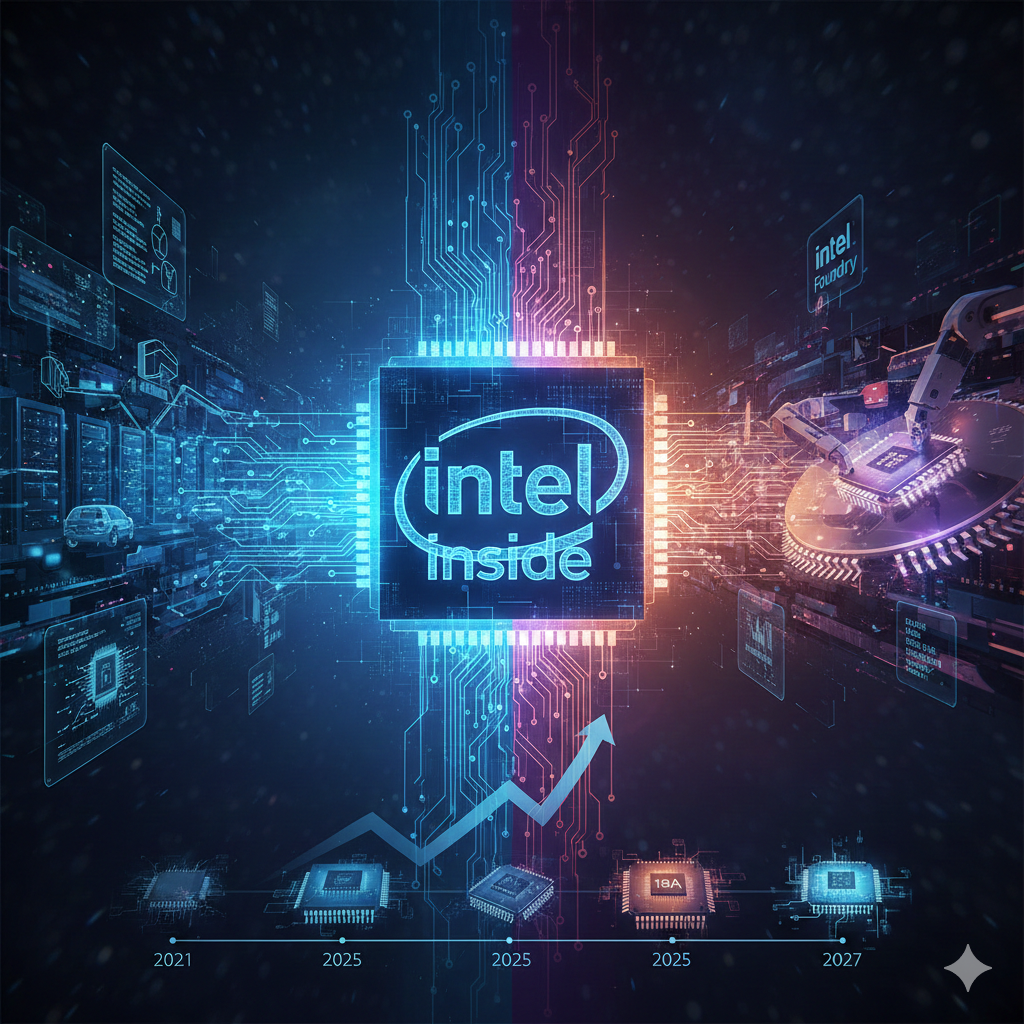
Intel 18A Process Progress: Intel 18A has begun fab runs and is on track for high-volume production in the second half of 2025. Leading products Panther Lake (Client) and Clearwater Forest (Server) have successfully powered-on.
Cost Reduction Plan: The company is executing its cost reduction initiative and achieved significant operating expense reductions in 2025, with a goal to lower total spending to more competitive levels in 2026.
Asset Impairment and Restructuring: The 2025 financial results include substantial charges related to restructuring and asset impairments, reflecting adjustments made to optimize the operational structure and focus on core strategies.
Q1 2026 Guidance
Estimated Revenue: Between 11.3 billion and 12.3 billion USD.
Estimated Gross Margin: 12.6% (GAAP); 26.5% (non-GAAP).
Estimated Earnings Per Share (EPS): (0.35) USD (GAAP); (0.19) USD (non-GAAP).
Here is the five-year financial ratio analysis for Intel:
Intel Five-Year Financial Ratio Analysis (2021-2025)
Profitability Analysis
Gross Margin (GAAP):
2021: 55.4%
2022: 42.6%
2023: 40.0%
2024: 35.4%
2025: 21.1%
Analysis: The gross margin has shown a significant downward trend over the past five years, dropping from 55.4% to 21.1%. This reflects high depreciation costs during the IDM 2.0 strategic transformation, capital expenditure pressure from catching up on process technology, and limited pricing power due to intense competition from rivals like AMD and NVIDIA.
Operating Margin (GAAP):
2021: 24.8%
2022: 3.7%
2023: 0.1%
2024: (3.9)%
2025: (27.4)%
Analysis: Operating margin turned negative, particularly in 2025 due to massive asset impairment and restructuring charges, leading to a sharp expansion in losses. Even excluding one-time fees, core profitability remains squeezed by shrinking revenue and high fixed costs.
Solvency and Liquidity Analysis
Current Ratio:
As of the end of 2025, current assets were 43.11 billion USD and current liabilities were 31.90 billion USD, resulting in a current ratio of approximately 1.35x.
Analysis: While this is a decrease from the 2.0x+ levels seen in 2021, it remains within a healthy range above 1.0x, indicating acceptable short-term debt-paying ability.
Debt-to-Equity Ratio:
At the end of 2025, long-term debt was approximately 51.6 billion USD against shareholder equity of 95.8 billion USD, resulting in a debt-to-equity ratio of approximately 0.54x.
Analysis: Intel has significantly increased debt financing to fund fab construction. While the leverage ratio is currently manageable, the erosion of profit by interest burdens is a point of concern given the weakening cash flow.
Asset Operational Efficiency Analysis
ROA and ROE:
Due to net losses in 2024 and 2025, both Return on Assets and Return on Equity have turned negative.
The net loss of 13.48 billion USD in 2025 led to a sharp decline in ROE, reflecting that asset utilization efficiency and shareholder returns are at historical lows.
Revenue Growth Analysis
Revenue Year-over-Year (YoY) Growth:
2021: 79.0 billion USD (approx. 1% growth)
2022: 63.1 billion USD (-20%)
2023: 54.2 billion USD (-14%)
2024: 54.2 billion USD (flat)
2025: 49.5 billion USD (-9%)
Analysis: The revenue trend over the past five years indicates a structural decline. Notably, the Data Center and AI (DCAI) segment fell by 28% in Q4 2025, highlighting the immense challenges in market share loss and the transition to AI servers.
Cash Flow Analysis
Free Cash Flow (FCF):
Operating cash flow for the full year 2025 was 9.3 billion USD, while capital expenditures (Adjusted Additions to PP&E) reached 24.1 billion USD, resulting in an adjusted free cash flow of negative 14.8 billion USD.
Analysis: Intel is currently in a capital-intensive cycle. Persistent negative free cash flow is its greatest financial challenge, which is the primary reason the company decided to cut dividends and launch a 10.0 billion USD cost-reduction plan.
Below is the P/E ratio comparison between Intel and its primary competitors as of February 2026:
Semiconductor Peer P/E Comparison (February 2026)
| Company | Ticker | P/E Ratio (TTM) | Forward P/E (2026E) | Market Positioning & Valuation Analysis |
| Intel | INTC | N/A / Negative | ~95.6x | Due to massive 2025 losses, TTM P/E is not applicable. The high Forward P/E reflects market expectations for a turnaround. |
| NVIDIA | NVDA | 46.5x | ~40.8x | AI leader; valuation reflects stable earnings growth and dominant market share. |
| AMD | AMD | 76.3x | ~48.0x | Benefiting from AI server and CPU share gains; valuation carries a high growth premium. |
| TSMC | TSM | 36.2x | ~31.3x | As the global leader in foundry, valuation is relatively rational, reflecting strong execution. |
| Broadcom | AVGO | 68.0x | ~48.8x | Supported by networking and AI custom chip demand; valuation remains elevated. |
Key Analysis and Insights
- Intel’s Valuation Paradox:Intel’s current P/E is in a “distorted” state. Because the company recognized significant asset impairments and restructuring charges in 2025, net income turned negative, making the trailing (TTM) P/E uncalculable. The market currently treats Intel as a “turnaround bet.” The estimated 2026 P/E of over 95x indicates that investors are pricing in a future return to profitability rather than current earnings.
- Premium Comparison vs. Competitors:
- VS. NVIDIA/AMD: Although NVIDIA’s P/E seems high (46.5x), its explosive earnings growth makes its PEG (Price/Earnings-to-Growth) ratio more attractive. In contrast, Intel’s premium is based on “recovery expectations” rather than “current growth strength.”
- VS. TSMC: TSMC’s P/E of approximately 36x is considered a stable benchmark in the 2026 semiconductor market. Since Intel Foundry is still operating at a loss with uncertain growth, the market gives TSMC a valuation premium for its technical leadership and earnings reliability.
- Market Expectations for 2026-2027:Analysts predict that Intel’s EPS will grow significantly in 2026 and 2027, driven by the mass production of the 18A process and cost-cutting initiatives. If Intel meets its targets, the P/E is expected to normalize to around 46x by 2027, bringing it back into a more competitive valuation range.
Risk Note: Intel’s high Forward P/E means its stock price is extremely sensitive to “execution misses.” Any delays in the 18A process or failure to secure foundry customers could lead to a sharp valuation correction.
Back to Intel page