The following is the main summary of the report of International Holding Company PJSC (IHC) and its subsidiaries (collectively the “Group”) for the nine-month period ended September 30, 2025.:
1. Financial Performance Highlights (First 9 Months of 2025)
- Strong Revenue Growth: The Group’s revenue during this period reached AED 84.638 billion, a significant increase from AED 63.959 billion in the same period of 2024.
- Increased Net Profit: Profit for the period was AED 19.500 billion, higher than the AED 18.001 billion recorded in the same period of 2024.
- Earnings Per Share: Basic and diluted earnings per share were AED 4.63, slightly lower than the AED 4.89 of the previous year.
- Balance Sheet Position: As of September 30, 2025, total assets increased to AED 462.141 billion (compared to AED 401.811 billion at the end of 2024). Total equity rose to AED 267.805 billion.
2. Major Business Combinations and Acquisitions
During this period, IHC significantly expanded its business footprint through the acquisition of several entities, primarily including:
- Castellano Investments S.A.R.L. (Tendam): Acquired a 67.91% stake in this fashion retail group for a consideration of approximately AED 2.578 billion.
- National Corporation for Tourism and Hotels PJSC (NCTH): Obtained control (increasing stake to 73.73%) through an asset-for-share swap.
- Alphamin Resources Corporation: Acquired a 56.23% stake in this tin mining company.
- Other Acquisitions: Including Good Energy Group PLC (Renewable Energy), Emdad LLC (Oil & Gas Services), Reem Finance PJSC (Financial Services), as well as Nammos Switzerland AG and Em Sherif Holding Ltd (Hospitality & Dining), among others.
3. Asset Disposals and Discontinued Operations
- Sale of Subsidiaries: The Group divested PAL Cooling Holding LLC (District Cooling) and Reach Group SPV Limited (HR Services) for considerations of approximately AED 3.871 billion and AED 158 million, respectively.
- Discontinued Operations: The Group plans to sell Al Jaraf Fisheries LLC (Fisheries) and Paragon Mall LLC (Real Estate), and has classified Harv Est Foods General Trading LLC as a discontinued operation.
4. Financing and Capital Management
- Increased Borrowings: Total borrowings rose from AED 64.972 billion at the end of 2024 to AED 76.400 billion, primarily to support acquisitions and general corporate purposes.
- Hybrid Capital Instruments: Subsidiary Aldar Properties issued new Hybrid Notes.
- Share Buybacks: The company repurchased over 4 million treasury shares during this period at a cost of approximately AED 1.621 billion.
5. Subsequent Events
- Major Merger Proposal: Announced a proposal to merge three subsidiaries via a share swap: Multiply Group PJSC, Two Point Zero Holding RSC Limited, and Ghitha Holding PJSC. The combined entity will be renamed Two Point Zero Group PJSC, with an expected asset base of approximately AED 120 billion.
- Sale of Modon: Subsequent to the period, the Group disposed of its entire 42.54% stake in Modon Holding PSC.
- Other Acquisitions: Subsequent to the period, the Group acquired stakes in First Women Bank Limited (Pakistan), Mwasalat Holding LLC, ISEM Packaging Group, and other entities.
International Holding Company (IHC) has transitioned from a localized investment firm into a global industrial powerhouse. Its recent acquisition strategy reflects a shift toward active operational control and sector-specific consolidation, particularly focusing on high-growth industries and geographical diversification.
Below are the key recent acquisitions and their strategic impacts:
1. Major Acquisitions & Consolidations
The 2PointZero Group Merger
This is the most significant structural move in IHC’s recent history. The Group merged Multiply Group PJSC, Two Point Zero Holding, and Ghitha Holding.
- Scale: Created a consolidated entity with an asset base exceeding AED 120 billion.
- Impact: This move eliminates internal competition between subsidiaries, streamlines operational costs, and focuses on two massive pillars: Energy and Consumer/Retail. It positions 2PointZero as a global champion capable of competing with the world’s largest private equity and sovereign-linked funds.
Global Retail Expansion: Tendam
IHC acquired a 67.91% stake in Castellano Investments S.A.R.L. (Tendam), a major Spanish fashion retail group.
- Impact: This marks a decisive entry into the European consumer market. It diversifies IHC’s revenue away from the UAE and provides a platform to scale global retail brands using IHC’s logistics and digital infrastructure.
Critical Resources: Alphamin Resources
The acquisition of a 56.23% stake in Alphamin Resources Corp, a leading tin producer.
- Impact: This is a strategic play in the Energy Transition space. Tin is critical for electronics and green energy technologies. By securing upstream mining assets, IHC is hedging against commodity volatility and positioning itself as a key supplier in the global tech supply chain.
Financial Technology: First Women Bank Limited
Acquired in Pakistan with the intent to transform it into a digital-first, AI-driven bank.
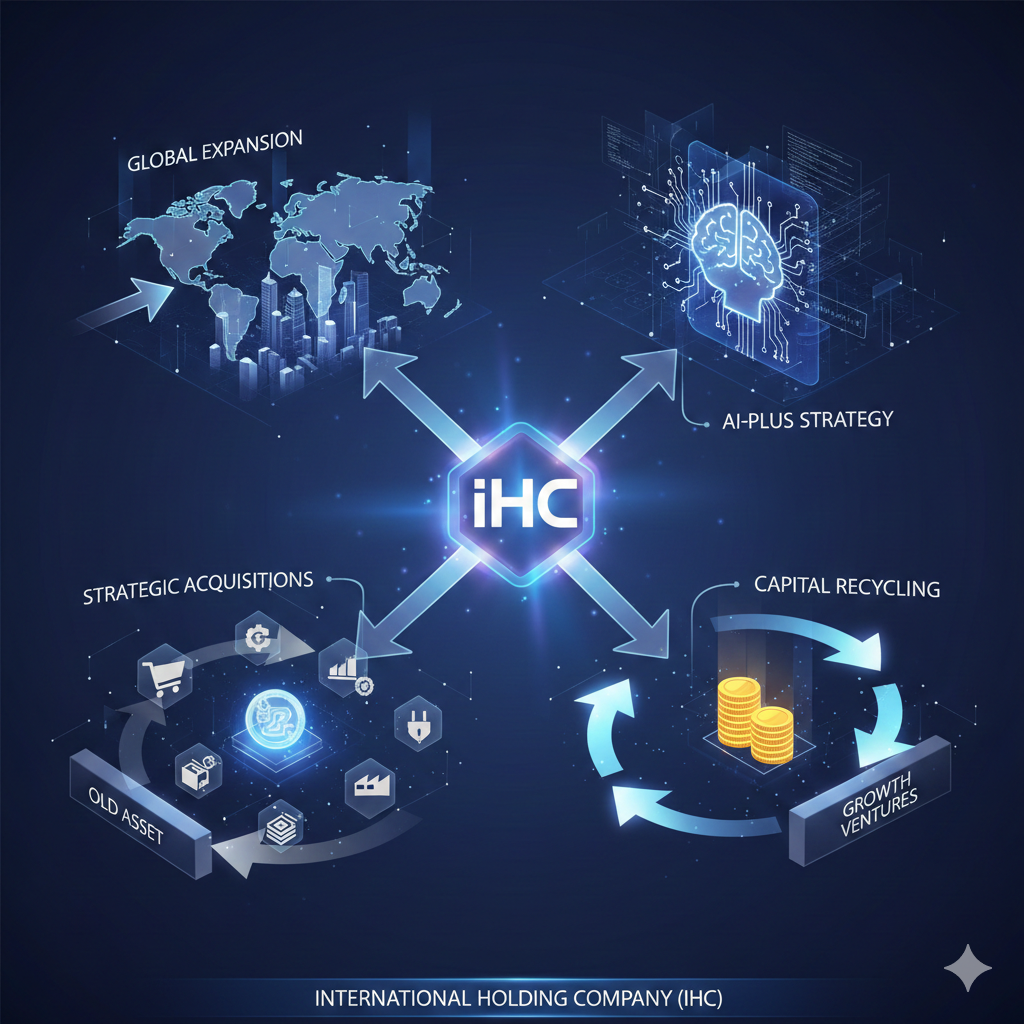
- Impact: Represents IHC’s “AI-Plus” strategy—taking traditional, underperforming financial assets and applying advanced technology to scale them rapidly in emerging markets.
2. Strategic Impacts on the Group
Revenue and Asset Growth
The aggressive M&A activity has led to explosive growth. In 2025, IHC reported:
- Total Revenue: AED 111.41 billion (+29.1% YoY).
- Total Assets: Reached AED 428.6 billion.
- Net Profit: AED 34.72 billion (+35.1% YoY).
Shift to “Active Management”
IHC is no longer just a passive holding company. The recent acquisitions show a preference for majority stakes (50%+), allowing IHC to install its own management, implement AI-driven efficiencies, and dictate the long-term strategy of the acquired companies.
Capital Recycling
To fund these multi-billion dollar acquisitions without over-leveraging, IHC is actively selling “mature” or “non-core” assets.
- Examples: The sale of PAL Cooling (District Cooling) and the divestment from Modon Holding provide the liquidity needed to pivot into higher-growth sectors like mining and global retail.
The “AI-Plus” Philosophy
Under the leadership of CEO Syed Basar Shueb, IHC is integrating AI across all new acquisitions. The impact is seen in optimized supply chains for Ghitha (food) and enhanced data analytics for Tendam (retail), aiming for a 25% increase in operational efficiency across the board.
Over the past five years (2021–2025), International Holding Company (IHC) has undergone a radical transformation from a local player to a global conglomerate. This growth is reflected in its financial ratios, which show a transition from hyper-growth to a more stabilized, operationally-focused powerhouse.
1. Profitability Ratios
IHC’s profitability has been bolstered by its “AI-Plus” strategy and high-margin acquisitions.
- Net Profit Margin: Maintained at remarkably high levels, often exceeding 30%. In 2025, the margin reached 31.2% (AED 34.72B profit on AED 111.41B revenue).
- Return on Equity (ROE): Despite a massive increase in the equity base to AED 267.8B, ROE has remained strong. This indicates that IHC is successfully generating high returns on the capital retained and reinvested into new acquisitions like Tendam and Alphamin.
- Return on Assets (ROA): As total assets surged to AED 462.14B (9M 2025), ROA has stabilized. The slight compression in ROA in recent years reflects the “heavy” nature of new industrial and mining assets compared to its earlier, more lean investment structure.
2. Liquidity and Solvency Ratios
The Group maintains a highly liquid balance sheet to facilitate rapid M&A execution.
- Current Ratio: Consistently high (often above 1.5x), supported by a massive cash chest which stood at AED 74.9B at the end of 2025.
- Debt-to-Equity Ratio: While total borrowings increased to AED 76.4B by Sep 2025, the ratio remains conservative relative to its equity. Most debt is utilized strategically for acquisitions rather than operational survival.
- Interest Coverage Ratio: Remains very healthy due to the massive EBITDA generated by core subsidiaries like NMDC and Aldar, ensuring that the cost of increased borrowing is easily covered.
3. Efficiency Ratios
These ratios highlight IHC’s shift toward active operational management.
- Asset Turnover: This ratio has seen an upward trend as IHC integrates its acquisitions (like Ghitha and PureHealth) and starts generating operational revenue rather than just recording fair value gains on investments.
- Inventory Turnover: With the 2025 acquisitions in retail (Tendam) and mining (Alphamin), this ratio has become a key KPI for the Group to monitor supply chain efficiency.
Five-Year Financial Summary Table (Approximated)
| Ratio | 2021 | 2022 | 2023 | 2024 | 2025 (FY) |
| Revenue Growth | 300%+ | 78% | 18% | 26% | 29.1% |
| Net Margin | 41% | 63% | 55% | 30% | 31.2% |
| Debt/Equity | Low | Moderate | Moderate | Moderate | Moderate |
| Cash Position | High | Very High | Very High | High | Very High |
Analysis of the “Shift”
The 2024-2025 period marks a “normalization” phase. In 2021-2022, ratios were skewed by massive one-time gains from listing subsidiaries (IPO pops). In 2025, the ratios reflect organic operational strength and cash-generative businesses. The “Capital Recycling” strategy (selling PAL Cooling and Modon) has kept the balance sheet lean despite the $100B+ asset base.
In evaluating International Holding Company (IHC) using the Price-to-Book (P/B) Ratio, it is essential to recognize that IHC consistently trades at a significant premium compared to global peers. This valuation reflects its unique position as the primary engine for Abu Dhabi’s economic diversification and the market’s high expectations for future asset injections.
1. P/B Ratio Comparison Table (Est. 2025/2026)
| Company | Region | Primary Sector | Approx. P/B Ratio | Note |
| IHC | UAE | Multi-sector Investment | 5.5x – 6.5x | Significant premium |
| Berkshire Hathaway | USA | Insurance / Conglomerate | 1.4x – 1.6x | Global value benchmark |
| SoftBank Group | Japan | Tech / Venture Capital | 0.8x – 1.2x | Often trades at a discount |
| Exor N.V. | Europe | Diversified Holding | 0.9x – 1.1x | High quality asset focus |
| Multiply Group | UAE | Tech / Investments | 2.5x – 3.0x | IHC subsidiary; high growth |
| Dana Gas | UAE | Energy | 1.0x – 1.2x | Single sector focused |
2. Strategic Analysis of IHC’s Premium
Why does IHC command a higher P/B than global peers?
- Inorganic Growth Engine: Unlike Berkshire Hathaway, which relies on mature cash flows, IHC is viewed as a “Growth-as-a-Service” vehicle. Investors pay a premium because they anticipate the continuous injection of high-value, strategically important assets at attractive valuations from its parent network.
- ROE Support: A high P/B is typically justified by a high Return on Equity (ROE). IHC’s ability to maintain an ROE above 20% while rapidly expanding its equity base justifies a valuation multiple that would be considered “expensive” for a traditional industrial firm.
- Scarcity and Liquidity: Within the Middle East, IHC offers unparalleled scale and liquidity. It acts as a proxy for the region’s sovereign-backed growth, attracting concentrated capital flows that bid up the price relative to book value.
Contrast with SoftBank and Exor
- SoftBank often trades at a discount to its Net Asset Value (NAV) due to market skepticism regarding its high leverage and the volatility of its private tech holdings.
- Exor trades closer to its book value, reflecting its status as a more traditional family-office style holding company with transparent, listed assets (like Ferrari or Stellantis).
- IHC avoids the “conglomerate discount” because it is seen as an active value creator that integrates AI and operational synergies across its portfolio (the “AI-Plus” strategy).
3. Risk Factors and Mean Reversion
The primary risk for IHC’s high P/B valuation is a slowdown in deal-making or a failure to realize synergies from recent international acquisitions (e.g., Tendam in Europe or mining in Africa). If the market perceives that the “asset injection” phase is ending, the P/B ratio may experience mean reversion, aligning closer to global conglomerate averages.
Source:
- https://ihcuae.com/
- https://ihcuae.com/investor-relations/
- https://www.adx.ae/
- https://www.bloomberg.com/
- https://www.reuters.com/
Back to IHC page