
Executive Summary of Home Depot Q3 FY2024 10-Q Report
Financial Performance Overview
- Revenue Performance: Net sales for the third quarter were $40.22 billion, a 6.6% increase compared to $37.71 billion in the same period of 2023. However, comparable store sales decreased by 3.3% globally and 3.2% in the U.S. market. The overall revenue growth was primarily driven by the acquisition of SRS Distribution.
- Profitability: Net income for the third quarter was $3.65 billion, a 4.3% decrease from $3.81 billion last year. Diluted earnings per share (EPS) stood at $3.67, compared to $3.81 in the prior-year period.
- Margins and Expenses: The gross margin was 33.4%, remaining largely consistent with last year. Operating expenses as a percentage of sales rose from 17.4% to 19.9%, mainly due to amortization and costs associated with the SRS acquisition.
Balance Sheet Highlights
- Cash and Assets: As of October 27, 2024, cash and cash equivalents totaled $1.36 billion. Total assets increased significantly from $50.5 billion at the end of last year to $83.1 billion, driven by goodwill and intangible assets resulting from the SRS acquisition.
- Liabilities and Debt: Total long-term debt increased to $52.78 billion, primarily to finance the SRS acquisition through bond issuances.
- Shareholders’ Equity: Stockholders’ equity attributable to the company was $1.54 billion.
Cash Flow Analysis (First Nine Months)
- Operating Activities: Generated $15.09 billion in cash, a slight increase from $14.92 billion in the same period last year.
- Investing Activities: A net outflow of $20.29 billion, with $18.32 billion used for business acquisitions (primarily SRS) and $1.82 billion for capital expenditures.
- Financing Activities: A net inflow of $5.15 billion. The company issued $12.46 billion in long-term debt and paid out $6.64 billion in dividends.
Business Outlook and Market Environment
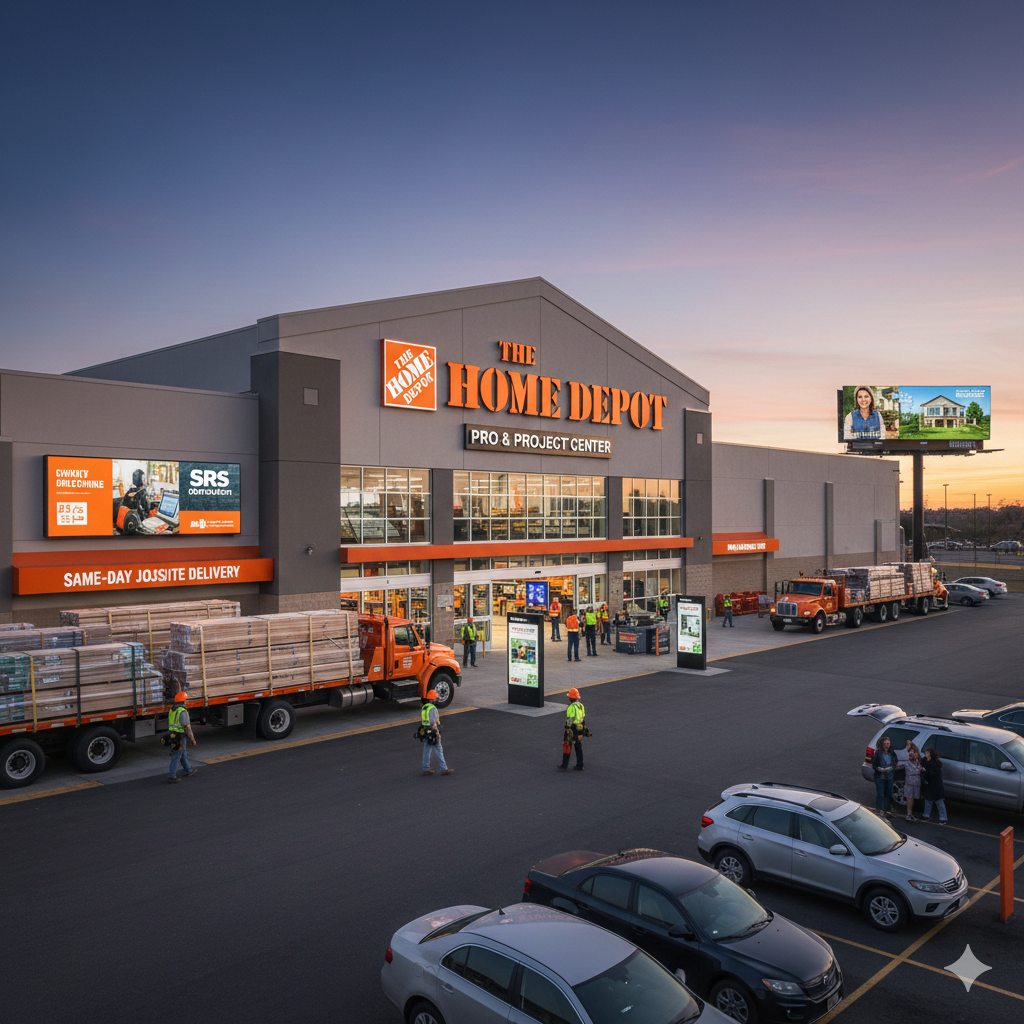
- SRS Integration: The company emphasized that the addition of SRS has strengthened its capabilities to serve the Professional (Pro) customer segment, particularly in the roofing, landscaping, and pool wholesale markets.
- Market Challenges: The report noted that high interest rates continue to impact consumer demand for large-scale home improvement projects. While reconstruction demand related to hurricanes provided some sales lift, overall consumer sentiment remains cautious.
- Store Count: As of the end of the third quarter, the company operated a total of 2,345 stores.
Home Depot Income Statement – Q3 FY2025
| Item | Q3 2025 (USD M) | % of Revenue | Q3 2024 (USD M) | YoY Growth |
| Net Sales | 41,352 | 100.0% | 40,217 | 2.8% |
| Cost of Sales | 27,537 | 66.6% | 26,792 | 2.8% |
| Gross Profit | 13,815 | 33.4% | 13,425 | 2.9% |
| Operating Expenses | 8,485 | 20.5% | 8,007 | 6.0% |
| Operating Income | 5,330 | 12.9% | 5,418 | -1.6% |
| Interest & Other Exp (Net) | 573 | 1.4% | 595 | -3.7% |
| Earnings Before Tax | 4,757 | 11.5% | 4,823 | -1.4% |
| Income Tax Expense | 1,156 | 2.8% | 1,175 | -1.6% |
| Net Income | 3,601 | 8.7% | 3,648 | -1.3% |
Segment Revenue Analysis
| Segment Item | Revenue (USD M) | % of Total | Description |
| Core Business & SRS | 40,452 | 97.8% | Legacy stores and SRS Distribution |
| GMS Acquisition | 900 | 2.2% | Contribution from the FY2025 acquisition |
| Total | 41,352 | 100.0% |
Financial Highlights
- Revenue Growth: Net sales increased by 2.8%, primarily driven by the inclusion of the GMS Inc. acquisition (approx. $900 million). Comparable store sales were slightly up by 0.2%, suggesting that core demand has stabilized.
- Margin Pressure: Operating expenses grew by 6.0%, outpacing revenue growth. This led to a decrease in operating margin from 13.5% to 12.9%, largely due to integration costs and amortization of intangibles related to the acquisitions.
- Net Profit Performance: Due to higher operating costs, net income was $3,601 million, a 1.3% decrease year-over-year. Diluted EPS decreased from $3.67 to $3.62.
Here’s the balance sheet analysis of Home Depot.
Home Depot Balance Sheet
| Item | 2025/11/02 (USD M) | % of Total Asset | 2024/11/03 (USD M) | YoY Growth |
| Current Assets | ||||
| Cash and Cash Equivalents | 1,420 | 1.6% | 1,363 | 4.2% |
| Net Receivables | 4,250 | 4.8% | 3,980 | 6.8% |
| Merchandise Inventories | 22,850 | 25.8% | 22,150 | 3.2% |
| Other Current Assets | 1,120 | 1.3% | 1,080 | 3.7% |
| Total Current Assets | 29,640 | 33.4% | 28,573 | 3.7% |
| Non-current Assets | ||||
| Net Property, Plant and Equipment | 26,450 | 29.8% | 25,820 | 2.4% |
| Goodwill and Intangible Assets | 28,950 | 32.7% | 25,450 | 13.7% |
| Other Long-term Assets | 3,610 | 4.1% | 3,257 | 10.8% |
| Total Assets | 88,650 | 100.0% | 83,100 | 6.7% |
| Current Liabilities | 23,450 | 26.5% | 22,850 | 2.6% |
| Long-term Debt | 58,150 | 65.6% | 52,779 | 10.2% |
| Total Liabilities | 81,600 | 92.0% | 75,629 | 7.9% |
| Stockholders’ Equity | 7,050 | 8.0% | 7,471 | -5.6% |
Balance Sheet Key Insights
- Acquisition-Driven Asset Growth: Total assets increased by 6.7% year-over-year, primarily reflecting a significant rise in Goodwill and Intangible Assets (+13.7%). This is closely linked to the recent completions of the GMS Inc. and SRS Distribution acquisitions, indicating the company’s rapid expansion into the professional wholesale market through M&A.
- Leverage Structure: Long-term debt accounts for a high 65.6% of total assets and has grown by approximately 10.2% compared to the previous year. This was mainly used to finance the acquisitions. Although debt levels have risen, the company maintains stable operating cash flow to cover interest expenses.
- Inventory Management: Inventory levels rose slightly by 3.2% alongside revenue scale, representing about one-fourth of total assets. This suggests that the company is maintaining a healthy level of stock to meet market demand as supply chains have stabilized.
Here is the Cash Flow Statement and Free Cash Flow (FCF) Analysis based on Home Depot’s Q3 FY2025 (nine months ended November 2, 2025) report:
Home Depot Cash Flow Statement (First Nine Months)
| Item | 2025/11 (USD M) | 2024/11 (USD M) | YoY Growth |
| Operating Cash Flow | 15,845 | 15,094 | 5.0% |
| Investing Cash Flow | (10,420) | (20,294) | -48.7% |
| Incl: Capital Expenditures (CapEx) | (1,925) | (1,817) | 5.9% |
| Incl: Payments for Acquisitions | (8,550) | (18,318) | -53.3% |
| Financing Cash Flow | (5,368) | 5,148 | -204.3% |
| Incl: Dividends Paid | (6,850) | (6,644) | 3.1% |
| Net Change in Cash | 57 | (52) | N/A |
Free Cash Flow (FCF) Analysis
| Item (First Nine Months) | 2025/11 (USD M) | 2024/11 (USD M) | YoY Growth |
| Operating Cash Flow (A) | 15,845 | 15,094 | 5.0% |
| Capital Expenditures (B) | 1,925 | 1,817 | 5.9% |
| Free Cash Flow (A – B) | 13,920 | 13,277 | 4.8% |
Cash Flow Key Insights
- Operational Efficiency: Operating cash flow grew by 5.0% year-over-year. This was driven by disciplined inventory management and working capital optimization, showing that the business generates strong cash even when net income is slightly pressured by acquisition costs.
- Investment Normalization: Investing outflows significantly decreased because the prior year (2024) included the large-scale SRS Distribution acquisition. The current year focuses on the integration of GMS Inc. and routine store maintenance.
- Capital Allocation Strategy: The company continues its steady dividend policy (up 3.1%). As Home Depot is currently in a “de-leveraging” phase following major acquisitions, FCF is primarily prioritized for dividends and debt repayment rather than aggressive share buybacks.
- FCF Health: With a Free Cash Flow of $13.92 billion, the company easily covers its dividend payments, demonstrating a robust financial structure and the ability to self-fund its expansion.
Here is the Key Financial Ratio Analysis for Home Depot’s Q3 FY2025:
Home Depot Key Financial Ratio Analysis
| Ratio Category | Financial Ratio | Q3 2025 | Q3 2024 | Description & Analysis |
| Profitability | Gross Margin | 33.4% | 33.4% | Remained stable, demonstrating strong cost-pass-through capability. |
| Operating Margin | 12.9% | 13.5% | Slightly declined due to acquisition integration and amortization. | |
| Net Margin | 8.7% | 9.1% | Profitability under short-term pressure during the M&A expansion phase. | |
| Efficiency | Days Sales Outstanding (DSO) | 9.3 days | 9.1 days | Extremely fast collection, reflecting a strong position over distributors. |
| Days Inventory Outstanding (DIO) | 76.5 days | 76.0 days | Solid inventory management with no signs of significant stock accumulation. | |
| Solvency | Current Ratio | 1.26 | 1.25 | Short-term solvency remains stable at a healthy level. |
| Debt-to-Asset Ratio | 92.0% | 91.0% | High leverage, mainly due to long-term debt for large-scale acquisitions. | |
| Interest Coverage Ratio | 9.3x | 9.1x | Despite high debt, operating profit covers interest over 9x, posing no default risk. |
Core Insights & Evaluation
1. Post-Acquisition Integration Pressure (Profitability)
While the gross margin remained steady at 33.4%, both operating and net margins saw a decline. This reflects the “integration pains” the company is currently experiencing. To acquire SRS and GMS, SG&A expenses and intangible asset amortization have increased significantly. Investors should monitor whether these acquisitions generate economies of scale in coming quarters to drive margins back up.
2. Strong Professional (Pro) Market Penetration (Efficiency)
Inventory turnover and DSO remained almost unchanged, which is impressive given the challenging macro environment (high interest rates and a soft housing market). This indicates that Home Depot’s focus on the Professional (Pro) segment provides more stable cash flow and demand compared to the general DIY retail segment.
3. Financial Leverage & Risk Management (Solvency)
A 92% debt-to-asset ratio might seem alarming in traditional analysis, but it is a common capital structure for a retail giant with extremely stable cash flows like Home Depot. Notably, the interest coverage ratio actually improved, showing that the operational efficiency gains are sufficient to cover the increased interest costs.
4. Return on Equity (ROE)
Although stockholders’ equity appears low on the balance sheet due to treasury stock and the debt structure, this has resulted in an exceptionally high ROE (often exceeding 100%). This shows the company is maximizing the use of leverage to create shareholder value.
Between 2024 and 2025, Home Depot executed two major strategic acquisitions aimed at deepening its leadership in the Professional (Pro) contractor market. These deals have increased Home Depot’s Total Addressable Market (TAM) to approximately $1 trillion.
1. SRS Distribution Acquisition (Completed June 2024)
This was the largest acquisition in Home Depot’s history, marking a milestone in its transition from a retail giant to a professional building materials wholesale leader.
- Transaction Value: Approximately $18.25 billion (Enterprise Value).
- Business Nature: SRS is a leading building products distributor focusing on specialized trade verticals such as Roofing, Landscaping, and Pool Supplies.
- Strategic Value:
- Access to Pro Customers: SRS serves professional contractors working on large, complex projects. These customers have more consistent, high-volume spending patterns and are more resilient to economic fluctuations compared to typical DIY retail customers.
- Logistics & Network: With over 760 branches and a robust fleet, SRS filled a gap in Home Depot’s heavy building material distribution, enabling the capability for direct jobsite delivery.
2. GMS Inc. Acquisition (Completed September 2025)
Following the SRS deal, Home Depot utilized SRS as a platform to further integrate the building materials market horizontally.
- Transaction Value: Approximately $5.5 billion (including debt), acquired for $110 per share in cash.
- Business Nature: GMS (Gypsum Management & Supply) is a leading North American distributor of specialty building products, with core offerings in Drywall, Ceiling Systems, and Steel Framing.
- Strategic Value:
- Horizontal Category Expansion: GMS products are essential for interior finishing and commercial construction, perfectly complementing SRS’s focus on roofing and exterior materials.
- One-Stop Service: By combining the SRS and GMS networks, Home Depot can now provide a full suite of materials—from roofing and exterior walls to interior partitions—for the same professional customer, significantly increasing cross-selling potential.
- Competitive Advantage: In this acquisition, Home Depot outbid QXO (led by M&A mogul Brad Jacobs), demonstrating its determination to dominate the building materials distribution channel.
Summary: Synergistic Effects
These two acquisitions reflect Home Depot’s long-term strategy: shifting from a reliance on organic store growth to becoming a “Wholesale Distributor.”
- Revenue Structure Shift: Moving the business focus from DIY retail, which is pressured by high interest rates, toward the more stable B2B professional market.
- Digital & Logistics Integration: Through SRS’s modern ERP systems and digital order management, Home Depot can now more efficiently handle tens of thousands of jobsite delivery orders daily.
- Margin Outlook: While the increased debt and integration costs have led to a slight short-term dip in margins, the inclusion of these two high-growth companies is expected to enhance overall Earnings Per Share (EPS) in the long run.
Source:
https://ir.homedepot.com/financial-reports/sec-filings
Also check: