
Q4 2025 Financial Performance
Eli Lilly delivered robust growth driven by a surge in demand for its weight-loss and diabetes treatments.
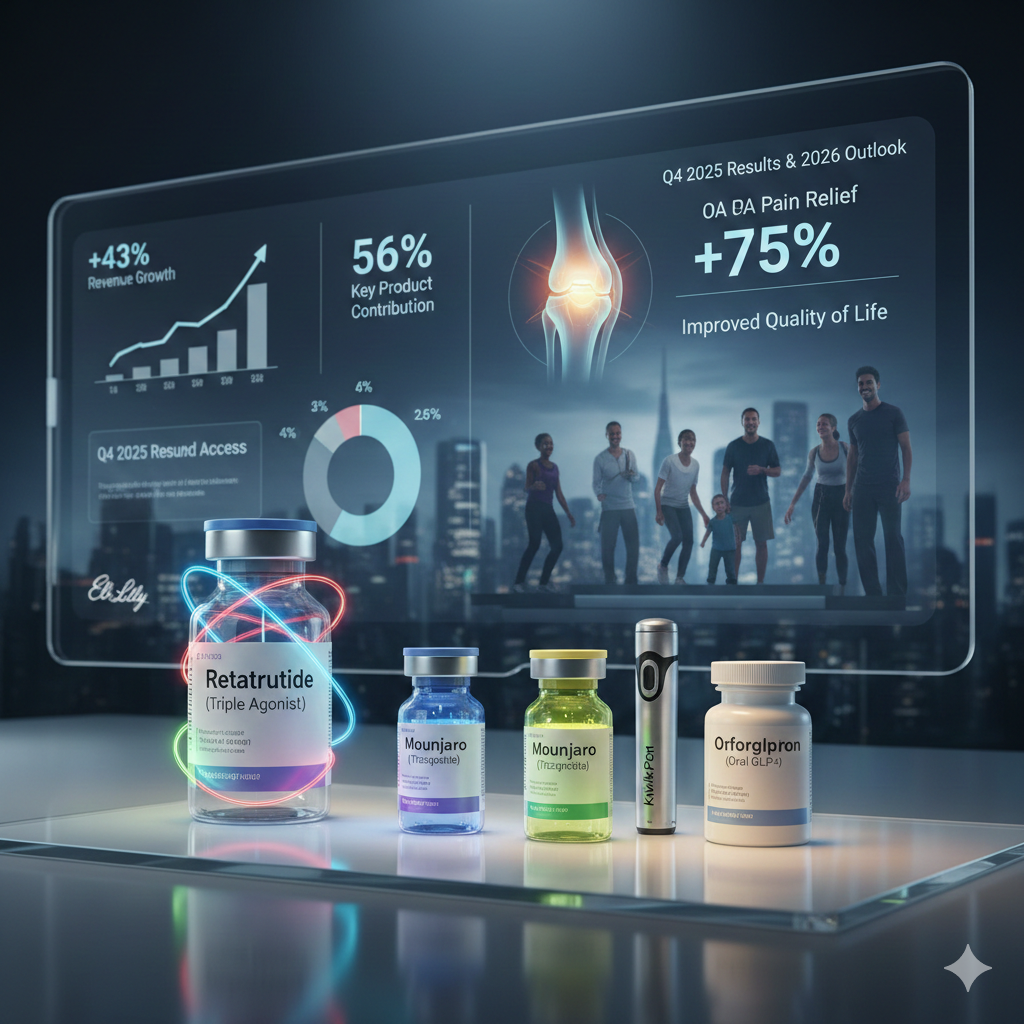
- Revenue: Total revenue reached $19.3 billion, up 43% compared to Q4 2024. Growth was primarily fueled by a 46% increase in volume, partially offset by a 5% decline in realized prices.
- EPS: Reported EPS was $7.39 (up 51%), and Non-GAAP EPS was $7.54 (up 42%). These figures include a $0.52 per share impact from IPR&D charges.
- Gross Margin: Reported gross margin increased to 82.5% of revenue, driven by favorable product mix and manufacturing efficiencies.
Key Product Performance
Growth was spearheaded by the tirzepatide franchise, despite some pricing headwinds.
- Mounjaro: Global revenue hit $7.409 billion, up 110% year-over-year. International markets performed strongly with $3.3 billion in revenue.
- Zepbound: U.S. revenue reached $4.261 billion, a 122% increase year-over-year.
- Verzenio: Global revenue was $1.604 billion, up 3%. While U.S. sales dipped 4%, international volume growth sustained overall performance.
- New Growth Products: Highlights include Ebglyss, Inluriyo, Jaypirca, Kisunla, and Omvoh.
R&D and Regulatory Progress
- Regulatory Milestones: The FDA approved the Kwikpen for tirzepatide and expanded indications for Jaypirca.
- Orforglipron (oral GLP-1): Applications for obesity were submitted in the U.S. and Japan, with filings for both obesity and type 2 diabetes in the EU.
- Phase 3 Clinical Results:
- Taltz + Zepbound: Positive results in treating active psoriatic arthritis in adults with obesity.
- Orforglipron: Data showed efficacy in maintaining weight loss for patients transitioning from injectable incretins.
- Retatrutide: Significant results in obesity patients with knee osteoarthritis, showing an average weight loss of 71.2 lbs and substantial pain reduction.
Operational and Strategic Updates
- Access Expansion: Announced an agreement with the U.S. government to expand access to obesity medications for millions of Americans.
- Capacity Expansion: New manufacturing sites are under construction in Pennsylvania, Alabama, and Europe to boost production of injectables and oral medicines.
- Increased Investment: R&D expenses rose 26% and SG&A expenses rose 29% to support new product launches and the late-stage pipeline.
2026 Financial Guidance
The company issued an optimistic outlook for the coming year:
- Revenue: Expected to be between $80.0 billion and $83.0 billion.
- Non-GAAP EPS: Expected to be between $33.50 and $35.00.
- Tax Rate: Projected at approximately 18% to 19%.
Executive Summary
Eli Lilly concluded 2025 with massive momentum from Mounjaro and Zepbound. By expanding manufacturing capacity, advancing next-generation candidates like orforglipron and retatrutide, and improving patient access, the company is positioned for significant continued growth in 2026.
Consolidated Income Statement 2025
Units: $ Millions, except for EPS
| Items | 2025 Full Year | % of Total Revenue | 2024 Full Year | YoY |
| Total Revenue | $65,179 | 100.0% | $45,043 | +45% |
| Key Product Revenue | ||||
| — Mounjaro | $22,965 | 35.2% | $11,540 | +99% |
| — Zepbound | $13,542 | 20.8% | $4,926 | +175% |
| — Verzenio | $5,723 | 8.8% | $5,307 | +8% |
| Operating Expenses | ||||
| Cost of Sales | $11,052 | 17.0% | $8,418 | +31% |
| Research & Development | $13,337 | 20.5% | $10,991 | +21% |
| Marketing, Selling & Admin (SG&A) | $11,094 | 17.0% | $8,594 | +29% |
| Acquired IPR&D | $2,910 | 4.5% | $3,280 | (11)% |
| Asset impairment & Restructuring | $484 | 0.7% | $861 | (44)% |
| Operating Income | $26,302 | 40.4% | $12,899 | +104% |
| Other Income / Expense | ||||
| Net Interest | ($642) | (1.0)% | ($606) | N/A |
| Net Other Income | $71 | 0.1% | $387 | N/A |
| Total Other Income / (Expense) | ($571) | (0.9)% | ($219) | +161% |
| Income Before Tax | $25,731 | 39.5% | $12,680 | +103% |
| Income Tax Expense | $5,091 | 7.8% | $2,090 | +144% |
| Net Income – Reported | $20,640 | 31.7% | $10,590 | +95% |
| EPS – Diluted | $22.95 | N/A | $11.71 | +96% |
Key Data Analysis
Product-Driven Hypergrowth
Mounjaro and Zepbound collectively generated approximately $36.5 billion in revenue, accounting for 56% of total annual sales. These two products remain the core catalysts behind the company’s 45% top-line expansion.
Significant Profitability Expansion
Operating Income more than doubled (+104%), with the net margin reaching a remarkable 31.7%. This demonstrates significant operating leverage, where Eli Lilly managed to control costs and optimize product mix while scaling volume aggressively.
Sustained R&D Investment
Despite the massive surge in revenue, the company maintained a high level of innovation investment. R&D spending reached $13.3 billion, representing 20.5% of total revenue, ensuring a robust pipeline for future growth.
Analysis of Realized Price Decline in the U.S. Market
Based on the financial documents, the decline in realized prices within the U.S. market is a direct result of Eli Lilly’s strategic initiative to prioritize market expansion and patient accessibility for its core weight-loss and diabetes portfolio.
Key Drivers of Price Reduction
- Impact of Core Products: Realized prices in the U.S. declined by 7%. The report explicitly attributes this trend to Zepbound (obesity) and Mounjaro (type 2 diabetes). This indicates that the average net selling price—the actual revenue retained after accounting for discounts and rebates—has decreased for these high-demand medications.
- Strategic Expansion via Government Agreements: The price drop reflects a deliberate shift toward broadening patient access. Eli Lilly announced a landmark agreement with the U.S. government designed to provide millions of Americans with access to obesity treatments.
- Typically, such agreements involve price concessions (lower realized prices) in exchange for inclusion in government programs or achieving broader insurance coverage.
- The report notes these “voluntary agreements with the U.S. government regarding drug pricing and access” as a factor impacting financial results.
- Competitive and Regulatory Pressure: Beyond proactive strategy, the company continues to face pricing pressure from both private payers and government entities seeking to influence drug reimbursement and pricing structures.
Strategic Outcome: Volume-Driven Growth
Eli Lilly has adopted a “Price for Volume” strategy. While the realized price per unit fell by 7% due to expanded coverage and government deals, this move successfully catalyzed explosive demand:
- U.S. Sales Volume: Increased by 50%.
- Overall U.S. Revenue: Grew by 43%.
Executive Summary
The trade-off of lower unit pricing has enabled Eli Lilly to capture massive market share and achieve a dominant position in the metabolic health space. By securing government and payer support through competitive pricing, the company has traded short-term margins for long-term market penetration and total revenue growth.
Strategic Significance of Recent FDA Approvals
The FDA approvals for the KwikPen delivery system and the expanded indications for Jaypirca represent pivotal milestones that strengthen Eli Lilly’s leadership in metabolic health and accelerate its growth in oncology.
1. Tirzepatide (Mounjaro/Zepbound) KwikPen Approval
Description:
The KwikPen is a multi-dose, pre-filled injection device containing four doses per pen. Previously, Mounjaro and Zepbound were primarily available in the U.S. as single-dose autoinjectors.
Strategic Impact:
- Resolution of Supply Bottlenecks: The complexity of manufacturing single-dose autoinjectors was a primary driver of global shortages. The KwikPen design simplifies the assembly process and reduces the reliance on specific components, significantly increasing production capacity to meet overwhelming demand.
- Enhanced Patient Convenience: Patients can now manage a full month’s treatment (one dose per week) with a single pen. This is particularly advantageous for travel and reduces the medical waste associated with four separate injectors.
- Logistical Efficiency: Multi-dose pens are more compact than four individual injectors. This optimizes cold-chain storage and reduces shipping costs per dose, contributing to margin protection.
- Global Supply Synchronization: Since the KwikPen is already the standard in many international markets (e.g., UK and Europe), its U.S. adoption allows Eli Lilly to streamline its global supply chain and pivot inventory more flexibly across regions.
2. Jaypirca (Pirtobrutinib) Indication Expansion
Description:
The FDA expanded Jaypirca’s label to treat patients with relapsed or refractory Chronic Lymphocytic Leukemia (CLL) or Small Lymphocytic Lymphoma (SLL) who have previously received a covalent BTK inhibitor (such as Imbruvica, Calquence, or Brukinsa). This also converted the previous accelerated approval into a full traditional approval.
Strategic Impact:
- Unique Competitive Moat: Jaypirca is the first and only “non-covalent” (reversible) BTK inhibitor approved. It remains effective even after patients develop resistance to traditional covalent BTK inhibitors, making it the “rescue therapy” of choice.
- Upstream Market Penetration: By moving earlier in the treatment sequence, Jaypirca can now be prescribed immediately after the failure of first-line covalent inhibitors. This significantly expands the addressable patient population and is expected to drive exponential sales growth.
- Diversification of Revenue Streams: While Eli Lilly is currently dominated by its metabolic portfolio, the success of Jaypirca provides a critical second growth engine in oncology. It establishes the company as a major player in hematologic malignancies, competing directly with incumbents like AstraZeneca and AbbVie.
- Path to Blockbuster Status: Analysts project that this expanded label will propel Jaypirca toward “blockbuster” status (annual sales exceeding $1 billion), further de-risking the company’s long-term financial outlook.
Summary: Operational and Financial Synergy
These approvals address Eli Lilly’s two biggest challenges: capacity constraints (KwikPen) and revenue concentration risk (Jaypirca). By scaling supply and diversifying the portfolio, the company has solidified the foundation required to reach its ambitious 2026 revenue target of $80–83 billion.
Strategic Significance of Orforglipron: From Injection to Oral Maintenance
The clinical data for Orforglipron, specifically from the ATTAIN-MAINTAIN Phase 3 trial, represents a paradigm shift in chronic weight management. It demonstrates that patients can successfully transition from highly potent injectable therapies (like Zepbound or Wegovy) to a daily pill without sacrificing their weight-loss progress.
1. Data Overview: The “Bridge” to Long-Term Success
Trial Mechanism:
The study evaluated patients who had completed 72 weeks of injectable incretin therapy (Semaglutide or Tirzepatide) and achieved significant weight loss. They were then transitioned to oral Orforglipron to observe weight stability over 52 weeks.
Key Clinical Findings:
- Effective Weight Maintenance: Patients switching to Orforglipron maintained almost 100% of their prior weight loss over the one-year study period.
- Prevention of Rebound: In sharp contrast, those who switched to a placebo experienced a rapid “weight rebound,” regaining an average of over 9 kg within 24 weeks.
- Seamless Transition: The data showed that moving from high-dose injectables to an oral small molecule did not trigger unexpected gastrointestinal side effects, proving the safety of the transition protocol.
2. Strategic and Market Impacts
Eliminating “Needle Fatigue”
While injectable pens have become user-friendly, a significant portion of the population remains needle-phobic or finds cold-chain storage (refrigeration) a barrier to long-term compliance. As a once-daily pill, Orforglipron removes these hurdles, dramatically increasing patient adherence during the “maintenance phase” of their weight-loss journey.
Creation of a “Metabolic Ecosystem”
Eli Lilly is moving toward a total-solution strategy:
- Induction Phase: Use high-potency Tirzepatide (Zepbound) injections to achieve rapid, significant weight reduction.
- Maintenance Phase: Transition to Orforglipron (Oral) for convenient, long-term weight stability.This “one-two punch” locks patients into the Eli Lilly ecosystem, preventing them from discontinuing treatment or switching to competitors once they reach their target weight.
Supply Chain and Margin Expansion
Orforglipron is a small-molecule drug. Unlike large-molecule proteins (biologics) used in injections, small molecules are:
- Cheaper to Manufacture: Significantly lower production costs compared to complex biologics.
- Easier to Distribute: No cold-chain requirement means easier access to emerging markets with less developed infrastructure.This shift is expected to be a major tailwind for Eli Lilly’s long-term gross margins.
Projected Financial Contribution
With a targeted U.S. launch in Q2 2026, Orforglipron is positioned as the next multi-billion-dollar “mega-blockbuster.” It captures a different market segment (oral-preferring patients) and extends the lifecycle of the company’s metabolic franchise.
Summary: Solidifying the Weight-Loss Hegemony
Orforglipron proves that patients do not need to rely on needles for life to keep weight off. By filling the clinical gap of “post-injection maintenance,” Eli Lilly has created a formidable competitive moat against Novo Nordisk and other emerging biotech rivals.
Strategic Significance of Retatrutide: The Triple Agonist Breakthrough
Based on the TRIUMPH-4 Phase 3 trial results, Retatrutide—Eli Lilly’s “triple agonist” targeting GIP, GLP-1, and Glucagon receptors—has demonstrated unprecedented efficacy. This study is particularly significant because it moves beyond “cosmetic” weight loss to demonstrate profound clinical improvements in obesity-related structural complications, specifically Knee Osteoarthritis (OA).
1. Clinical Breakdown: Beyond Weight Loss
Unprecedented Weight Reduction:
At the 12 mg dose, patients achieved a 28.7% average weight loss (approx. 71.2 lbs) over 68 weeks. This level of efficacy is approaching the results typically seen only in bariatric surgery, setting a new bar for the pharmaceutical industry.
Revolutionary Pain Management:
The reduction in WOMAC pain scores by 75.8% is a game-changer for orthopedic medicine.
- The “Pain-Free” Milestone: The fact that 1 in 8 patients achieved a total absence of knee pain is a powerful clinical endpoint.
- The Glucagon Advantage: As a triple agonist, the inclusion of Glucagon signaling—alongside GIP and GLP-1—is thought to potentially enhance energy expenditure and provide additional metabolic benefits compared to dual agonists like Tirzepatide.
2. Strategic and Market Impacts
Expanding the Reimbursement Narrative
One of the biggest hurdles for obesity drugs is insurance coverage. By proving that Retatrutide significantly treats Knee Osteoarthritis, Eli Lilly provides payers (insurers and governments) with a clear economic justification:
- Reducing Surgical Costs: Effective medical management of OA pain can delay or eliminate the need for expensive total knee replacements.
- Improving Productivity: Reducing chronic pain directly correlates with improved physical function and workforce participation.
Creating a “Super-Premium” Category
Retatrutide positions Eli Lilly to segment the market:
- Standard Care: Oral options (Orforglipron).
- High Efficacy: Dual agonists (Zepbound).
- Elite/Complex Care: Triple agonists (Retatrutide) for patients with massive weight-loss needs or severe comorbidities like OA.
Competitive Advantage over Novo Nordisk
While Novo Nordisk is developing CagriSema, Retatrutide’s triple-mechanism approach (adding Glucagon) currently shows a stronger trend toward the 30% weight-loss threshold. This helps Eli Lilly maintain its lead in “next-generation” metabolic innovation.
Safety and Tolerability Considerations
The discontinuation rate (up to 18%) suggests that while the drug is highly potent, managing the titration and side-effect profile will be critical for commercial success. However, the safety profile remains consistent with the broader incretin class, reducing regulatory risk.
Summary: A New Era in Metabolic Medicine
Retatrutide is no longer just a “weight-loss drug”; it is a functional restoration therapy. By achieving nearly 30% weight loss and eliminating pain for a significant portion of patients, Eli Lilly is redefining the standard of care for obesity and its associated mechanical diseases.
Source:
- https://www.lilly.com/news/archive
- https://investor.lilly.com/financial-information/quarterly-results
- https://investor.lilly.com/news-releases
Back to Eli Lilly page