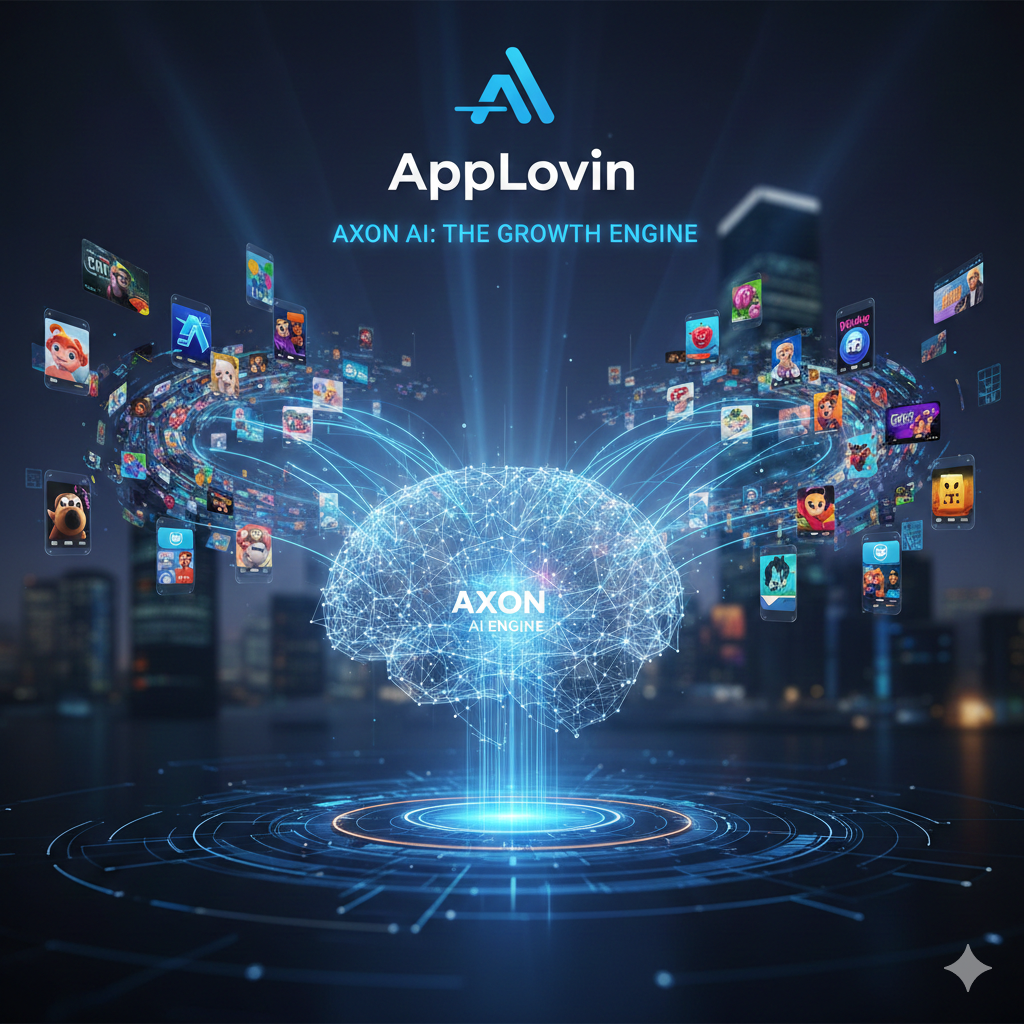
AppLovin Corporation (NASDAQ: APP) delivered exceptional financial results for the fourth quarter and full year 2025, driven primarily by the continued scaling of its AI-based AXON engine and the high-margin Software Platform segment.
Financial Performance Highlights
AppLovin reported total revenue of 1.66 billion for the fourth quarter of 2025, a 66% increase compared to the same period in 2024. For the full year, total revenue reached 5.48 billion, representing a 70% year-over-year growth. This surge was almost entirely fueled by the Software Platform, which saw its annual revenue jump 76% to 4.42 billion, now accounting for 81% of the company’s total business. The Apps segment grew more modestly, ending the year with 1.07 billion in revenue, a 25% increase.
Profitability metrics reached record levels. Net income for the full year 2025 soared to 3.33 billion, more than doubling the 1.58 billion earned in 2024. In the fourth quarter alone, the company achieved a net income of 1.10 billion with a remarkable net margin of 66%. Gross profit for Q4 stood at 1.47 billion, reflecting a gross margin of 89%, a testament to the high efficiency and scalability of its software-led business model.
Cash Flow and Capital Allocation
The company’s cash generation capabilities remained a standout feature. Full-year net cash from operating activities reached 3.97 billion, an 86% increase over 2024. Free Cash Flow (FCF) followed suit, totaling 3.95 billion for the year. Notably, the company’s FCF exceeded its net income, indicating very high earnings quality. In the fourth quarter, the FCF margin hit an impressive 79%.
AppLovin utilized its strong liquidity to aggressively return capital to shareholders. During 2025, the company repurchased and withheld 25.8 million shares of Class A common stock for a total of 2.58 billion. By the end of the year, AppLovin maintained a robust cash position with 2.49 billion in cash and equivalents on the balance sheet.
Balance Sheet Strength
As of December 31, 2025, total assets grew to 7.26 billion, up from 5.87 billion at the end of the previous year. This growth was largely driven by the significant increase in cash reserves. Total liabilities were 5.64 billion, and total shareholders’ equity improved to 1.62 billion. The company’s financial structure remains solid, supporting its continued investment in AI technology and market expansion.
Based on AppLovin’s Q4 and full-year 2025 financial report, here is a detailed analysis of the Income Statement:
Revenue Growth and Composition
The total revenue for 2025 reached 5.48 billion, a massive 70% increase from 3.22 billion in 2024. This growth was primarily fueled by the Software Platform segment, which grew 76% year-over-year to 4.42 billion. The revenue contribution from this segment rose from 78% in 2024 to 81% in 2025. This shift highlights the company’s successful transformation into a high-margin technology platform provider rather than just an app developer.
Gross Margin and Cost Efficiency
In Q4 2025, gross profit was 1.47 billion, representing a staggering 89% gross margin. For the full year, the margin remained consistently high at approximately 88%. This reflects the technological edge of the AXON AI engine; as the software platform scales, operating costs do not rise proportionally, demonstrating powerful economies of scale.
Profitability Analysis
Profit growth significantly outpaced revenue growth. Net income for 2025 was 3.33 billion, a 111% increase year-over-year. In Q4 alone, net income hit 1.10 billion with a net margin of 66%. Unlike traditional SaaS companies that often sacrifice profit for growth, AppLovin is delivering exceptional earnings quality. The efficiency gains in ad bidding and matching driven by their AI models are converting directly into bottom-line profit.
Operating Expenses and Leverage
Despite the rapid expansion of the business, full-year operating expenses only increased from 952 million to 1.24 billion, a 30% rise. This is far below the 70% revenue growth rate. This proves that the company’s investments in R&D and sales are yielding high returns, showcasing significant operating leverage.
Quality of Earnings
When cross-referenced with the cash flow statement, the conversion of net income (3.33 billion) to operating cash flow (3.97 billion) is very healthy. This indicates that the reported profits are backed by actual cash inflows rather than just accounting adjustments.
In summary, AppLovin’s Income Statement depicts a high-performance tech entity: rapid top-line growth, elite-level margins, and effective operating leverage, signaling that their AI investments have entered a period of high-yield harvest.
Based on AppLovin’s Q4 and full-year 2025 financial report, here is a detailed analysis of the Balance Sheet:
Asset Structure and Liquidity
AppLovin’s asset composition underwent significant strengthening in 2025. Total assets grew to 7.26 billion from 5.87 billion at the end of 2024. The most notable change is the surge in cash and equivalents, which climbed 257% to 2.49 billion. Cash now represents 34% of total assets, providing the company with immense liquidity and financial flexibility. Net accounts receivable rose 42% to 1.82 billion, a growth rate well below the 70% revenue increase, indicating highly efficient collection processes and strong credit management during rapid scaling.
Intangible Assets and Goodwill
Goodwill and intangible assets remained stable at approximately 1.94 billion, accounting for about 27% of total assets. Since the company focused on organic growth driven by AI rather than large-scale acquisitions in 2025, the stability of this figure suggests a healthy asset base with minimal risk of impairment from overvalued premiums.
Liability and Capital Structure
Total liabilities stood at 5.64 billion, a 28% increase compared to 4.39 billion at the end of 2024. While the debt-to-asset ratio is approximately 78%, this must be viewed in the context of the company’s financing strategy to fund aggressive share repurchases. Given that annual operating cash flow (3.97 billion) nearly equals total debt, the company’s ability to service its obligations is exceptionally strong.
Shareholders’ Equity and Capital Allocation
Total equity ended the year at 1.62 billion. This figure is particularly impressive considering the company spent 25.8 billion to repurchase and withhold shares throughout 2025. Under standard accounting, share buybacks reduce equity; however, because net income doubled to 3.33 billion, the company was able to fund these massive buybacks while still growing its overall equity base. This demonstrates masterful capital allocation, increasing shareholder value by reducing share count without compromising the balance sheet.
Summary of Financial Health
AppLovin’s balance sheet characterizes a “light-asset, high-cash” technology platform. Asset growth is driven by cash accumulation from organic profits rather than debt accumulation. This robust cash position provides ample “dry powder” for future R&D in AI, potential strategic M&A, or further capital returns to shareholders.
Based on AppLovin’s Q4 and full-year 2025 financial report, here is a detailed analysis of the Cash Flow Statement:
Exceptional Cash Generation Power
AppLovin demonstrated immense strength in its operating cash flow. For the full year of 2025, net cash provided by operating activities reached 3.97billion, an 86% increase compared to 2.14billion in 2024. This growth rate outpaced the 70% revenue growth, signaling that as the business scales, the company is becoming increasingly efficient at collecting cash.
Superior Earnings Quality
The full-year Free Cash Flow (FCF) reached 3.95billion. When compared to the net income of 3.33billion, the cash conversion rate exceeds 100%. This is a critical indicator showing that profits are fully backed by hard cash rather than just accounting entries. In the fourth quarter specifically, the FCF margin hit a remarkable 79%, placing the company at the top tier of the technology industry.
Asset-Light Operating Model
Capital expenditures (CapEx) for the entire year were only 17million, representing a negligible fraction of total revenue. This reflects the “asset-light” nature of their business model. Major investments in R&D, such as the AXON AI engine, are captured within operating expenses, allowing the company to double its revenue without requiring heavy investment in physical infrastructure.
Aggressive Capital Allocation and Shareholder Returns
The company maintained an aggressive shareholder return policy within its financing activities. In 2025, AppLovin spent 2.58billion on share repurchases, utilizing over 60% of its annual free cash flow. Executing buybacks of this magnitude during a high-growth phase signals management’s strong confidence in the company’s long-term valuation and continued cash generation, effectively maximizing earnings per share by reducing the total share count.
Financial Flexibility and Outlook
By the end of 2025, the company’s cash reserves climbed to 2.49billion. This robust cash flow not only covers debt obligations and interest expenses but also provides ample funding for future AI research and potential strategic acquisitions. This allows the company to maintain high growth rates without relying on external financing.
In summary, AppLovin’s cash flow statement reveals a company in a “golden phase” of high growth, high profitability, and low capital intensity. Its ability to convert earnings into cash is exceptional, creating significant tangible value for shareholders.
Over the past five years (2021–2025), AppLovin has undergone a profound financial transformation, evolving from a growth-focused mobile app company into a high-margin AI technology powerhouse.
Profitability Ratios: The AI “AXON” Effect
The most striking trend is the explosive expansion of margins following the launch of the AXON 2.0 engine in 2023.
- Gross Margin: This metric surged from approximately 64.6% in 2021 to a record high of 88-89% by late 2025. This reflects a transition toward higher-margin software platform revenue.
- Net Margin: AppLovin turned a corner from near-break-even levels (net income was just 32M in 2021 and turned negative in 2022) to a staggering 61-66% net margin by the end of 2025.
- Adjusted EBITDA Margin: This rose from 21% in 2021 to over 82% in late 2025, showcasing rare operational leverage where incremental revenue flows almost entirely to profit.
Efficiency and Cash Flow Ratios
AppLovin’s “asset-light” model has become a defining characteristic of its financial health.
- FCF Conversion: The company’s ability to convert earnings to cash is exceptional. In 2025, the Free Cash Flow to Net Income conversion ratio exceeded 100%, indicating high-quality earnings backed by actual cash inflows.
- CapEx Intensity: Capital expenditure as a percentage of revenue remained negligible, consistently below 1%. For the full year 2025, CapEx was only 17M against 5.48B in revenue.
- Return on Equity (ROE): By 2025, ROE reached over 160%. While boosted by a lower equity base due to aggressive stock buybacks, it fundamentally highlights the massive profit-generating power of the platform.
Solvency and Capital Structure
As the company matured, its focus shifted from building the balance sheet to aggressive capital return.
- Cash Reserves: Cash and equivalents grew by 257% in 2025 alone, ending at 2.49B.
- Leverage: The total liabilities-to-assets ratio stood at roughly 78% in 2025. While this appears high, the debt is comfortably managed by an annual operating cash flow of nearly 4B, which almost equals the total long-term debt.
- Shareholder Yield: In 2025, the company used over 60% of its FCF (2.58B) for share repurchases, significantly reducing the share count and increasing earnings per share (EPS).
Summary Table (Approximate Annual Figures)
| Metric | 2021 | 2022 | 2023 | 2024 | 2025 |
| Revenue ($B) | 2.79 | 2.82 | 3.28 | 3.22 | 5.48 |
| Gross Margin (%) | 64.6% | 55.4% | 67.7% | 75.2% | 88.0% |
| Net Income ($M) | 32 | (193) | 355 | 1,580 | 3,334 |
| Adj. EBITDA Margin (%) | 21% | 18% | 35% | 49% | 82% |
| FCF ($B) | 0.37 | 0.45 | 1.07 | 2.10 | 3.95 |
As of mid-February 2026, AppLovin’s (APP) valuation reflects a high-growth premium that has recently undergone significant volatility due to a sharp stock price correction early in the year.
1. P/E Ratio Comparison (TTM vs. Forward)
AppLovin currently trades at a valuation that reflects its hyper-growth status, though its forward multiples suggest that earnings are catching up quickly to its stock price.
| Company Name | TTM P/E Ratio | Forward P/E (Dec 2026) | Market Positioning |
| AppLovin (APP) | 41.3x – 46.7x | 23.8x – 25.0x | High-Growth/AI Premium: Valuation is rapidly “de-risking” as massive earnings growth lowers the forward multiple. |
| The Trade Desk (TTD) | 30.3x | 28.5x | The Benchmark: Historically commands a high multiple for its dominance in CTV, though now trading at a lower TTM than APP. |
| Meta Platforms (META) | 27.9x | 23.3x | The Giant: Trading at a similar forward multiple to APP, despite having a much larger scale. |
| Unity (U) | N/A (Loss) | 21.5x | Turnaround Play: Valuation is based on recovery expectations rather than current profitability. |
| Magnite (MGNI) | 29.4x | 18.5x | Value/Niche: Trading at a discount compared to the “AI-driven” leaders like APP and TTD. |
2. Deep Dive: Why the Premium?
- Earnings Growth vs. P/E (PEG Ratio):AppLovin’s trailing P/E of ~41x might seem expensive compared to the broader tech sector (~25x). However, when adjusted for growth, its PEG Ratio is estimated between 0.31 and 0.75 (Forward). A PEG below 1.0 is traditionally considered “undervalued” relative to growth, explaining why analysts remain bullish despite the “high” P/E.
- The 2026 “Correction” Context:In early 2026, APP shares saw a sharp decline (down ~40% YTD as of February) despite crushing Q4 earnings. This sell-off was driven by “valuation fatigue” after a 700% rally in 2024-2025 and fears of AI disruption from rivals like Meta or new startups (e.g., CloudX).
- Margin Superiority:AppLovin’s P/E premium is supported by its 84% Adjusted EBITDA margin. Most AdTech peers operate with margins in the 15%–25% range. Investors pay more for each dollar of APP’s earnings because those earnings are generated with significantly higher efficiency.
3. Summary Analysis
AppLovin has transitioned from being a “speculative growth” stock to a “highly profitable AI platform.” While its TTM P/E is higher than The Trade Desk, its Forward P/E is actually lower than TTD’s (~24x vs ~28x). This suggests that if AppLovin hits its 2026 targets, it is currently “cheaper” than its main rival on a future-earnings basis.
Source:
- https://investors.applovin.com/financials/quarterly-results/default.aspx
- https://www.macrotrends.net/stocks/charts/APP/applovin/revenue
- https://simplywall.st/stocks/us/software/nasdaq-app/applovin/past
Back to AppLovin page