
Market Position and Market Share
ABN AMRO Bank N.V.is the third-largest banking institution in the Netherlands by total assets, trailing ING Group and Coöperatieve Rabobank. Together, these three institutions constitute an oligopoly controlling the vast majority of the Dutch banking sector.
- Domestic Ranking & Asset Base:Ranked #3 in the Netherlands with total assets standing at approximately €413.21 billion, representing around 14.61% of total Dutch banking sector assets.In comparison, ING Bank holds #1 with roughly €1.05 trillion (~37.28% share), and Rabobank holds #2 with around €638.89 billion (~22.58% share).
- Mortgage Market:Historically holds a top-two position in new mortgage originations and total mortgage stock in the Netherlands, maintaining an estimated market share oscillating between 17% and 20%.
- Retail & SME Banking:Serves approximately 5 million retail clients and over 360,000 SME customers.It acts as the primary bank for roughly 20% of the Dutch population.
- Private Banking & Clearing:A leading player in Northwest Europe (specifically the Netherlands, France, Germany, and Belgium), while its subsidiary, ABN AMRO Clearing, ranks as a global top-tier provider of clearing, execution, and risk management services across global securities and derivatives exchanges.
Upstream & Downstream Supply Chain Analysis and Key Vendors
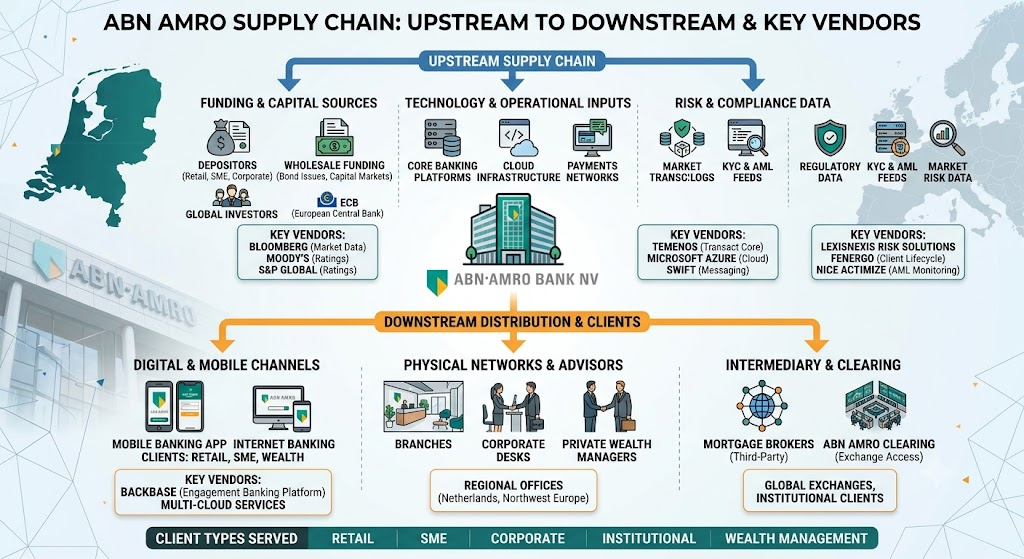
In modern banking, supply chains encompass wholesale capital/deposits (upstream inputs), core infrastructure and operational vendors, and client-facing delivery channels (downstream distribution).
- Upstream Supply Chain (Capital, Liquidity, & Information):
- Funding Inputs: Sourced primarily through domestic retail and commercial customer deposits (representing over €279 billion in customer balances), covered bonds, senior unsecured wholesale debt, and liquidity facilities from the European Central Bank (ECB).
- Financial Data & Ratings: Market data feeds and risk benchmarks provided by Bloomberg, FactSet, and S&P Global, alongside rating assessments from Fitch, Moody’s, and S&P.
- Key Operational & Technology Vendors (Middleware & Infrastructure):
- Core Banking & Architecture: Utilizes Temenos (specifically Temenos Transact) for wealth and specialized transaction processing, alongside cloud-native modular platforms like Mambu for specialized lending and new digital products within a “two-speed” IT architecture.
- Cloud & Compute Infrastructure: Operates a multi-cloud enterprise structure with primary reliance on Microsoft Azure and Amazon Web Services (AWS) for scalable compute, digital client channels, and regulatory reporting environments.
- Payments & Rails: Clears transactions through European payment infrastructures (TARGET2, SEPA, EBA Clearing, and Equens Worldline) and SWIFT for international correspondent banking.
- Regulatory, KYC & AML Compliance: Key vendor relationships with enterprise providers such as Fenergo, NICE Actimize, and LexisNexis Risk Solutions to execute client lifecycle management and Anti-Money Laundering (AML) monitoring.
- Downstream Distribution Channels (Delivery & Client Touchpoints):
- Digital Channels: Over 80% of routine client interactions take place via the ABN AMRO mobile application and internet banking platforms.
- Intermediary Networks: Mortgage loans are distributed both directly and via independent third-party mortgage brokers across the Netherlands.
- Corporate & Wealth Desks: Regional offices, private wealth advisors across Northwest Europe, and direct corporate treasury integration interfaces (APIs).
Competitor Analysis: Technology and Financial Metrics
ABN AMRO’s primary domestic and regional rivals are ING Group and Rabobank, followed by neo-banks and specialized lenders.
- Technology Comparison:
- ABN AMRO: Pursues a “personal bank in the digital age” strategy. It modernized its tech stack by combining legacy stability with modular core engines (e.g., Mambu and Temenos). While robust in automated mortgage processing and digital onboarding, its legacy footprint is somewhat less cloud-native across all verticals than pure digital alternatives.
- ING Group: Often viewed as the technological benchmark among European traditional banks. ING pioneered early branchless direct banking (ING Direct) and maintains a unified, standardized microservices and API-first platform across its European footprint.
- Rabobank: A cooperative model heavily focused on agriculture, commercial banking, and retail. Rabobank has modernized its front-end interfaces significantly, though its distributed cooperative legacy historically made back-office IT unification more complex than ING.
- Financial Comparison:
- Asset Scale & Balance Sheet: ING dominates with total assets over €1 trillion, Rabobank sits second at around €639 billion, while ABN AMRO remains leanest among the three at roughly €413 billion.
- Revenue & Profitability: ABN AMRO generated net income of approximately €2.25 billion (2025) with a Return on Equity (ROE) hovering around 8.5% to 9.5%. ING delivers higher absolute net profits (often €6+ billion) and an ROE frequently exceeding 12% due to greater geographic and wholesale banking diversification. Rabobank’s net income sits around €4.96 billion with an ROE near 9.5%.
- Cost-to-Income (C/I) Ratio: ABN AMRO historically operates with a C/I ratio between 56% and 62%, slightly higher than ING’s more cost-efficient ~50–54% range, primarily due to ABN AMRO’s heavier cost burden from private banking advisory services and compliance remediation programs.
- Capital Position (CET1 Ratio): ABN AMRO maintains one of the strongest Common Equity Tier 1 (CET1) capital buffers in Europe (regularly between 14.5% and 15.5%), allowing substantial share buyback programs and dividend distributions.
Sources
- https://thebanks.eu/banks/16393
- https://thebanks.eu/countries/Netherlands/major_banks
- https://assets.ctfassets.net/1u811bvgvthc/511LAQzAr2Lzq9TMF1HADH/81f511e6d900f5d7741e59add48b81fb/DBRS_research_report_ABN_AMRO_18_July_2022.pdf
- https://assets.ctfassets.net/1u811bvgvthc/3tn2c2U6QjiBj1IWRNX9cl/c2dde83a535488509bbf0c37726fa407/ABN_AMRO_____Integrated_Annual_Report_2022.pdf
- https://ing.com/binaries/content/assets/documents/annual-reports/2025-ing-groep-nv-annual-report.pdf
- https://www.temenos.com/press_release/temenos-community-unites-in-copenhagen-to-lead-banking-forward/
Back to ABN AMRO