
Market Position and Market Share
Panasonic Holdings Corporation is a diversified multinational conglomerate operating primarily through five operating companies: Panasonic Energy, Panasonic Industry, Panasonic Connect, Panasonic HVAC & Cold Chain, and Panasonic Life Solutions. While historically renowned as a consumer electronics giant, its primary growth engines and market-defining segments have pivoted toward mobility energy, automotive electronics, and industrial supply chain solutions.
- Electric Vehicle(EV) Batteries: According to global battery market tracker SNE Research, Panasonic ranks among the top global EV battery manufacturers, consistently holding the #4 to #6 position globally with roughly 3.7% to 4.5% global market share by deployment volume. However, in North America, Panasonic maintains a commanding position as the #2 supplier with approximately 20% to 25% regional market share, driven primarily by its joint venture with Tesla at the Gigafactory Nevada and its Kansas facility.
- Consumer Electronics & Domestic Appliances: In Japan, Panasonic holds the #1 market share across multiple home appliance categories, commanding roughly 20% to 25% of the domestic market in washing machines, refrigerators, and personal grooming appliances. Globally, its consumer electronics division faces heavy fragmentation, retaining top-tier niches in premium microwave ovens, shavers, and professional imaging(Lumix).
- Automotive Cockpit & Infotainment: Panasonic Automotive Systems is one of the top tier-1 suppliers globally, commanding approximately 8% to 10% global market share in automotive head units and digital cockpit domain controllers.
- Supply Chain Software & Industrial Automation:Through its acquisition of Blue Yonder, Panasonic ranks in the top 3 globally in end-to-end digital supply chain execution software alongside SAP and Manhattan Associates.
Supply Chain Analysis and Key Suppliers
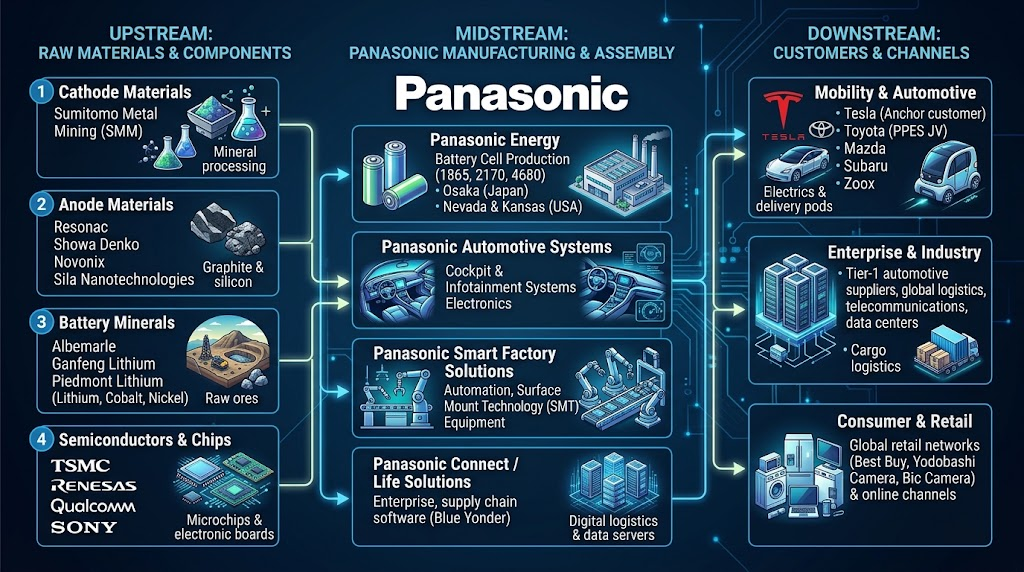
Panasonic maintains an intricate, global supply chain spanning raw chemicals, electronic components, and advanced assembly.
Upstream(Raw Materials and Core Inputs)
- Cathode & Anode Active Materials: For its battery division(Panasonic Energy), the company relies heavily on high-nickel chemistry(NCA/NCMA). Its most critical strategic partner is Sumitomo Metal Mining(SMM), which provides the vast majority of specialized NCA cathode active materials. For anode active materials, Panasonic procures synthetic and natural graphite from suppliers such as Hitachi Chemical(now Resonac), Showa Denko, and emerging synthetic/silicon-anode partners like Sila Nanotechnologies and Novonix to increase energy density.
- Battery Minerals & Lithium Salts:Upstream lithium hydroxide and carbonate are secured via multi-year off-take agreements with suppliers like Ganfeng Lithium, Albemarle, and Piedmont Lithium, while nickel is sourced and refined through Sumitomo Metal Mining.
- Semiconductor & Optical Components: For its Connect and Automotive units, Panasonic procures microcontrollers, image sensors, and system-on-chips(SoCs) from semiconductor foundries and design houses including TSMC, Renesas, Qualcomm, and Sony.
Midstream(Manufacturing, Packaging, and Assembly)
- Panasonic manufactures its cylindrical battery cells(1865, 2170, and 4680 formats) across plants in Japan(Suminoe, Kaizuka, Wakayama) and the United States(Sparks, Nevada; De Soto, Kansas).
- Midstream automation equipment is largely developed in-house via Panasonic Smart Factory Solutions, which builds surface mount technology(SMT) pick-and-place machines and precision battery cell winders.
Downstream(Distribution Channels and End Customers)
- Mobility & Automotive: Tesla remains the largest anchor customer for Panasonic Energy, consuming over 60% to 70% of its automotive battery output. Other automotive clients include Toyota(via their Prime Planet Energy & Solutions joint venture), Mazda, Subaru, and autonomous delivery vehicle makers like Zoox.
- B2B & Retail Channels: Consumer lifestyle goods are distributed through large retail chains(e.g., Best Buy, Yodobashi Camera, Bic Camera), e-commerce channels, and direct dealer networks(Panasonic Shop in Japan). Industrial components flow into tier-1 automotive suppliers, enterprise data centers, and telecommunications infrastructure.
Competitor Analysis: Technical and Financial Comparison
Panasonic operates against distinct heavyweight competitors in its key revenue-generating divisions, most notably Contemporary Amperex Technology Co. Limited(CATL) and LG Energy Solution(LGES) in battery technologies, and Sony Group Corporation in diversified electronics and imaging.
1. Technical Capabilities
- Cell Architecture & Chemistry vs. CATL & LGES:
- Panasonic focuses primarily on cylindrical battery formats(2170 and 4680) utilizing high-nickel NCA chemistry. This provides superior volumetric energy density and cycle safety, making it ideal for high-performance passenger vehicles.
- In contrast, CATL dominates prismatic and Cell-to-Pack(CTP) pouch architectures utilizing Lithium Iron Phosphate(LFP) and M3P chemistries, which deliver significantly lower production costs and longer cycle life at the expense of lower gravimetric energy density.
- LGES offers a broader portfolio across pouch, cylindrical, and prismatic form factors using NCMA chemistries, maintaining greater OEM customer diversification(GM, Hyundai, Stellantis, Volkswagen) compared to Panasonic’s historical concentration on cylindrical formats for Tesla.
- Industrial & Sensing Tech vs. Sony:
- While Sony leads the world in CMOS image sensors and entertainment software, Panasonic excels in ruggedized edge devices(Toughbook), factory automation hardware(SMT placement), and enterprise logistics AI(Blue Yonder).
2. Financial Metrics Comparison
- Revenue Scale:
- Panasonic Group generates roughly ¥8.3T to ¥8.5T(around $55B to $58B) annually across all divisions combined.
- CATL generates approximately $50B to $55B exclusively from batteries and energy storage systems.
- LG Energy Solution records roughly $25B to $27B in battery-specific revenue.
- Operating Margins:
- Panasonic exhibits overall corporate operating margins of 5% to 6%, compressed by lower-margin legacy consumer appliance businesses. Its Energy division achieves adjusted margins of 8% to 11%, supported substantially by United States Inflation Reduction Act(IRA) Section 45X Advanced Manufacturing Production Credits.
- CATL maintains industry-leading operating margins between 12% and 15%, driven by massive scale, proprietary automated manufacturing, and domestic upstream supply chain control in China.
- LG Energy Solution typically operates at 4% to 6% margins, frequently constrained by warranty provisions and capacity expansion costs.
- Capital Expenditure & Valuation:
- Panasonic trades at conservative valuation multiples(typically 8x to 12x forward P/E and EV/EBITDA of 4x to 6x) due to its conglomerate discount and mature segments.
- Pure-play battery competitors like CATL and LGES command premium valuations(15x to 25x P/E), reflecting their dedicated exposure to the structural shift in global automotive electrification.
Sources
- https://holdings.panasonic/global/corporate/about/business-segments.html
- https://holdings.panasonic/global/corporate/investors/pdf/annual/2024/pana_ar2024e_a4.pdf
- https://cnevpost.com/2026/01/07/global-ev-battery-market-share-jan-nov-2025/
- https://news.panasonic.com/global/press/en250331-3
- https://technology.panasonic.eu/insight-inspiration-innovation/manufacturing.html
- https://www.iea.org/reports/global-ev-outlook-2026/electric-vehicle-batteries
back to Panasonic