
Market Position and Market Share
Canon Inc. maintains an entrenched global leadership position across consumer imaging, office printing, and specialized industrial equipment:
- Consumer and Professional Imaging (Digital Cameras):Canon ranks #1 globally in interchangeable-lens cameras (ILCs), controlling approximately 43.2% to 46.5% of total unit shipments. In mirrorless cameras, Canon maintains the top global market share by volume, competing closely with Sony in dollar value and high-end full-frame categories.
- Printing Group (Office Multifunction Printers and Inkjet/Laser): Printing represents Canon’s largest business division by revenue. Canon holds a top-tier global position (top 2 alongside HP Inc.) in A4/A3 office multifunction devices (MFDs) and commercial production printers, supported by long-standing original equipment manufacturing (OEM) engine partnerships and proprietary imageRUNNER platforms.
- Medical Systems: Through Canon Medical Systems Corporation (formerly Toshiba Medical), Canon ranks among the global top 4 in diagnostic imaging (CT, MRI, ultrasound, X-ray), alongside Siemens Healthineers, GE HealthCare, and Philips. Canon holds a prominent domestic #1 position in Japan and high-tier market shares globally in computed tomography (CT) scanners.
- Industrial and Semiconductor Equipment: In semiconductor lithography, Canon ranks #2 worldwide by unit shipment volume (trailing ASML and competing with Nikon). While ASML dominates leading-edge immersion DUV and EUV tools, Canon commands significant market share in mature-node i-line and KrF excimer laser steppers, as well as commercializing nanoimprint lithography (NIL) systems for sub-5nm pattern scaling. In flat panel display (FPD) and OLED manufacturing, subsidiary Canon Tokki controls over 50% of the global vacuum deposition equipment market for high-resolution OLED panels.
Supply Chain Analysis and Key Suppliers
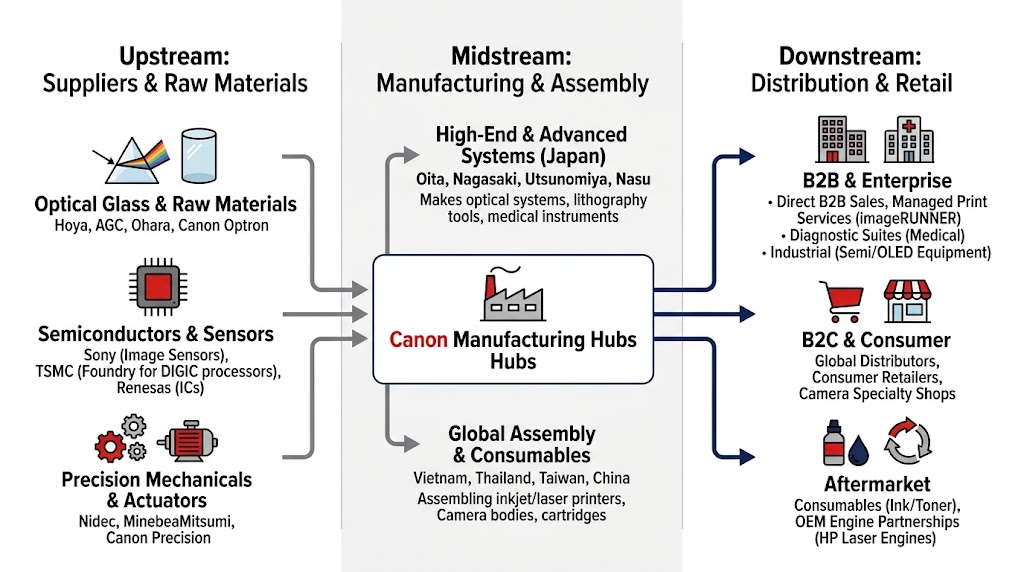
Canon operates a hybrid manufacturing and procurement model characterized by internal vertical integration for proprietary optical and sensor components, paired with diversified global sourcing for sub-assemblies and raw materials:
- Upstream Tier-1 and Key Component Suppliers:
- Optical Glass and Raw Materials: High-purity optical glass, fluorite crystals, and chemical coatings are supplied by specialized Japanese material leaders such as Hoya Corporation, AGC Inc., and Ohara Inc., as well as Canon’s internal material division (Canon Optron).
- Semiconductors, Processors, and Sensors: While Canon manufactures proprietary CMOS image sensors for its flagship EOS camera lines in-house, it sources specialized sensors, mixed-signal ICs, memory modules, and display drivers from Sony Semiconductor Solutions, TSMC (foundry services for DIGIC processors), and Renesas Electronics.
- Precision Mechanicals and Actuators: Specialized stepper motors, linear actuators, air bearings, and miniature drive units are sourced from Nidec, MinebeaMitsumi, and internal precision subsidiaries (Canon Precision Inc.).
- Midstream Manufacturing and Assembly:
- Canon distributes production across Japan (Oita, Nagasaki, Utsunomiya, Nasu) for high-end optical systems, lithography tools, and medical instruments.
- Mass-market assembly for inkjet/laser engines, printer cartridges, and mid-tier digital cameras is managed via wholly owned production hubs in Taiwan (Canon Inc., Taiwan), Vietnam (Canon Vietnam Co., Ltd.), Thailand, and mainland China (Canon Dalian, Canon Suzhou).
- Downstream Integration and Channel Distribution:
- Direct B2B and Managed Print Services (MPS): Canon deploys direct corporate sales organizations (Canon Solutions America, Canon Europe) targeting enterprise printing, commercial packaging, and hospital diagnostic suites.
- Retail and Distribution Network: Consumer cameras and desktop printers are routed through authorized international distributor networks, global consumer electronics retailers, and specialized camera specialty stores.
- Aftermarket Ecosystem: Toner, ink cartridges, consumables, and OEM engine supply agreements (notably supplying laser printer engines and toner cartridges to HP) provide recurring high-margin cash flows across the machine lifecycle.
Competitor Analysis: Technical and Financial Comparison
Printing and Office Solutions
- Key Competitors: HP Inc., Ricoh Company, Ltd., Xerox Holdings.
- Technical Comparison: HP leads desktop consumer/SMB printing with cloud integrations (HP+ and Instant Ink), while Canon excels in electrophotographic laser engine durability, color accuracy (imagePRESS), and heavy-duty office workflows (imageRUNNER ADVANCE). In enterprise production printing, Canon’s continuous-feed and cut-sheet inkjet systems (e.g., varioPRINT) provide high speeds and lower thermal degradation than traditional dry-toner engines.
- Financial Comparison: HP posts higher gross revenues driven by consumer PC and printer bundles, but carries cyclical hardware pressure. Canon’s Printing division generates stable operating margins (~9% to 11%), underpinned by steady aftermarket consumable replenishment and OEM licensing revenues.
Imaging Systems (Digital Cameras)
- Key Competitors: Sony Group Corporation, Nikon Corporation, Fujifilm Holdings.
- Technical Comparison:
- Autofocus and Sensor Architecture: Sony maintains an advantage in stacked BSI sensor readouts and third-party E-mount lens open standards. Canon counters with proprietary Dual Pixel CMOS AF technology, ergonomic weather-sealing, RF lens optical designs, and high-efficiency RAW codecs.
- Ecosystem Strategy: Nikon focuses on professional hybrid camera/lens fidelity (Z-mount), whereas Fujifilm concentrates on APS-C and Medium Format (GFX) color science. Canon maintains a closed RF-mount ecosystem for full-frame lenses while gradually expanding licensed crop-sensor optics.
- Financial Comparison: Imaging is Canon’s most profitable operational segment by operating margin (often exceeding 16% to 18%). Sony’s imaging segment benefits from vertical integration via Sony Semiconductor, whereas Canon optimizes profitability by driving average selling prices (ASPs) higher among professional and creator segments rather than chasing commoditized entry-level cameras.
Semiconductor and Industrial Equipment
- Key Competitors: ASML Holding N.V., Nikon Corporation.
- Technical Comparison: ASML maintains an effective monopoly over high-numerical-aperture EUV and advanced immersion DUV systems. Canon bypasses direct EUV competition by focusing on:
- High-throughput mature i-line and KrF steppers for power semiconductors, automotive ICs, and advanced 3D packaging.
- Nanoimprint Lithography (NIL): Canon’s FPA-1200NZ2C stamps circuit patterns directly onto wafers without optical projection, reducing power consumption and tool capital costs relative to EUV for memory architectures (such as 3D NAND).
- Financial Comparison: ASML achieves higher gross margins (>50%) and substantial order backlogs due to its monopoly pricing power. Canon’s industrial division maintains lower operational scale relative to ASML, but preserves high capital efficiency by targeting automotive, compound semiconductor, and packaging capex cycles without absorbing the extreme R&D expenditures required for High-NA EUV tools.
Consolidated Financial Profile (Canon Inc.)
- Revenue and Operating Performance: Canon generates consolidated annual revenues in the range of ¥4.2 trillion to ¥4.6+ trillion, maintaining a consolidated operating profit margin between 8.5% and 10.6%.
- Balance Sheet Strength: Canon maintains a low net debt-to-equity profile, consistent positive free cash flow generation, and disciplined R&D spending (~7% to 8% of net sales), supporting steady dividend distributions and share buyback programs.
Information Sources
- https://global.canon/en/ir/annual/canon-annual-report-2025.pdf
- https://global.canon/en/ir/annual/canon-annual-report-2024.pdf
- https://global.canon/en/ir/conference/pdf/conf2026q2e-note.pdf
- https://global.canon/en/mfg/f-01.html
- https://semicon.canon/en/business/
- https://petapixel.com/2025/08/29/canon-had-the-top-camera-market-share-in-2024/
- https://martinkleinheinz.de/en/camera-statistics/
- https://www.gminsights.com/industry-analysis/lithography-equipment-market
back to Canon