
Company History
Foundational Era and Camera Innovation(1933–1960s)
Canon traces its origins to the establishment of Precision Optical Instruments Laboratory in Tokyo in 1933, creating Japan’s first 35mm focal-plane shutter camera prototype, named the Kwanon. Renamed Precision Optical Industry Co., Ltd. in 1937 and officially adopting Canon Camera Co., Inc. in 1947, the firm established its foundational manufacturing standards around premium consumer lenses and rangefinder cameras, eventually releasing the Canonflex SLR in 1959.
Diversification into Office Equipment(1970s–1990s)
Recognizing the cyclical risk of consumer electronics, Canon entered office automation by introducing Japan’s first plain-paper copier, the NP-1100, in 1970. This period saw heavy R&D into Bubble Jet inkjet printing technology, laser printer engines partnered with HP, and stepper systems for semiconductor wafer fabrication. By the 1980s, the company launched the EOS(Electro-Optical System) camera series with autofocus capabilities, establishing a global dual-engine business model powered by cameras and office printing.
Digital Transformation and Strategic Acquisitions(2000s–2010s)
Under CEO Fujio Mitarai’s “Excellent Global Corporation Plan,” Canon consolidated its manufacturing efficiency through production-cell systems. To offset secular declines in consumer compact cameras and desktop printing, Canon pursued major strategic acquisitions. Key transactions included the buyout of Dutch printing company Océ in 2010 to strengthen production printing, the acquisition of Swedish video surveillance leader Axis Communications in 2015 for approximately $2.8 billion, and the acquisition of Toshiba Medical Systems Corporation in 2016 for approximately $5.9 billion(renamed Canon Medical Systems).
Industrial Reorganization and Next-Generation Tech(2020s–Present)
Entering the 2020s, Canon restructured its corporate reporting structure into four primary segments: Printing, Imaging, Medical, and Industrial. The company has accelerated commercial deployment of Nanoimprint Lithography(NIL) as an alternative to extreme ultraviolet(EUV) systems, deepened its full-frame mirrorless camera lineup, and transitioned its enterprise imaging solutions toward automated healthcare diagnostics and network-driven edge analytics.
Business Model and Strategy
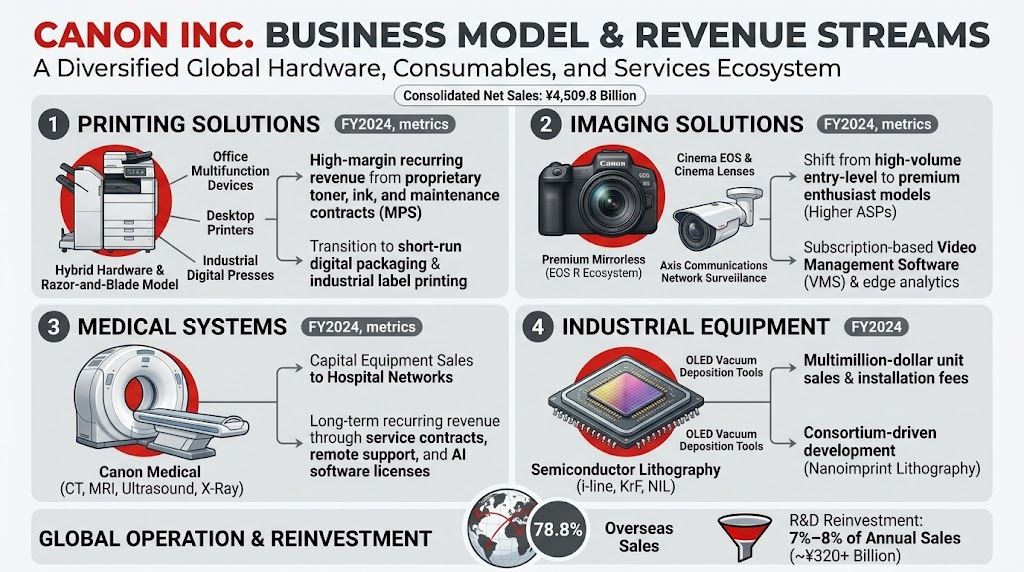
Canon operates a hybrid business model centered on hardware-driven ecosystems, razor-and-blade consumables, enterprise maintenance contracts, and high-capital industrial machinery. In fiscal year 2024, consolidated net sales reached ¥4,509,821 million(an increase of 7.9% year-on-year), with overseas operations accounting for 78.8% of net sales, yielding an operating profit of ¥375,366 million.
Printing Solutions(Core Cash Generator)
The Printing segment generates revenue through a hybrid approach: selling commercial digital presses, office multifunction devices, and desktop printers, which subsequently drive recurring, high-margin revenue through proprietary toner cartridges, ink tanks, maintenance contracts, and managed print services(MPS). Even as enterprise document volumes mature, the strategic focus has transitioned toward short-run digital commercial packaging presses and industrial label printers to protect operating cash flow.
Imaging Solutions(Premiumization and Video Surveillance)
In consumer and professional imaging, Canon shifted from high-volume entry-level cameras to premium mirrorless systems(EOS R ecosystem) and high-margin cinema lenses, capturing higher average selling prices(ASPs) from enthusiasts and professionals. Network cameras operated through Axis Communications follow an infrastructure-as-a-service model, combining hardware with video management software(VMS), cloud storage subscriptions, and computer-vision security analytics.
Medical Systems(Capital Equipment and Service Contracts)
Acquired from Toshiba, Canon Medical monetizes via the sale of computed tomography(CT), magnetic resonance imaging(MRI), ultrasound, and diagnostic X-ray systems. Beyond upfront hardware purchases by hospital networks, Canon generates long-term recurring service contracts, remote diagnostic support, and software license upgrades for clinical image post-processing.
Industrial Equipment(Semiconductor and Display Systems)
The Industrial segment sells high-value capital equipment, including i-line and KrF semiconductor lithography steppers, vacuum deposition tools for OLED displays, and Nanoimprint Lithography(NIL) tools. Monetization relies on multimillion-dollar unit sales, installation engineering fees, spare parts, and software-driven process tuning for chipmakers and display fabricators.
Development Strategy
Canon’s overarching development strategy revolves around channeling strong operating cash flow from legacy printing and consumer photography into high-barrier industrial niches—chiefly advanced medical modalities, smart city optical surveillance, and cost-effective semiconductor patterning systems.
Business Model Source Links
- https://global.canon/en/ir/annual/canon-annual-report-2024.pdf
- https://global.canon/en/ir/annual/canon-annual-report-2024-05.pdf
- https://global.canon/en/ir/business.html
- https://umbrex.com/resources/company-profiles/canon-inc/
AI Strategy, Budget, and Partnerships
Canon’s artificial intelligence strategy focuses on embedding proprietary deep learning algorithms directly into hardware processors(edge AI) rather than competing in general-purpose cloud large language models. The strategy is anchored across three principal pillars:
Healthcare and Medical Diagnostic AI
Canon Medical’s flagship clinical AI initiative is AiCE(Advanced intelligent Clear-IQ Engine), a deep learning reconstruction algorithm trained on high-quality imaging data. AiCE reduces image noise and enhances anatomical structures in CT and MRI scans, allowing medical providers to cut radiation dosage requirements and accelerate scan times. Canon Medical partners with academic hospitals worldwide, including Kyoto University Hospital and Johns Hopkins Medicine, to validate AI-driven early detection of cardiovascular diseases and oncology diagnostics.
Edge AI in Surveillance and Smart Vision
Through Axis Communications and its own vision solutions, Canon integrates deep learning processing units(DLPUs) directly into network cameras. This enables on-device computer vision analytics, including vehicle classification, license plate recognition, and crowd behavioral anomaly detection, minimizing cloud transmission bandwidth. Canon collaborates with system integrators and software partners like Milestone Systems to build multi-sensor edge-to-cloud smart monitoring networks.
Industrial Automation and Nanoimprint Lithography
In industrial operations, Canon applies computer vision and machine learning for automated wafer alignment, precision defect inspection, and drift compensation in semiconductor manufacturing. In Nanoimprint Lithography(FPA-1200NZ2C), AI models optimize mask positioning and resin dispensation to control defect density at circuit pattern geometries equivalent to advanced nodes. Canon develops this platform in close collaboration with consortium partners, notably Dai Nippon Printing(DNP) and memory maker Kioxia.
R&D Budget and AI Resource Allocation
Canon consistently commits approximately 7% to 8% of its annual consolidated net sales to research and development, equating to an annual R&D investment exceeding ¥320 billion(approximately $2.1 billion to $2.3 billion based on prevailing exchange rates). A dedicated and expanding portion of this R&D budget is allocated to centralized software development, algorithm architecture, and AI-assisted simulation tools to streamline physical prototyping and accelerate clinical algorithm deployment.
back to Canon