
Market Position and Market Share
Mitsui Fudosan Co., Ltd. (TYO: 8801) is Japan’s largest comprehensive real estate developer by revenue and total assets. In the domestic real estate and property development market, it holds the No. 1 ranking, generating consolidated revenue from operations of approximately ¥2.71 trillion (FY2025 ended March 31, 2026) with full-year operating income reaching ¥397.8 billion and total balance sheet assets exceeding ¥10.1 trillion.
Because Japan’s overall real estate industry is vast and fragmented—encompassing regional brokerages, residential builders, asset managers, and facility operators—aggregate market share across the entire sector is estimated at approximately 4% to 6% of total industry transactions. However, within the institutional grade, prime urban mixed-use, and commercial development segment, Mitsui Fudosan and its primary peer, Mitsubishi Estate, form an effective duopoly in Tokyo’s central business districts (CBDs). Specific segment standings include:
- Commercial and Retail Facilities: Ranked No. 1 in Japan by gross leasable area (GLA) and retail sales volume through regional flagships such as “LaLaport” and “Mitsui Outlet Park”.
- J-REIT Asset Management: Ranked No. 1 in Japan by assets under management (AUM) through sponsored entities, anchored by Nippon Building Fund Inc. (NBF, TYO: 8951), Japan’s largest office REIT, alongside Mitsui Fudosan Logistics Park (MFLP) and private real estate investment trusts.
- Office Leasing: Ranked No. 2 in central Tokyo office gross floor area behind Mitsubishi Estate, maintaining a core Tokyo metropolitan vacancy rate of 2.2% across mature properties (compared to the broader market average of approximately 9.2%).
- Residential Condominium Supply: Consistently ranks among the top three national suppliers in unit volume and average sales value through its “Park Court”, “Park Tower”, and “Park Mansion” brands alongside Nomura Real Estate and Sumitomo Realty.
Supply Chain Analysis and Key Suppliers
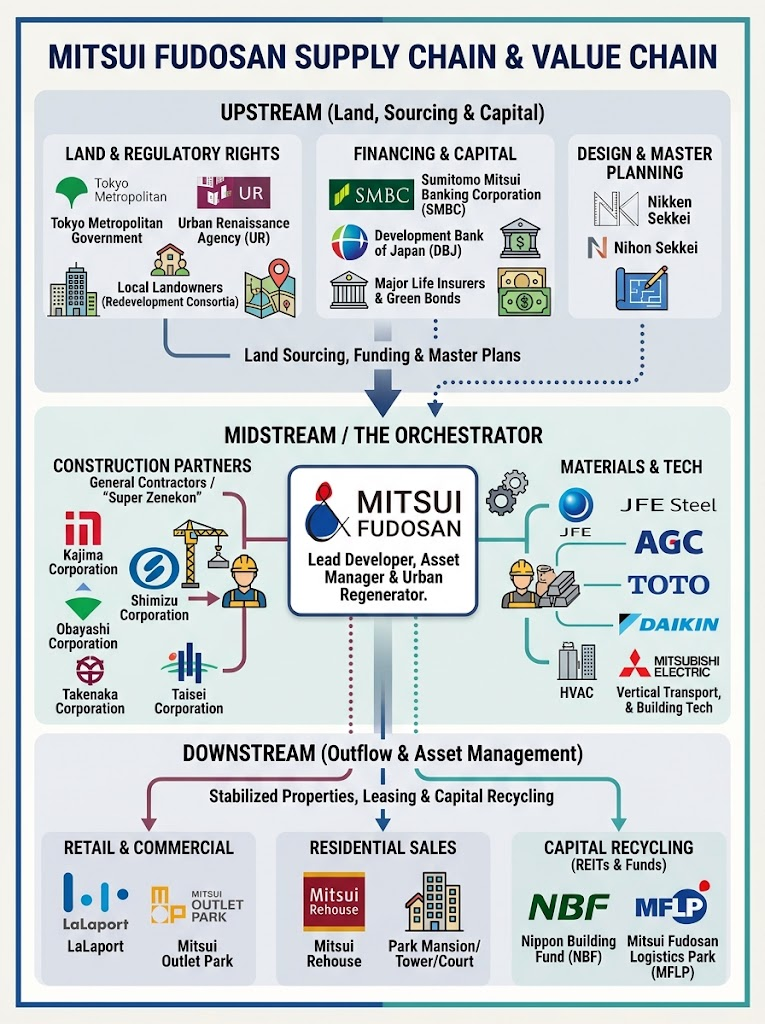
Mitsui Fudosan operates an asset-light, capital-recycling business model where it serves as master developer, orchestrator, and long-term asset/property manager rather than an in-house construction contractor.
1. Upstream (Land Sourcing, Urban Redevelopment Consortia, and Capital)
- Land and Redevelopment Rights Acquisition: Land acquisition in Japan’s major metropolitan centers relies heavily on multi-party rights adjustments (kenrishu) with historical landholders, municipal bodies (such as the Tokyo Metropolitan Government), and state-affiliated agencies like the Urban Renaissance Agency (UR). In major urban regeneration projects (e.g., Nihonbashi Revitalization Plan and Tokyo Bay Waterfront development), Mitsui acts as the lead organizer of land consolidation consortia.
- Financing and Capital Providers: Capital is secured through Japanese megabanks—primarily Sumitomo Mitsui Banking Corporation (SMBC) as main reference bank—alongside the Development Bank of Japan (DBJ), major life insurers (Nippon Life, Dai-ichi Life), and green bond issuances. Mitsui maintains long-term, low-interest funding structures with over 80% fixed-rate borrowing.
- Master Planning and Architectural Design Partners: Conceptualization and architectural design are contracted to premier engineering and architectural firms, including Nikken Sekkei, Nihon Sekkei, Kume Sekkei, and global design consultancies (such as Skidmore, Owings & Merrill (SOM) and Pelli Clarke & Partners).
2. Key Suppliers (General Contractors and Building Technology Providers)
Mitsui Fudosan does not operate internal construction execution arms (outside of 2×4 prefabricated wooden residential housing via Mitsui Home). Construction execution is tendered to Japan’s “Super Zenekon” (tier-1 general contractors) and specialized building equipment providers:
- General Contractors (Zenekon): Kajima Corporation (鹿島建設), Shimizu Corporation (清水建設), Taisei Corporation (大成建設), Takenaka Corporation (竹中工務店), and Obayashi Corporation (大林組). Kajima and Shimizu frequently secure prime urban high-rise and Nihonbashi complex contracts, while Takenaka frequently handles luxury retail and hospitality projects.
- Structural Steel and Building Products: JFE Steel and Nippon Steel (heavy structural wide-flange beams, seismic damper systems); AGC Inc. and Nippon Sheet Glass (low-emissivity glass and curtain walls); LIXIL Corporation and TOTO Ltd. (interior fittings, plumbing modules, and ceramic facades).
- Building Automation, HVAC, and Vertical Transport: Mitsubishi Electric, Hitachi, and Fujitec (high-speed destination dispatch elevators); Daikin Industries (commercial VRV/HVAC systems); Azbil Corporation (building energy management systems (BEMS) and automated environmental sensors).
3. Downstream (Distribution Channels, Tenants, and Capital Markets)
- Corporate and Retail Tenants: Corporate occupiers spanning international investment banks, IT giants, pharmaceutical hubs (the Nihonbashi Life Science initiative), and national retail chains anchored in suburban LaLaport properties.
- Residential Buyers: Individual domestic homebuyers and international high-net-worth investors serviced through Mitsui Fudosan Real Estate Sales (Mitsui Rehouse, Japan’s top real estate brokerage network by transaction volume for over three consecutive decades).
- Capital Exit and Recycling Channels: Sponsored public J-REITs (Nippon Building Fund, Mitsui Fudosan Logistics Park Inc., Frontier Real Estate Investment Corp.) and private institutional funds. Mitsui develops properties, stabilizes cash flows, sells equity ownership stakes to sponsored funds or institutional co-investors to harvest development margins, and retains long-term asset management (AM) and property management (PM) contracts.
Competitor Analysis: Strategic, Technical, and Financial Comparison
Mitsui Fudosan’s primary domestic rivals are Mitsubishi Estate Co., Ltd. (TYO: 8802) and Sumitomo Realty & Development Co., Ltd. (TYO: 8830), followed by secondary diversified peers Tokyu Fudosan Holdings (TYO: 3289) and Nomura Real Estate Holdings (TYO: 3231).
1. Strategic and Technical Capabilities
- Mitsui Fudosan vs. Mitsubishi Estate: Mitsubishi Estate holds an entrenched geographic monopoly in the Marunouchi-Otemachi-Yurakucho district (Japan’s financial command center), giving it superior rental pricing power and a concentrated asset footprint. In contrast, Mitsui Fudosan operates a far more diversified portfolio across asset classes: commercial retail (LaLaport), logistics hubs (MFLP), mixed-use urban master plans (Tokyo Midtown Roppongi and Hibiya), hospitality (Mitsui Garden, Halekulani), and sports/entertainment (Tokyo Dome integration). Technically, Mitsui leads in open innovation ecosystems, smart-city operational software, life-science cluster creation, and wooden fire-resistant hybrid skyscraper technology.
- Mitsui Fudosan vs. Sumitomo Realty: Sumitomo Realty adopts a buy-and-hold strategy, retaining high-rise office buildings under full direct leasing and focusing aggressively on urban condominium sales. Sumitomo pursues higher operating profit margins on static leases with minimal asset turnover. Mitsui Fudosan, by comparison, relies on rapid capital recycling, development turnover, fee-generating property management, and proactive portfolio reconfiguration.
2. Financial and Performance Comparison
- Scale and Top-Line Revenue: Mitsui Fudosan leads the industry with FY2025 revenue from operations of approximately ¥2.71 trillion, compared to Mitsubishi Estate’s revenue of approximately ¥1.45 trillion to ¥1.55 trillion and Sumitomo Realty’s revenue of approximately ¥1.01 trillion. Mitsui’s broader commercial retail and development sales footprint drive substantially larger gross volume.
- Operating Profitability: Sumitomo Realty historically commands higher operating margins (approximately 25% to 27%) due to its lean cost structure and long-term freehold leasing assets. Mitsui Fudosan generates higher absolute operating income (¥397.8 billion in FY2025, forecasted at ¥410 billion in FY2026) with operating margins of roughly 14.5% to 15.0%, reflecting the mixed composition of property sales, fee management, and hotel operations. Mitsubishi Estate posts operating profit around ¥280 billion to ¥310 billion.
- Capital Efficiency (ROE and ROA):Mitsui Fudosan maintains superior capital efficiency among the major developers, targeting and delivering Return on Equity (ROE) between 8.7% and 10.0% under its Medium-Term Management Plan, compared to Mitsubishi Estate (approx. 8.0%–9.0%) and Sumitomo Realty (approx. 7.5%–8.5%). Mitsui achieved this by setting aggressive shareholder distribution thresholds, increasing buybacks, and offloading mature assets to off-balance-sheet investment vehicles.
- Leverage and Balance Sheet Risk:Total assets for Mitsui Fudosan exceed ¥10.1 trillion with an equity ratio around 35%. Mitsubishi Estate operates with total assets of approximately ¥7.5 trillion to ¥8.0 trillion, and Sumitomo Realty around ¥6.5 trillion to ¥7.0 trillion. While Mitsui carries higher absolute debt, its interest coverage ratio remains healthy (above 10x), insulated by deep relationships with Japanese institutional lenders and substantial unrealized gains across its real property holdings (estimated at over ¥5.3 trillion in fair-market portfolio value above book value).
Sources
- https://www.mitsuifudosan.co.jp/english/corporate/ir/presentation/pdf/investors_guide2605e.pdf
- https://www.mitsuifudosan.co.jp/english/corporate/ir/finance/forecast/
- https://www.mec.co.jp/assets/img/annual/integratedreport2024e_p.pdf
- https://www.sumitomo-rd.co.jp/uploads/Financial_Results_FY2024_4Q.pdf
- https://note.com/magic_swift2546/n/n8d174da4fbb1?hl=en
back to Mitsui Fudosan