
History of Bridgestone
Founding and Domestic Expansion(1931–1970s)
Founded in 1931 in Kurume, Fukuoka by Shojiro Ishibashi(using an English translation of his family name, “Stone Bridge”), Bridgestone established early dominance by pioneering domestic tire production in Japan. During the postwar automotive boom, the company expanded rapidly into radial tires, automotive components, and industrial rubber goods.
Global Scale and Firestone Acquisition(1980s–1990s)
In 1988, Bridgestone executed a transformative cross-border acquisition by purchasing the Firestone Tire and Rubber Company in the United States for $2.6 billion. This gave Bridgestone direct access to North American manufacturing plants, distribution networks, and key OEM partnerships, establishing the group as a truly global tire conglomerate.
Quality Crises and Consolidation(2000s–2010s)
The early 2000s were challenged by widespread product recalls in the U.S. involving Firestone tires mounted on Ford Explorer SUVs, which caused substantial brand and financial strain. Bridgestone overhauled quality control frameworks, unified corporate governance, expanded aggressively into emerging markets across Asia and Latin America, and built dedicated solutions for off-the-road(OTR) mining and commercial fleets.
Bridgestone 3.0 and Solutions Transformation(2020–Present)
Entering its “Bridgestone 3.0” transformation era, the company pivoted from purely selling manufactured rubber to offering high-value sustainable mobility solutions. Management initiated major footprint restructuring—divesting non-core diversified businesses, scaling back unprofitable mid-range lines in Europe and China, and acquiring fleet telematics platform Webfleet to expand recurrent software-enabled revenue streams.
Business Model and Strategic Execution
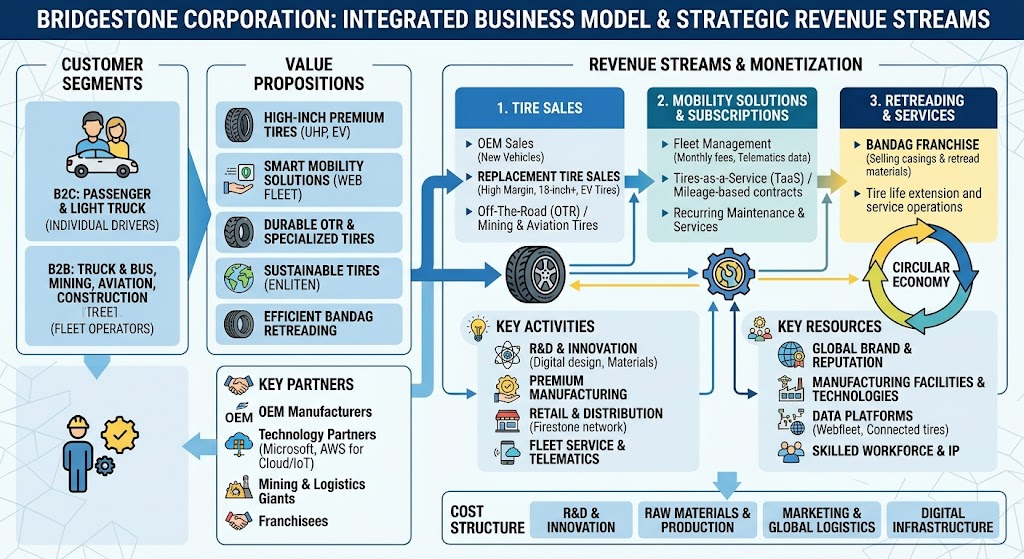
Bridgestone operates an integrated product-and-service monetization model, generating annual consolidated revenue of approximately ¥4.43 trillion with adjusted operating profit margins hovering around 11%. The company monetizes through three core pillars:
1. Premium Replacement Tire Sales(Core Cash Engine)
The vast majority of operating profit is derived from replacement tires rather than OEM sales. While OEM tire supply carries narrow margins, it secures replacement market captivity. Bridgestone focuses capital on high-inch(18-inch and above) passenger tires, EV-specific lines, and high-performance replacement products, branded under its ENLITEN modular design platform. Premium segments offer higher gross margins and buffer against commodity price swings through dynamic pass-through pricing adjustments.
2. Off-The-Road(OTR) and Specialized Mining/Aviation Solutions
Bridgestone dominates the global market for ultra-large radial tires used in heavy earthmoving and open-pit mining equipment. These tires carry substantial pricing power and cannot be easily replicated by tier-2 or tier-3 manufacturers. Bridgestone ties tire sales to long-term performance-based service contracts, deploying embedded monitoring systems to maximize fleet uptime and capture recurring high-margin maintenance revenue.
3. Commercial Fleet and Mobility Solutions(Tires-as-a-Service)
Instead of transaction-based sales, commercial truck and bus fleets are serviced via mileage-based or monthly subscriptions(TaaS/CaaS). Through Webfleet telematics and the Bandag retreading franchise, Bridgestone sells a closed-loop model: new premium tires, continuous sensor-driven pressure/wear management, casing collection, retreading(up to 30–50% cheaper than new tires with high margins for Bridgestone), and eventual raw material recycling.
Strategic Objectives Under Mid-Term Business Plan(24MBP)
Under its 2024–2026 management plan, Bridgestone targets a Return on Invested Capital(ROIC) of over 8.5% and Return on Equity(ROE) exceeding 9% through the deployment of its proprietary BCMA(Bridgestone Common Module Architecture). BCMA standardizes tire components into modular blocks, lowering R&D costs, reducing factory mold tooling complexity by up to 30%, and shrinking working capital requirements across global manufacturing hubs.
Sources for Business Model Information
- https://www.bridgestone.com/ir/financialdata/target/
- https://press.bridgestone-emea.com/bridgestone-releases-its-bridgestone-30-journey-2024-integrated-report/
- https://press.bridgestone-emea.com/bridgestone-releases-2026-bridgestone-integrated-report/
AI Strategy, Capital Allocation, and Strategic Partnerships
Bridgestone integrates artificial intelligence across three operational dimensions: Smart Manufacturing, Connected Tire Telematics, and R&D Materials Informatics. The group allocates approximately ¥130 billion annually to R&D alongside capital expenditures exceeding ¥400 billion, with digital transformation(DX) and software capabilities receiving a dedicated portion of strategic development budgets.
Key Strategic Partnerships
- Microsoft Azure & Edge AI Integration: Bridgestone collaborates closely with Microsoft to build tire analytics and predictive maintenance models hosted on Microsoft Azure. Using Azure Machine Learning and IoT Edge processing, the system measures real-time friction, surface temperature, and road-hazard damage directly through connected tire telemetry and vehicle sensors, eliminating the need for separate external hardware.
- Amazon Web Services(AWS): AWS acts as Bridgestone’s strategic cloud infrastructure provider. Bridgestone leverages AWS serverless compute, data lakes, and analytics to scale its cloud-native fleet management platforms, aggregate fleet telematics data from hundreds of thousands of connected commercial vehicles, and power automated dispatch algorithms for fleet tire replacements.
Concrete AI Applications and Deployments
- Virtual Tire Modeling & BCMA Generative Design: Bridgestone utilizes machine-learning algorithms to simulate structural strain, rolling resistance, and acoustic wear before physical prototypes are manufactured. This digital twin process cuts physical tire prototype production by up to 50% and reduces product development cycle times from years to months.
- Smart Factory Quality Automation: In production hubs such as the Hikone and Tosu facilities, Bridgestone deploys edge AI visual inspection algorithms trained on millions of tire casing surface images. The automated systems identify micro-imperfections, bead misalignment, and rubber compound variances in real time, reducing scrap rates and standardizing quality control without manual inspector bottlenecking.
back to Bridgestone