
Market Position and Market Share
Denso Corporation ranks as the world’s second-largest automotive Tier-1 supplier by original equipment manufacturer(OEM)automotive parts revenue, trailing only Robert Bosch GmbH. In fiscal year 2024(ended March 31, 2024), Denso generated approximately ¥7.14 trillion($47.2 billion)in consolidated revenue, maintaining its position ahead of peers such as ZF Friedrichshafen, Magna International, and Hyundai Mobis.
In key product segments, Denso holds dominant global market positions:
- Automotive Thermal Management Systems: Global market share stands at approximately 26% to 28%, ranking #1 worldwide ahead of Hanon Systems(around 13% to 15%)and Valeo(around 12% to 14%). Denso is the primary supplier of integrated heat pump modules and multi-zone climate control systems.
- Electrification Components(Inverters and Silicon Carbide Power Modules): In automotive traction inverters, Denso holds an estimated 15% to 18% global volume share, ranking among the top three globally alongside BYD(in-house)and Bosch, driven heavily by hybrid electric vehicle(HEV)and battery electric vehicle(BEV)platforms.
- Powertrain and Fuel Injection Systems: For internal combustion and hybrid powertrains, Denso maintains approximately 20% to 22% global share in high-pressure gasoline direct injection(GDI)and common-rail diesel systems, ranking #2 behind Bosch.
- Advanced Driver Assistance Systems(ADAS)and Sensing: Denso controls approximately 8% to 10% of the automotive vision/millimeter-wave radar and sensor fusion market, trailing specialized players like Continental, Bosch, and Mobileye.
Supply Chain Upstream and Downstream Analysis
Upstream Analysis and Key Suppliers
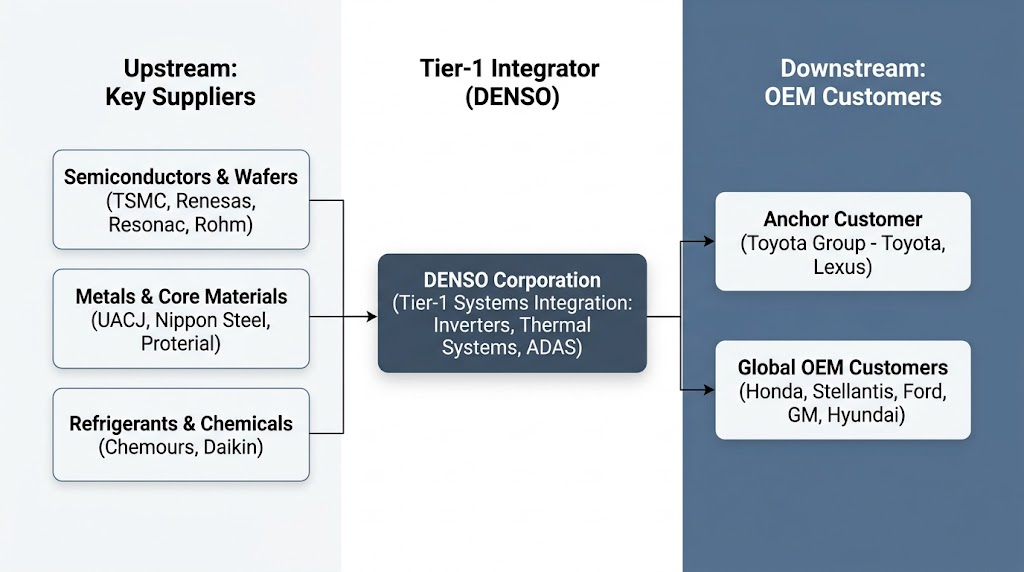
Denso relies heavily on raw materials, semiconductor substrates, specialized electronic components, and structural metals. The company executes a hybrid make-or-buy model, producing critical power semiconductors internally while dual-sourcing merchant hardware:
- Semiconductor Substrates and Foundries: For power electronics, Denso sources Silicon Carbide(SiC)wafers from suppliers including Resonac(formerly Showa Denko), Wolfspeed, and Coherent. For logic, microcontrollers(MCUs), and advanced process nodes, Denso partners closely with Renesas Electronics, TSMC(via Denso’s equity investment and capacity reservation in TSMC’s JASM fab in Kumamoto), and Rohm(cross-shareholding partnership focused on SiC development).
- Thermal Core Materials and Refrigerants: Raw aluminum extrusions, sheet coils, and brazing foils are supplied by UACJ Corporation and Nippon Light Metal. Refrigerants(R1234yf, R744/CO2)are procured from Chemours, Honeywell, and Daikin Industries.
- Magnetics and Electric Steel: Neodymium permanent magnets and magnetic assemblies for EV traction drives and motor generators are sourced from Proterial(formerly Hitachi Metals), TDK Corporation, and Shin-Etsu Chemical. Non-oriented electrical steel for motors and core components is primarily supplied by Nippon Steel and JFE Steel.
- Passive Components and Structural Plastics: Electronic passives(capacitors, inductors)are sourced from Murata Manufacturing and Kyocera, while engineering plastics(PPS, PA66)are provided by Toray Industries and BASF.
Downstream Analysis and OEM Integration
Denso acts as a Tier-1 systems integrator delivering plug-and-play modular architectures directly to OEM assembly lines under just-in-time(JIT)frameworks:
- Toyota Group Dependency: Toyota Motor Corporation and its group companies(Daihatsu, Hino, Lexus)represent Denso’s anchor customer base, historically accounting for roughly 48% to 52% of total group revenue. Toyota also retains an equity stake in Denso(approaching 20% following cross-shareholding unwinds).
- Non-Toyota Global OEMs: Denso has diversified outward to mitigate single-OEM concentration risk. Key non-captive OEM customers include Honda Motor, Stellantis, Ford Motor Company, General Motors, and Hyundai Motor Group. Non-Japanese OEMs collectively generate roughly 25% to 30% of consolidated sales.
- System Integration Points: Downstream delivery encompasses integrated thermal modules(e-compressor, heat exchanger, valve blocks), electrified powertrain modules(eAxle inverters, battery monitoring systems), ADAS sensor clusters, and central cockpit domain controllers.
Competitor Analysis: Technical and Financial Comparison
Technical Benchmarking
- Thermal Management Systems(vs. Valeo and Hanon Systems): Denso holds a distinct technological moat in heat pump efficiency down to sub-zero temperatures(-10°C to -20°C)without engaging auxiliary resistive PTC heaters, heavily deployed in Toyota’s bZ series and Lexus electrification platforms. Valeo focuses on smart cabin climate architectures and low-GWP refrigerant loops, whereas Hanon Systems leads in thin-tube heat exchangers and integrated battery chillers. Denso’s integration of high-pressure fluid valves and low-noise electric compressors provides superior energy conservation and acoustic NVH performance, though at a higher bill-of-materials(BOM)cost.
- Electrification and Inverters(vs. Robert Bosch and BorgWarner): Bosch excels in modular 800V silicon carbide(SiC)inverter platforms and high-speed motor designs deployed across European premium OEMs(Porsche, Mercedes-Benz). Denso’s strength lies in proprietary high-yield SiC trench MOSFET fabrication(leveraging proprietary crystal growth technology)and double-sided cooling packaging for inverters, offering market-leading thermal dissipation density. BorgWarner focuses primarily on integrated 3-in-1 eAxles and commercial vehicle electrification.
- E/E Architecture and ADAS(vs. Continental and Bosch): Bosch and Continental lead Denso in software-defined vehicle(SDV)platforms, high-performance central compute domain controllers, and automated driving software stacks. While Denso operates J-QuAD DYNAMICS(a joint venture with Aisin, Advics, and JTEKT)for autonomous driving software, Denso remains stronger in hardware-layer sensor precision(millimeter-wave radar, stereo cameras)than in autonomous driving AI algorithms.
Financial Performance Comparison
- Operating Margins: Denso operates with an operating profit margin typically between 6.5% and 7.5%, higher than Continental’s automotive division(which has fluctuated between 2% and 4.5% due to restructuring)and Magna International(around 5.0% to 5.5%). However, it trails Bosch’s mobility margins in peak cycle years and specialized component players.
- Capital Efficiency and Balance Sheet: Denso maintains a conservative capital structure characterized by low net debt and substantial cash reserves(debt-to-equity ratio consistently below 0.35x). In contrast, Valeo and BorgWarner carry higher leverage resulting from serial M&A activities(such as BorgWarner’s acquisition of Delphi Technologies).
- Research and Development(R&D)Intensity: Denso allocates approximately 8.5% to 9.5% of annual revenue to R&D(surpassing ¥500 billion annually), strictly focused on electrification, software architectures, and silicon carbide technologies. Bosch maintains a comparable R&D intensity of roughly 8% to 9%, whereas Magna operates at a lower R&D-to-sales ratio(around 2.5% to 3.5%)due to its heavier exposure to contract vehicle manufacturing and body structures.
Sources
- https://www.denso.com/global/en/about-us/investors/annual-report/
- https://www.denso.com/global/en/news/newsroom/
- https://www.bosch.com/company/our-figures/
- https://www.magna.com/company/investors
- https://www.valeo.com/en/financial-results/
- https://www.hanonsystems.com/En/Investors/FinancialInformation
back to Denso