
Market Position and Market Share
Nomura Holdings, Inc.is Japan’s largest full-service investment bank and securities brokerage firm, commanding an undisputed leadership position in domestic capital markets, retail wealth management, and wholesale trading.
- Domestic Ranking: Ranked No. 1 across overall investment banking underwriting in Japan, including initial public offerings (IPOs), equity underwriting, and Japanese Government Bond (JGB) primary dealer allocations.
- Underwriting League Tables: Nomura consistently captures between 20% and 30% of total Japan equity underwriting volume, maintaining the top tier ahead of mega-bank securities joint ventures.
- Assets Under Management (AUM): Nomura’s Investment Management division manages over 130 trillion yen in AUM (reaching 136.9 trillion yen in FY2025/26), solidifying its position as the largest investment trust and asset management group in Japan.
- Domestic Retail and Wealth Management: Nomura commands approximately 18% to 22% of total client assets among traditional domestic Japanese securities brokers, overseeing more than 140 trillion yen in client retail/wealth management assets.
- Global Standing: Outside Japan, Nomura operates as a focused global wholesale franchise across the Americas, EMEA, and Asia-Pacific. While trailing Tier-1 Wall Street mega-firms globally, it ranks among the leading cross-border M&A advisors and fixed-income/macro specialists bridging Asian and Western capital markets.
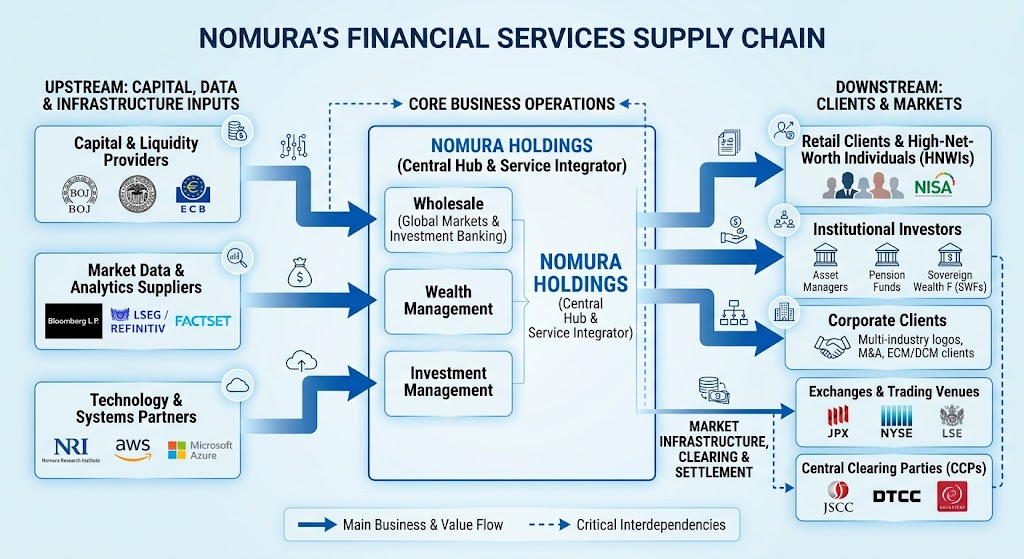
Upstream and Downstream Value Chain and Key Suppliers
Unlike traditional industrial manufacturing, an investment bank’s value chain is driven by capital inputs, technological pipes, financial market infrastructure, and institutional liquidity.
- Upstream (Capital, Liquidity, Technology, and Market Infrastructure):
- Central Banks and Liquidity Providers: The Bank of Japan (BOJ), Federal Reserve, and European Central Bank (ECB) form the foundational layer for monetary liquidity, interbank short-term funding, and repo financing.
- Financial Market Infrastructure and Clearinghouses: Upstream transaction settlement and clearing rely on entities such as the Japan Securities Clearing Corporation (JSCC), Depository Trust & Clearing Corporation (DTCC), Euroclear, and Clearstream.
- Market Data and Financial Technology Providers: Nomura’s trading desks and algorithmic platforms depend critically on financial data pipelines, specialized software, and exchange interfaces:
- Core Market Data: Bloomberg L.P., LSEG (London Stock Exchange Group/Refinitiv), and FactSet.
- Trading & Risk Engines: Murex, ION Group (Broadway/Fidessa), and Tradeweb/MarketAxess for fixed-income electronic connectivity.
- IT and Systems Integration: NRI (Nomura Research Institute), Nomura’s former IT subsidiary and primary strategic technology partner for core retail and wholesale banking architecture, alongside cloud infrastructure providers including Amazon Web Services (AWS) and Microsoft Azure.
- Midstream (Core Business Operations):
- Wealth Management: In-person branches, digital advisory platforms, discretionary investment mandates, and retail trust distribution.
- Investment Management: Fund structuring, public equities, fixed-income vehicles, private equity, alternative investments, and institutional pensions.
- Wholesale (Global Markets & Investment Banking): Institutional equity and fixed-income sales and trading, structured solutions, M&A advisory, DCM (Debt Capital Markets), and ECM (Equity Capital Markets) origination.
- Downstream (Clients and Capital Allocators):
- Retail Clients: High-net-worth individuals (HNWIs), business owners, mass-affluent Japanese savers transitioning deposits to investments via NISA (Nippon Individual Savings Account).
- Institutional Clients: Global asset managers, sovereign wealth funds (SWFs), life insurance companies, Japanese regional banks (shinkin banks), hedge funds, and corporate treasuries seeking risk hedging and corporate finance advisory.
Competitor Analysis
Nomura faces competition from domestic bank-backed securities houses in Japan and international universal investment banks globally.
- Domestic Competitors:
- Daiwa Securities Group: The main standalone securities competitor. Daiwa has a strong retail and wealth management presence in Japan but lacks the global wholesale scale of Nomura.
- Mitsubishi UFJ Morgan Stanley Securities (MUMSS): Leverages MUFG’s corporate lending balance sheet and Morgan Stanley’s global franchise, presenting formidable competition in domestic ECM and M&A league tables.
- SMBC Nikko Securities: Leverages Sumitomo Mitsui Financial Group’s corporate client base, competing fiercely in domestic debt underwriting and structured corporate solutions.
- Mizuho Securities: Part of Mizuho Financial Group, strong in debt capital markets and syndicated lending integration.
- International Competitors:
- Wall Street Tier-1 Firms (Goldman Sachs, Morgan Stanley, JPMorgan Chase, Citigroup): Compete against Nomura in global cross-border M&A advisory, prime brokerage, and structured derivatives.
Technical and Capabilities Comparison
- Electronic Execution and Algorithmic Trading: Through its subsidiary Instinet, Nomura maintains advanced algorithmic equity execution capabilities. However, in FICC (Fixed Income, Currencies, and Commodities) electronic market-making, Tier-1 US banks possess deeper balance sheets, superior low-latency infrastructure, and broader liquidity pools.
- Risk Management Systems: Following historical losses from the Archegos Capital default in 2021, Nomura overhauled its risk engine architecture, tightening counterparty exposure limits, prime brokerage stress testing, and real-time collateral margin controls to align closer to global tier-1 standards.
- IT Infrastructure Integration: Nomura benefits from its deep historical alignment with NRI for domestic back-office and clearing systems, giving it operational efficiency in Japan. In overseas wholesale markets, ongoing migration to hybrid cloud architectures has helped lower the cost-to-income ratio.
Financial Comparison
- Profitability and Return on Equity (ROE):Nomura achieved a consolidated ROE of approximately 10% in FY2024/25 and FY2025/26 (up from historical levels of 5% to 6%), driven by surging Japanese equity markets, corporate governance reforms, and fixed-income trading gains. However, this still trails US peers like Goldman Sachs and Morgan Stanley, which consistently target ROEs of 14% to 17%.
- Cost-to-Income Ratio (CIR): Nomura’s Wholesale division historically operated with a high CIR (often above 85% to 90%), which it has worked down toward the 75% to 80% range. Daiwa Securities maintains a lower CIR in retail, while global US peers benefit from superior operating leverage.
- Balance Sheet and Capital Adequacy: Nomura maintains a robust Common Equity Tier 1 (CET1) ratio comfortably above 15% under Basel III regulations, exceeding statutory requirements and offering a substantial buffer for market shocks.
Information Sources
- https://www.nomuraholdings.com/investor/
- https://www.nomuraholdings.com/company/outline.html
- https://www.nomuraholdings.com/news/
- https://www.jpx.co.jp/
- https://en.wikipedia.org/wiki/Nomura_Holdings
back to Nomura