
Corporate History
1. Foundation and Industrialization of Umami (1908–1945) The company was founded following chemist Kikunae Ikeda’s 1908 discovery that glutamate was the molecular driver of the taste profile he termed “umami.” In 1909, Saburosuke Suzuki II partnered with Ikeda to commercialize monosodium glutamate under the trademark “AJI-NO-MOTO.” Early expansion focused on scaling chemical extraction from wheat gluten and establishing industrial production in Japan, followed by initial exports to neighboring Asian markets.
2. Post-War Modernization and Fermentation Breakthroughs (1946–1979) Following World War II, the company shifted from acid hydrolysis extraction to modern microbial fermentation techniques in 1956, dramatically lowering amino acid production costs. During this era, Ajinomoto broadened its product line into flavored seasonings (such as Hondashi), frozen foods, and amino acid infusions for medical use. The group expanded aggressively across Southeast Asia and Latin America by establishing localized manufacturing joint ventures.
3. Specialty Diversification and The Discovery of ABF (1980–2000s) Ajinomoto leveraged its foundational knowledge of amino acid chemistry and epoxy resins to explore non-food industrial applications. In the late 1990s, research headed by Shigeo Nakamura led to the commercial development of Ajinomoto Build-up Film (ABF). As microprocessors transitioned to complex ball grid array packaging, ABF emerged as the global standard for insulating layers in integrated circuit packaging. Concurrently, the biopharmaceutical division grew into contract development and amino acid-based cell culture media.
4. Portfolio Restructuring and AminoScience Growth (2010s–Present) Facing margin compression in commoditized commodity food lines, Ajinomoto launched its ASV (Ajinomoto Group Creating Shared Value) roadmap and structural reforms under the 2020–2025 Medium-Term Management Plan. The group shed capital-intensive, non-core assets (including animal nutrition lines and selected CDMO facilities) while reallocating capital toward high-margin functional materials, healthcare, and semiconductor-related specialty chemicals.
Ajinomoto Group
Business Model and Strategic Framework
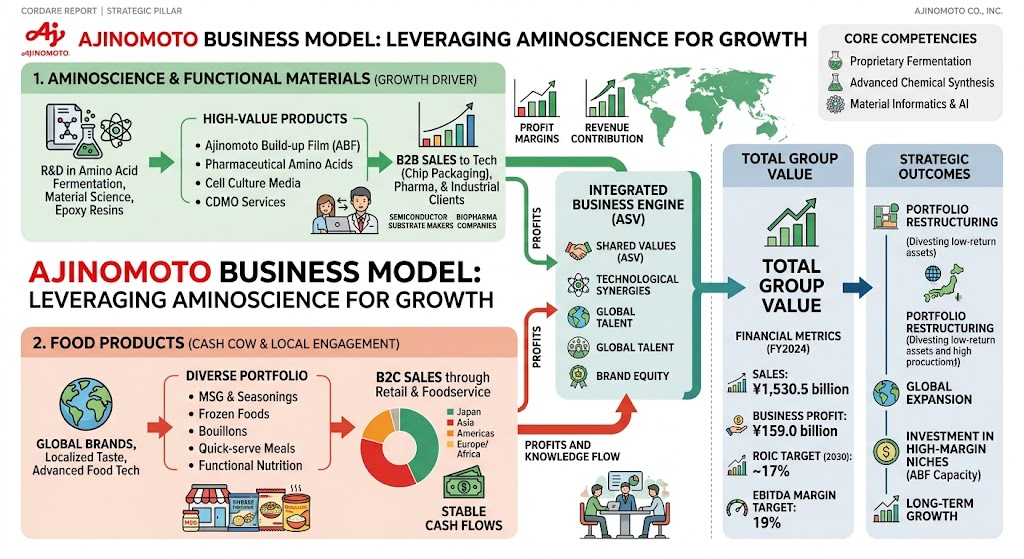
Ajinomoto generates revenue by monetizing proprietary fermentation and material science technologies across two primary operational pillars: Food Products and AminoScience.
Umbrex Consulting
1. Revenue Architecture and Monetization Streams For FY2024 (ended March 2025), Ajinomoto achieved consolidated sales of approximately ¥1,530.5 billion and a business profit of ¥159.0 billion, targeting over ¥1,618.0 billion in sales for FY2025.
www.ajinomoto.co.jp
- Food Products (Cash Cow): Represents approximately 65–70% of total revenue. It generates stable cash flows through consumer seasonings, bouillons, frozen Asian meals, and quick-serve items across mature markets (Japan, North America) and high-volume emerging markets (Southeast Asia, Latin America). Revenue is driven by unit sales volumes and local-market pricing power via localized formulations.
- AminoScience & Functional Materials (Growth Driver): Represents approximately 30–35% of group revenue, yet generates an outsized share of operating margin. Within this segment, the Functional Materials unit sells proprietary chemical formulations, primarily ABF, directly to tier-1 semiconductor substrate manufacturers (such as Unimicron, Ibiden, and Nan Ya). ABF operates with an estimated global market share exceeding 90% in advanced microchip packaging (CPUs, GPUs, and AI accelerators), providing strong pricing power and gross margins well above corporate food averages.
- Healthcare & Bio-Pharma Services: Generates recurring B2B contract revenue via pharmaceutical-grade amino acids, active pharmaceutical ingredient (API) synthesis, and specialized cell culture media supplied to biotherapeutic drug developers.
2. Strategic Execution and ASV 2030 Roadmap Ajinomoto executes a “Business Model Transformation” (BMX) strategy:
Ajinomoto Group
- Capital Discipline and ROIC Targeting: Ajinomoto shifted management metrics from pure revenue volume to Return on Invested Capital (ROIC) and EBITDA margins. By divesting low-return legacy commodity assets, the company aims to elevate its group ROIC from roughly 8–10% toward a corporate target of approximately 17% by 2030, alongside an EBITDA margin target of 19%. Ajinomoto Group
- Capacity Expansion in Advanced Materials: The company has deployed consecutive multi-billion-yen capital expenditure tranches to scale ABF film production facilities, aligning manufacturing outputs with multi-year server, high-performance computing (HPC), and AI processor capacity roadmaps.
- High-Value Product Mix: In food, Ajinomoto focuses on premiumization—selling reduced-sodium, enzyme-based texture optimizers, and functional nutrition products rather than generic commodity ingredients, insulating gross margins against input cost swings.
Sources for Business Model Information
- https://www.ajinomoto.com/cms_wp_ajnmt_global/wp-content/uploads/pdf/2023_02_28_01E.pdf
- https://www.ajinomoto.co.jp/company/en/ir/event/presentation/main/011111112/teaserItems1/01/linkList/02/link/FY25Q2_Presentation_E_with%20script.pdf
- https://ajinomoto-ir.swcms.net/company/en/ir/event/presentation/main/011111110/teaserItems1/01/linkList/03/link/FY24Q4_Presentation_E_with%20script.pdf
- https://www.ajinomoto.com/aboutus/what-the-ajinomoto-group-will-be-in-2030
Artificial Intelligence and Digital Strategy
Ajinomoto approaches Artificial Intelligence (AI) and Digital Transformation (DX) as structural enablers spanning R&D, supply chain logistics, and material engineering rather than standalone commercial IT products.
1. Enterprise Strategy and Core Infrastructure Under its corporate transformation framework, Ajinomoto implemented the ADAMS (Ajinomoto Data Management System) platform to aggregate proprietary molecular, operational, and market data globally. By breaking divisional data silos across purchasing, production, and R&D, the platform reduces operational overhead—yielding over 40,000 hours in annual process efficiencies—while deploying enterprise-wide generative AI assistant tools to accelerate internal data analytics.
2. Materials Informatics (MI) and Bio-AI in R&D The primary high-value application of AI within Ajinomoto is Materials Informatics and computational molecular modeling:
- Accelerating Dielectric Formulations: Developing advanced insulation films like ABF requires optimizing multi-component chemical properties (thermal expansion coefficient, dielectric loss tangent, adhesion, and elasticity). Ajinomoto utilizes AI-driven materials informatics to simulate chemical polymer matrix behaviors, reducing experimental formulation iteration cycles from months to days.
- Fermentation Bioprocess Optimization: In amino acid synthesis, deep learning and metabolic flux models analyze gene expression and fermentation sensor telemetry in real time, maximizing microbial yield rates while reducing energy consumption at industrial bioreactor plants.
3. Strategic Partnerships and Tech Alliances Ajinomoto works closely with enterprise technology leaders and academic consortia:
- Cloud & Advanced Analytics Partners: The company leverages cloud platforms and data infrastructure built around providers such as Microsoft and Amazon Web Services (AWS) for scalable enterprise computing, supply chain replenishment forecasting, and enterprise generative AI integration.
- Semiconductor Ecosystem Collaboration: Through its Functional Materials division, Ajinomoto maintains joint development roadmaps with leading chip designers (including Intel and AMD) and foundry substrate packaging partners to customize future ABF dielectric specifications around next-generation 2.5D/3D chiplet interconnect architectures.
back to Ajinomoto