
Market Position and Market Share
Daiichi Sankyo Company, Limited ranks as the 2nd largest pharmaceutical company in Japan by market capitalization (following Takeda Pharmaceutical) and has emerged as the global leader in the next-generation Antibody-Drug Conjugate (ADC) oncology landscape.
- Overall ADC Market Position:In the global ADC space (valued at approximately $18.60 billion in 2025 and rising above $22.60 billion in 2026), Daiichi Sankyo holds the #1 market position through its flagship blockbuster drug, Enhertu (trastuzumab deruxtecan), developed and commercialized jointly with AstraZeneca.
- Flagship Product Market Share:In 2025, global combined sales of Enhertu reached $4.982 billion (up 32.7% YoY from $3.754 billion in 2024), capturing approximately 29.5% of the total global ADC market revenue.It is the single best-selling ADC in the world, surpassing Roche’s Kadcyla (~14.5% share) and Pfizer/Astellas’ Padcev (~18% combined revenue share).
- Corporate Scale:Under its 5-year strategic plan, Daiichi Sankyo achieved consolidated corporate revenue exceeding ¥2.1 trillion (approximately $14.5 billion) in fiscal year 2025, driven predominantly by oncology expansion. The company has established a strategic roadmap targeting a global top-5 oncology ranking by 2035.
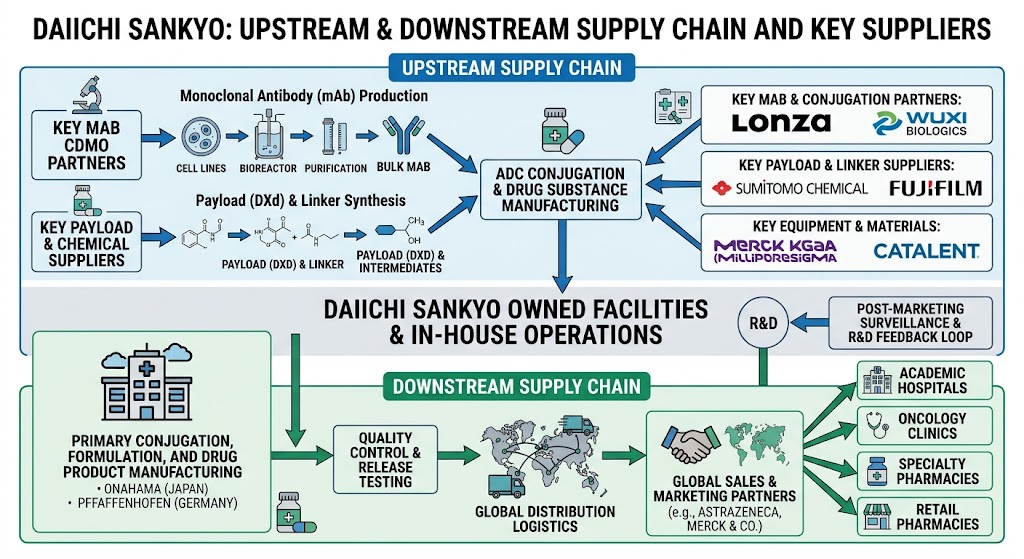
Supply Chain Upstream, Downstream, and Key Suppliers
The ADC supply chain is among the most intricate in the biopharmaceutical sector, requiring specialized multi-facility coordination across four primary segments: monoclonal antibodies (mAbs), cytotoxic payloads, chemical linkers, and sterile fill-finish operations.
- Upstream Supply Chain (Biologics, Payloads, Linker Synthesis):
- Payload Chemistry (DXd): Daiichi Sankyo maintains tight in-house control over its proprietary topoisomerase I inhibitor payload (deruxtecan/DXd) and its tetrapeptide-based cleavable linker technology. Active pharmaceutical ingredient (API) payload synthesis is conducted at high-potency containment facilities in Japan (such as its Odawara and Kitamoto sites), supplemented by strategic fine-chemical synthesis partners.
- Antibody Intermediates: Monoclonal antibody production requires mammalian cell culture expression systems. While Daiichi Sankyo handles internal bulk antibody drug substance (DS) at its Japanese facilities, it relies on global contract development and manufacturing organizations (CDMOs) for capacity redundancy.
- Key Suppliers & CDMO Partners:
- Lonza Group (Switzerland): Primary manufacturing partner for high-potency conjugation, complex payload-linker chemistry, and bio-conjugation scaling.
- WuXi Biologics / WuXi XDC (China): Key CDMO partner providing integrated antibody and bio-conjugation support for clinical and commercial pipeline pipelines.
- Catalent (now part of Novo Holdings): Critical fill-finish and sterile vialing supplier for sterile biologics.
- Merck KGaA / MilliporeSigma: Core supplier of single-use bioreactor systems, filtration cassettes, chromatography resins, and specialized fine chemicals.
- Midstream & Downstream Supply Chain (Conjugation, Formulation, and Distribution):
- Conjugation & Packaging: Linking the hydrophobic DXd payload to purified antibodies requires highly specialized occupational exposure band (OEB 5) containment suites. Daiichi Sankyo has invested over ¥300 billion to expand internal conjugation and formulation suites across Japan (including the Onahama and Hiratsuka sites) and Germany (Pfaffenhofen site).
- Commercial Distribution & Logistics: Commercial delivery requires a validated cold chain maintained strictly at 2°C to 8°C. Distribution in North America and Europe is co-managed with global partner AstraZeneca, using specialized specialty pharmacy networks (e.g., McKesson, AmerisourceBergen/Cencora, and Cardinal Health in the U.S.) to supply oncology infusion centers and academic hospitals.
Competitor Analysis: Technological and Financial Comparison
Daiichi Sankyo’s primary competitive peer group in oncology and ADCs comprises AstraZeneca, F. Hoffmann-La Roche, Pfizer (via its Seagen acquisition), and Gilead Sciences.
1. Technological Comparison
- Linker-Payload Platform Superiority:
- Daiichi Sankyo (DXd Platform): Utilizes an exatecan-derived topoisomerase I inhibitor payload that is ~10x more potent than SN-38 (used in Gilead’s Trodelvy). It features a stable, tumor-selective enzymatically cleavable tetrapeptide linker that achieves an industry-leading Drug-to-Antibody Ratio (DAR) of ~8 without compromising systemic stability or causing aggregation. Crucially, the released DXd payload is cell-membrane permeable, generating a potent bystander antitumor effect that eradicates adjacent antigen-negative tumor cells in heterogeneous tumors.
- Roche (Kadcyla / Polivy): Uses older first- and second-generation technology. Kadcyla relies on a non-cleavable thioether linker (SMCC) with a maytansinoid tubulin inhibitor (DM1) at a lower DAR of ~3.5.Lacking a bystander effect, it requires high, uniform target antigen expression (limiting efficacy in HER2-low settings).
- Pfizer / Seagen (Adcetris / Padcev): Built on auristatin-based payloads (MMAE/MMAF, microtubule disruptors) using valine-citrulline cleavable linkers at a typical DAR of ~4. While effective in bladder cancer and lymphomas, tubulin inhibitors carry distinct class toxicities (peripheral neuropathy), whereas DXd primarily triggers hematologic and pulmonary monitoring requirements (interstitial lung disease / ILD).
- Gilead (Trodelvy): Employs an SN-38 payload targeting TROP2 with a hydrolyzable pH-sensitive linker at a DAR of ~7.6. However, its linker is less stable in systemic circulation compared to Daiichi’s enzymatic tetrapeptide linker, resulting in higher premature payload release and neutropenia rates.
- Pipeline Depth & Target Breadth:
- Beyond Enhertu (HER2), Daiichi Sankyo has validated its DXd platform across multiple targets: Datopotamab deruxtecan (Dato-DXd, TROP2) co-developed with AstraZeneca, Patritumab deruxtecan (HER3-DXd), and multi-asset alliances with Merck & Co. (MSD) valued at up to $22 billion (covering Ifinatamab deruxtecan / B7-H3, Raludotatug deruxtecan / CDH6, and Patritumab deruxtecan).
2. Financial Comparison
| Metric / Company | Daiichi Sankyo | Roche | Pfizer | AstraZeneca |
| Annual Revenue (FY2025/CY2025) | ~¥2.10T (~$14.5B) | ~CHF 60.8B (~$70.0B) | ~$61.5B | ~$54.2B |
| ADC Portfolio Revenue (2025) | ~$4.98B (Enhertu combined) | ~$2.33B (Kadcyla) + ~$1.1B (Polivy) | ~$2.85B (Padcev + Adcetris share) | ~$2.49B (Enhertu 50% split) |
| Operating Margin (Core/Adj.) | ~22% – 25% | ~35% – 38% | ~28% – 30% | ~32% – 34% |
| R&D Intensity (% of Revenue) | ~21% – 23% | ~22% | ~17% – 19% | ~23% |
| Balance Sheet Leverage | Low net debt; high cash reserves | Modest leverage; strong FCF | High leverage (post-$43B Seagen deal) | Moderate leverage; robust operational cash flow |
- Strategic Financial Synergies: Daiichi Sankyo operates with lower capital risk by monetizing its DXd platform through massive upfront co-development deals with AstraZeneca and Merck & Co. These partnerships fully fund 50% or more of global clinical development expenses while delivering billions in upfront and regulatory milestone payments, insulating Daiichi Sankyo’s balance sheet while maximizing commercial launch velocity.
Sources
- https://www.fiercepharma.com/pharma/daiichi-sankyo-targets-global-top-5-oncology-rank-2035-13b-efficiency-drive-new-5-year-plan
- https://www.biochempeg.com/article/1462.html
- https://www.gminsights.com/industry-analysis/antibody-drug-conjugates-market
- https://www.fortunebusinessinsights.com/antibody-drug-conjugates-market-116146
- https://www.mordorintelligence.com/industry-reports/antibody-drug-conjugates-market
- https://www.marketsandmarkets.com/ResearchInsight/antibody-drug-conjugates-market.asp
- https://www.daiichisankyo.com/files/investors/library/annual_report/index/pdf/VR2025/VR2025_en_all_0925_03.pdf
back to Daiichi Sankyo