
Company History
Foundation and Merger Phase (1899–2005)
Sankyo was originally founded in 1899, establishing its legacy through digestive enzymes and later statins, while Daiichi Pharmaceutical was founded in 1915, specializing in anti-infectives and synthetic medicines. Both entities grew into cornerstone Japanese pharmaceutical houses throughout the 20th century. In September 2005, facing intensifying global consolidation and patent cliffs on traditional small-molecule therapies, the two legacy companies merged under a joint holding company before fully integrating as Daiichi Sankyo Company, Limited in 2007.
Global Diversification and Strategic Reset (2006–2015)
Following the merger, the company pursued aggressive international expansion to mitigate domestic pricing pressures. In 2008, it acquired a controlling stake in Indian generic drugmaker Ranbaxy Laboratories. This venture turned into a costly failure marked by severe US FDA compliance sanctions, manufacturing bans, and protracted legal liabilities, culminating in Daiichi Sankyo selling its Ranbaxy holdings to Sun Pharma in 2014. Domestically and regionally, the company leaned on cardiovascular therapies such as olmesartan (Benicar) and edoxaban (Lixiana/Savaysa), while quietly pivoting internal research toward biologics and oncology.
The DXd Platform Transformation (2016–Present)
Recognizing the limitations of primary care blockbusters, Daiichi Sankyo redirected clinical investment toward oncology via its proprietary DXd ADC technology. The breakthrough validation of Enhertu in HER2-low and HER2-positive metastatic breast cancer transformed the company into a biopharma heavyweight. High-profile global collaboration deals with AstraZeneca (2019, 2020) and Merck & Co. (2023) injected tens of billions of dollars in upfront cash and milestones, transforming Daiichi Sankyo from a regional Japanese player into a premier oncology powerhouse.
Business Model and Growth Strategy
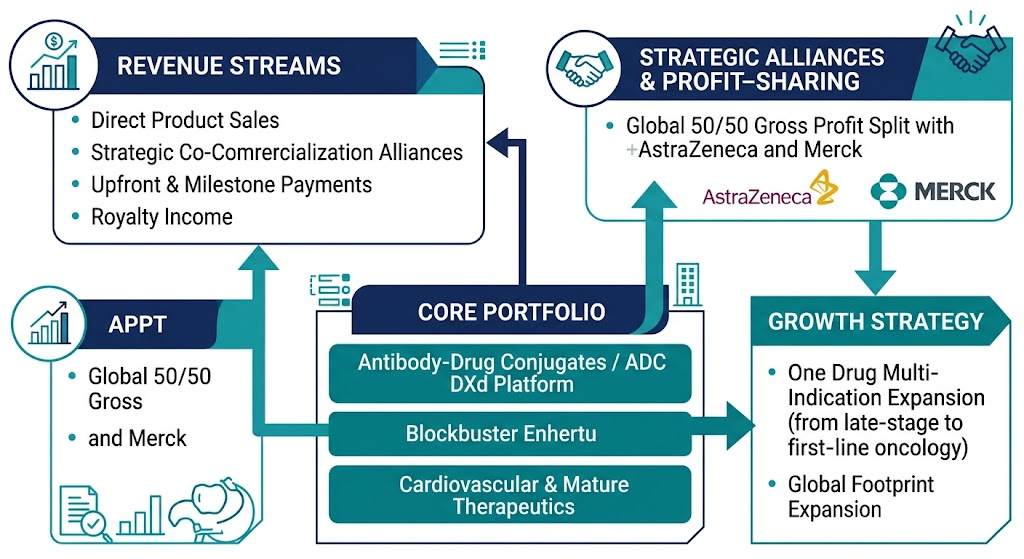
Daiichi Sankyo generates revenue through three core pillars: direct proprietary sales, high-margin out-licensing and co-commercialization alliances, and milestone/royalty recognition.
Revenue Engine and Profit Sharing Structure
Rather than building an expensive, high-risk standalone commercial salesforce in every overseas geography, Daiichi Sankyo leverages strategic alliance structures with global multinational corporations. Under its landmark agreements with AstraZeneca for Enhertu and datopotamab deruxtecan (Dato-DXd), Daiichi Sankyo books product sales in territories where it holds distribution rights (such as Japan and parts of the US/Europe) and pays AstraZeneca a 50% gross profit split, while receiving 50% profit-share payments where AstraZeneca books the revenue.
Actual Figures and Milestones
In FY2025, consolidated revenue reached approximately 2.1-2.2 trillion yen, powered by oncology revenue surpassing 900 billion yen. Global alliance product sales for Enhertu alone reached 698.4 billion yen in FY2025 (a 26.3% YoY increase), yielding substantial sales milestone receipts such as an 86.0 billion yen ($537.5 million) payout for crossing annual volume thresholds. The company forecasts total DXd platform peak sales to exceed 3.0 trillion yen ($19.1 billion), bolstered by a five-year R&D allocation of approximately 2.9 trillion yen ($18.5 billion).
Multi-Indication Expansion Strategy
The strategic core relies on a “one drug, multiple indications” paradigm. Daiichi Sankyo expands Enhertu from refractory, late-stage settings into lucrative first-line regimens (e.g., DESTINY-Breast09) while simultaneously obtaining approvals across HER2-mutant non-small cell lung cancer, gastric cancers, and pan-tumor solid indications. This maximizes the return on a single manufacturing construct before expanding adjacent pipeline assets (such as patritumab deruxtecan and ifinatamab deruxtecan partnered with Merck).
Sources
- https://www.daiichisankyo.com/files/investors/library/quarterly_result/2025/FY2025%20Financial%20Results%20and%205Year%20Business%20Plan%20Presentation_E.pdf
- https://www.fiercepharma.com/pharma/daiichi-sankyo-targets-global-top-5-oncology-rank-2035-13b-efficiency-drive-new-5-year-plan
- https://www.daiichisankyo.com/files/investors/library/quarterly_result/2024/4Q/FY2024Q4_Financial_Results_Presentation_E.pdf
Artificial Intelligence Strategy, Budget, and Partnerships
Daiichi Sankyo treats AI not as an isolated software experiment, but as an embedded clinical-acceleration and operational-efficiency engine across target discovery, patient stratification, and manufacturing. Within its current multi-year capital expenditure and R&D framework (which allocates approximately 2.9 trillion yen to R&D through FY2030), digital transformation, cloud compute, and AI informatics represent a dedicated multi-billion-yen strategic envelope aimed at shortening clinical cycle times and optimizing trial design.
AI in Clinical Trials and Biomarker Discovery
- Tempus AI Partnership: In March 2026, Daiichi Sankyo entered a strategic collaboration with Tempus AI to deploy multimodal real-world clinical and genomic datasets alongside algorithmic modeling. This partnership utilizes Tempus’s multimodal libraries to uncover novel biomarkers, optimize synthetic control arms, and accelerate patient enrollment for Daiichi Sankyo’s ADC pipeline.
- Imagene AI Collaboration: In April 2026, the company partnered with Imagene AI to leverage deep-learning computer vision models directly on digital pathology biopsy images. This algorithmic approach detects molecular alterations and predicts therapeutic responses directly from routine H&E biopsy slides, enabling precise patient selection for ADCs without waiting weeks for complex genomic panels.
Computational Drug Discovery and Operational Modernization
Internally, Daiichi Sankyo utilizes molecular dynamics modeling and machine learning algorithms to screen linker-payload combinations, engineering linker cleavage stability while minimizing off-target payload toxicity in next-generation ADCs. On the enterprise scale, the company has integrated AI-driven predictive logistics within its ERP and global supply platforms to forecast cold-chain ADC drug product demand and balance inventory against complex clinical trial expansion timelines.
back to Daiichi Sankyo