
Company History
Foundation and Land Reclamation (1960–1978)
Oriental Land was established in 1960 by Keisei Electric Railway, Mitsui Fudosan, and the Industrial Bank of Japan to reclaim land off the coast of Urayasu in Chiba Prefecture. Originally intended for commercial and residential development alongside public recreational space, management redirected its focus toward entertainment to foster tourism and rail ridership. In 1974, formal negotiations commenced with Walt Disney Productions, culminating in a historic master licensing agreement signed in 1979 that granted Oriental Land operational autonomy without Disney taking equity ownership.
Tokyo Disneyland and Public Listing (1979–1999)
Construction began in 1980, and Tokyo Disneyland officially opened on April 15, 1983, becoming Disney’s first theme park outside the United States. Defying initial skepticism, attendance surged immediately. To fund sustained long-term capital investments, Oriental Land completed its initial public offering on the Tokyo Stock Exchange in 1996.
Resort Evolution and Tokyo DisneySea (2000–2019)
The company transitioned from a single theme park into a comprehensive multi-day destination resort. In 2000, it opened Ikspiari and the Disney Ambassador Hotel. In September 2001, it debuted Tokyo DisneySea—a uniquely themed maritime park designed exclusively for Japan—along with the Tokyo Disney Resort line monorail and Tokyo DisneySea Hotel MiraCosta. Sustained high reinvestment rates cemented Tokyo Disney Resort’s reputation as the gold standard of global theme park operations.
Pandemic Pivot and Expansion Era (2020–Present)
The COVID-19 pandemic forced extended park closures and capacity limits. Oriental Land restructured its operations by ending mass-discount ticketing, implementing dynamic variable pricing, and capping daily attendance below historical peaks to preserve guest satisfaction and drive net spending per visitor. In June 2024, it opened Fantasy Springs, a ¥320 billion expansion of Tokyo DisneySea featuring Frozen, Tangled, and Peter Pan areas alongside a luxury hotel. In 2024, it announced an entry into the Disney cruise business, committing roughly ¥330 billion to launch Japan-based operations by fiscal 2028–2029.
Business Model and Growth Strategy
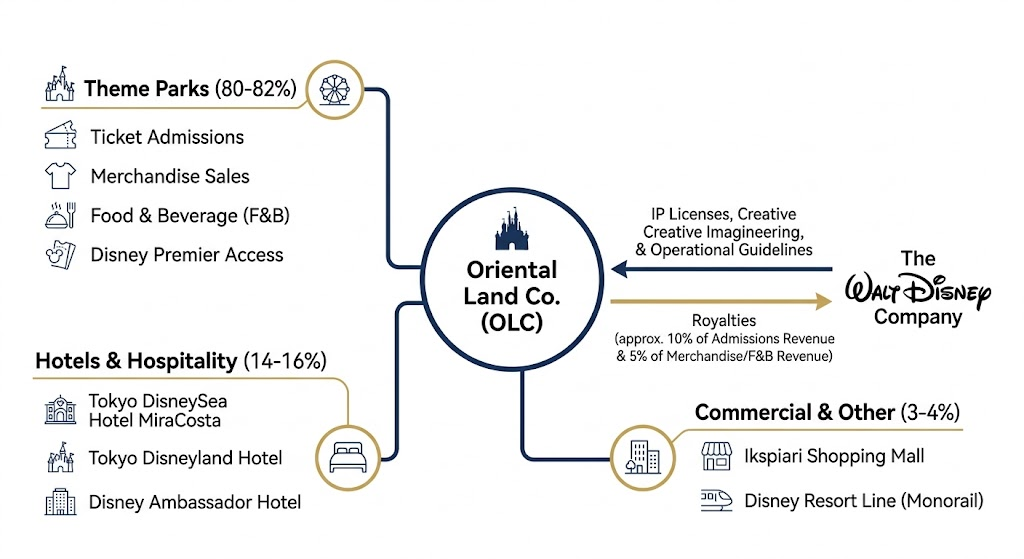
Oriental Land generates revenue through four operational pillars: Theme Parks, Hotels, Retail/Commercial Facilities, and Transportation. In the fiscal year ended March 31, 2025, consolidated net sales reached ¥679.4 billion with operating profit of ¥172.1 billion, demonstrating robust pricing power and monetization efficiency.
Theme Park Segment (Core Cash Engine)
Theme parks account for approximately 80% to 82% of total net sales. Revenue is generated across three primary channels:
- Admissions: Oriental Land utilizes variable daily pricing (ranging from ¥7,900 to ¥10,900 per adult ticket) depending on predicted demand patterns. This maximizes yields on peak weekends while shifting crowds toward off-peak weekdays.
- Merchandise: Character goods, seasonal collectibles, and souvenir sales generate high margins, supported by strict product exclusivity limited to park boundaries.
- Food & Beverage: Themed dining, quick-service counters, and seasonal snack offerings drive substantial secondary transactions throughout the guest journey.
Net Sales Per Guest Breakdown
Under its structural shift to cap daily entries, Oriental Land expanded revenue per attendee well beyond pre-pandemic benchmarks. In recent fiscal years, net sales per guest surpassed ¥16,000–¥17,000 (up from roughly ¥11,600 in FY2019), divided into:
- Ticket Receipts: ~¥7,500–¥8,000 per guest
- Merchandise: ~¥5,000–¥5,500 per guest
- Food & Beverage: ~¥3,500–¥4,000 per guest
Digital Monetization (Disney Premier Access)
Replacing the legacy free FastPass, the Tokyo Disney Resort App sells Disney Premier Access(DPA) passes for popular attractions (¥1,500 to ¥2,500 per ride) and parade viewing spaces (¥2,500 per seat). This creates high-margin, software-like ancillary revenue directly layered on top of admissions.
Hotel and Real Estate Operations
Contributing approximately 14% to 16% of revenue, the Hotel Segment commands industry-leading occupancy rates (regularly exceeding 85% to 90%) and average daily room rates exceeding ¥60,000 to ¥100,000+ per night at luxury properties like Hotel MiraCosta and Tokyo Disneyland Hotel. The Fantasy Springs Hotel provides a captive, ultra-premium revenue tier bundled directly with guaranteed park entry.
Licensing and Cost Structure Mechanics
Oriental Land bears 100% of construction, capital expenditure, and operating expenses. In exchange for intellectual property rights, characters, and Disney Imagineering design support, Oriental Land pays licensing royalties directly to The Walt Disney Company. Under the long-standing agreement, royalties are estimated at roughly 10% of park admissions and 5% of merchandise and food/beverage sales.
Growth Strategy: Value Over Volume and Business Diversification
- Per-Capita Spend Expansion: Instead of chasing 32+ million annual attendees that overload park infrastructure, management targets sustainable attendance of 26 to 29 million visitors while lifting per-guest spend via premium services, dynamic pricing, and exclusive merchandise.
- Disney Cruise Line Japan Expansion: To break out of physical land limits at Urayasu, Oriental Land committed ~¥330 billion to build and operate a licensed Disney Cruise ship homeporting in Japan. The initiative targets ¥100 billion in annual net sales and 400,000 passengers within its first few operating years (targeting FY2028–2029 deployment).
Sources for Business Model
- https://www.olc.co.jp/en/ir/achievement/revenue.html
- https://www.olc.co.jp/en/ir/achievement/anticipation.html
- https://www.olc.co.jp/en/ir/achievement.html
- https://www.olc.co.jp/en/ir/management/plan.html
- https://www.olc.co.jp/en/news/news_olc/auto_20220427529841/main/0/link/20220427_09e.pdf
Artificial Intelligence and Digital Transformation Strategy
Oriental Land approaches artificial intelligence and digital transformation(DX) not as a consumer tech feature, but as a critical operational framework to counter Japan’s severe demographic decline and domestic labor shortage while enhancing guest monetization.
Strategic Objectives and Investment Scope
Under its Medium-Term Management Plans and 2035 Long-Term Strategy, Oriental Land has integrated IT, automation, and digital enhancement directly into its capital expenditure framework, allocating tens of billions of yen toward operational DX, digital guest experiences, and systems modernization. Its corporate venture capital arm, OLC Innovation Capital, manages an expanded fund allocation (raised from ¥3 billion to ¥13 billion) to invest in early-stage startups specializing in automation, AI, robotics, and hospitality technology.
Core AI and Digital Implementation Pillars
- Dynamic Crowd Flow Modeling and Queue Management: Oriental Land leverages predictive machine learning models to forecast wait times, simulate pedestrian bottlenecks across park hubs, and optimize ride dispatches. Integrated through the Tokyo Disney Resort App, algorithmic wait-time distribution nudges foot traffic toward under-utilized attractions, merchandise shops, or quick-service restaurants in real time.
- Algorithmic Dynamic Pricing: Utilizing historical attendance figures, meteorological forecasts, regional school holiday schedules, and macroeconomic variables, Oriental Land deploys pricing optimization algorithms to set variable tiering for one-day passport tickets (ranging from ¥7,900 to ¥10,900). This dynamic yield management dampens weekend demand spikes and lifts off-peak weekday revenues.
- Mobile Ordering and Food Waste Optimization: The company expanded Disney Mobile Order across major park restaurants. The backend uses machine learning to align prep schedules with scheduled arrival windows, flattening kitchen backlogs, shortening guest wait times, reducing labor overhead, and minimizing food preparation waste.
- Computer Vision and Predictive Maintenance: To uphold Disney’s safety standards while containing maintenance costs, Oriental Land applies computer vision and vibration/sensor anomaly detection algorithms to monitor attraction mechanics, tracks, and rolling stock. Predictive diagnostics flag part wear before mechanical failures occur, reducing unscheduled ride downtimes.
- Cast Member Augmentation and Administrative Automation: Confronting acute staffing constraints, the company deploys internal generative AI tools, multilingual automated translation assistants, and robotic process automation(RPA) across administrative and back-office functions. Automated self-checkout counters, smart turnstiles, and mobile hotel check-in systems reduce manual administrative loads, enabling human staff to focus on high-touch hospitality and guest engagement.
Partnerships and Technology Ecosystem
Oriental Land collaborates closely with The Walt Disney Company’s centralized technology and Imagineering divisions to integrate global Disney digital infrastructure. Domestically, it partners with Japanese telecommunications and cloud infrastructure providers—including NTT Group and major enterprise cloud vendors—for secure edge computing, low-latency on-premise networks, and scalable customer database management.
back to Oriental Land