
Market Position and Market Share
FANUC Corporation(TYO:6954)is the preeminent global titan in factory automation, industrial robotics, and numerical controls. The company operates across four main business segments: Factory Automation(FA/CNC systems), Robot, Robomachine(Robodrill, Roboshot, Robocut), and Service.
- CNC Systems(Computerized Numerical Control):FANUC ranks #1 globally, controlling approximately 50% to 55% of the worldwide CNC market for machine tools. Its proprietary servo motors, drives, and control panels serve as the de facto global industry standard.
- Industrial Robotics:Part of the premier global “Big Four”(FANUC, ABB, Yaskawa Electric, KUKA). FANUC holds the #1 or #2 global revenue share, capturing roughly 16% to 18% of the global industrial robotics volume. By cumulative shipments, FANUC remains the global leader with over 1 million industrial robots deployed worldwide.
- Robomachine(Specialized Compact Machining Centers): FANUC is the market leader in high-speed, compact vertical machining centers(ROBODRILL), maintaining an estimated 30% to 40% global share in IT/consumer electronics enclosure manufacturing(smartphone metal casings, electronics tooling)and precision automotive parts.
- Financial Scale:Net sales reached approximately ¥857.8 billion(~$5.7 billion)with an operating profit margin around 21.4% and a debt-free equity ratio near 89%, representing the strongest balance sheet in the capital goods industry.
Supply Chain Analysis and Key Suppliers
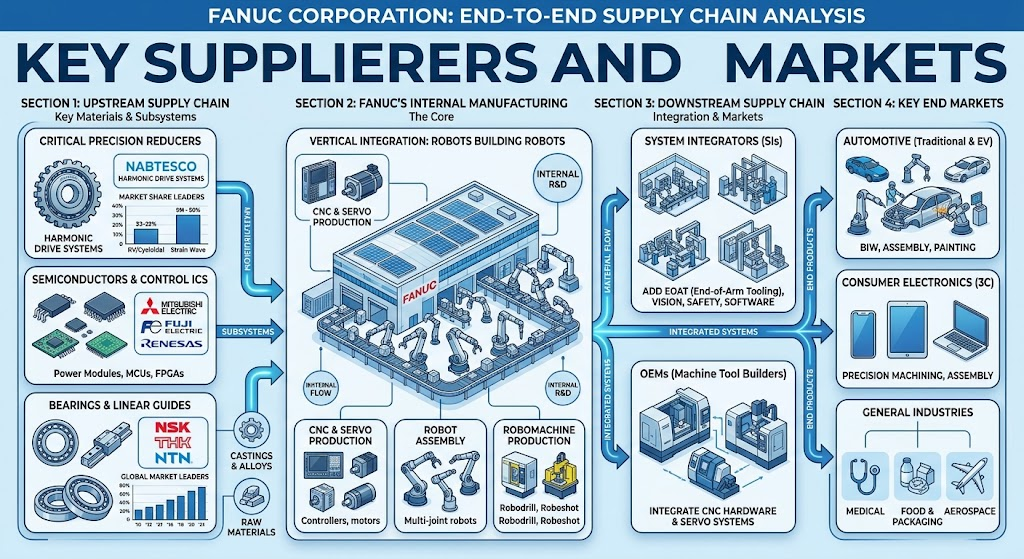
1. Upstream Supply Chain(Raw Materials and Core Subsystems)
Industrial automation hardware relies on precision metallurgy, electronic semiconductors, precision mechanical transmission components, and specialized software. FANUC maintains an exceptionally high internal production ratio for servo motors, encoders, CNC controllers, and robot frames, but depends on specialized upstream suppliers for specific hardware inputs:
- Precision Speed Reducers(Critical Mechanical Bottleneck): Industrial robots require specialized reduction gears capable of high rigidity, zero backlash, and extreme torque accuracy.
- Cycloidal Reducers: Nabtesco Corporation serves as FANUC’s primary supplier for heavy-payload RV reducers, holding approximately 60% of the world’s market for medium-to-heavy robot joint reducers.
- Strain Wave/Harmonic Gearing:Harmonic Drive Systems(HDS) supplies precision harmonic reducers used primarily in small-to-medium payload arms, wrists, and collaborative robots(cobots).
- Power Semiconductors and Control ICs: FANUC designs its own drive and controller architectures, but sources discrete semiconductor power modules(IGBTs, SiC MOSFETs)and microcontrollers/FPGAs from suppliers such as Mitsubishi Electric, Fuji Electric, Renesas Electronics, and specialized FPGA providers(e.g., AMD/Xilinx).
- Bearings and Linear Guides: High-precision rotational and linear motion components are sourced from tier-one Japanese precision manufacturers, primarily NSK Ltd., THK Co., Ltd., and NTN Corporation.
- Structural Castings and Specialty Alloys: Robot arms and machine bases require high-grade ductile cast iron and aluminum alloy frames, sourced from domestic Japanese casting foundries and certified alloy distributors.
2. Downstream Supply Chain(Integration and End Markets)
FANUC’s distribution strategy relies on direct machine tool OEM relationships, system integrators(SIs), and authorized distributor networks across North America, Europe, China, and Asia-Pacific:
- Machine Tool Builders(FA/CNC Integration): CNC hardware and software suites are sold directly to global machine tool OEMs—including DMG Mori, Okuma, Doosan Machine Tools(DN Solutions), and various Taiwanese and Chinese machine builders—who design their cutting, milling, and turning machines around FANUC controllers.
- System Integrators(SIs)and Turnkey Line Builders: For robotics, FANUC sells robot units to authorized system integrators who assemble end-of-arm tooling(EOAT), vision sensors, safety fencing, and PLCs into complete automated assembly, welding, and painting cells.
- End-Market Industries:
- Automotive(Traditional and EV): Major automotive OEMs(General Motors, Ford, Toyota, BYD)for body-in-white(BIW)spot welding, component handling, and painting.
- Consumer Electronics(3C): Contract manufacturers(Foxconn, Pegatron, Luxshare)deploying thousands of ROBODRILL and ROBOROBOT units for machining aluminum cases and micro-assembly.
- General Industries: Medical devices, food packaging, logistics material handling, plastics molding(ROBOSHOT), and aerospace die-sinking/wire cutting(ROBOCUT).
Competitor Analysis: Technical and Financial Comparison
1. Competitive Landscape
- Robotics Peers:ABB Ltd.(Switzerland/Sweden), Yaskawa Electric(Japan), KUKA AG(Germany, owned by Midea Group).
- CNC and Motion Peers: Siemens AG(Germany), Mitsubishi Electric(Japan), Heidenhain(Germany).
2. Technical Comparison
- FANUC vs. Siemens(CNC): FANUC dominates high-volume production turning, milling, and 3C manufacturing due to unmatched reliability, MTBF(mean time between failures), and ease of programming(G-code compatibility). Siemens(Sinumerik)leads in ultra-high-end 5-axis aerospace machining, complex mold manufacturing, and tight integration with enterprise PLM software(Siemens NX/Teamcenter).
- FANUC vs. Yaskawa(Motion and Mechatronics): Both utilize proprietary servo motors and drives. Yaskawa holds an edge in motion control algorithms and arc welding applications(Motoman robots), while FANUC dominates automotive spot welding, material handling, and vision-guided pick-and-place robotics with its proprietary iRVision integrated system.
- FANUC vs. ABB(Robotics and Software): ABB excels in complex process automation, robotic painting, foundry environments, and modular software simulation(RobotStudio). However, FANUC’s vertically integrated hardware approach delivers superior mechanical durability, lifetime spare-parts availability(“Service First” policy), and higher standardized modularity across factories.
- FANUC vs. KUKA(Automotive and Architecture): KUKA holds heavy market share among European automotive OEMs(Volkswagen, BMW, Mercedes-Benz)utilizing a PC-based control architecture. In contrast, FANUC uses proprietary dedicated ASIC hardware controllers, resulting in boot times measured in seconds, virtual immunity to Windows-based cyber vulnerabilities, and significantly lower field failure rates.
3. Financial Comparison
| Metric / Financial Attribute | FANUC Corporation(Japan) | ABB Ltd.(Robotics & Discrete Auto) | Yaskawa Electric(Japan) | KUKA AG(Midea Group) |
| Gross Margin Profile | High(38% – 42%) | Moderate-High(35% – 37%) | Moderate(30% – 33%) | Lower(22% – 26%) |
| Operating Margin(OPM) | 20% – 22%(Industry Benchmark) | 12% – 15%(Segment Level) | 9% – 12% | 4% – 6% |
| Balance Sheet Structure | Virtually Zero Debt; >¥600B Net Cash | Moderate leverage(Industrial conglomerate) | Conservative leverage; low net debt | Backed by Midea Group balance sheet |
| Return on Equity(ROE) | ~8% – 12%(Depressed by large cash hoard) | ~18% – 22%(Higher capital efficiency) | ~9% – 11% | ~6% – 8% |
| Capital Intensity / CapEx | High(Self-funded automated domestic plants) | Moderate(Global assembly footprint) | Moderate(Multi-hub assembly) | Moderate |
- Financial Summary: FANUC exhibits structurally superior operating margins due to its extreme production automation—its headquarters and factories at the base of Mt. Fuji utilize its own robots to build robots 24/7 in lights-out manufacturing environments. Its balance sheet is one of the most fortress-like in Asia, holding zero bank borrowings and massive cash reserves. In contrast, European peers like ABB operate with higher asset turnover and aggressive capital return programs, yielding higher ROE despite lower structural hardware gross margins.
Sources
- https://www.fanuc.co.jp/en/profile/ir/
- https://umbrex.com/resources/company-profiles/fanuc-corp/
- https://envalith.com/en/companies/6954/segments
- https://www.fool.com/research/largest-robotics-companies/
- https://www.nabtesco.com/en/products/robot/
back to Fanuc