
Corporate History
Origins and Incubation(1956–1972)
Fanuc began in 1956 as a numerical control development unit inside Fujitsu Limited, led by Dr. Seiuemon Inaba. In 1972, the unit was spun off as Fujitsu Fanuc Ltd. to commercialize NC servo systems and pulse motors for machine tool builders across Japan.
Global Expansion and Robotics Diversification(1973–1999)
The company rebranded as Fanuc Ltd. in 1982 and terminated joint ventures with Siemens to build independent global distribution. It expanded aggressively into industrial robotics, forming the GMFanuc joint venture with General Motors in 1982 to automate automotive assembly lines, eventually buying out GM’s stake in 1992 to solidify global direct operations.
High-Margin Specialization and Electronic Proliferation(2000–2019)
During the 2000s and 2010s, Fanuc capitalized on consumer electronics expansion. Its Robodrill machining centers became the primary tool used by contract manufacturers to mill smartphone metal unibody enclosures. It established its iconic all-yellow corporate branding, expanded production at its Mount Fuji headquarters, and maintained lifetime customer service support.
Autonomous Factory Era and Physical AI Integration(2020–Present)
Facing competitive inroads from local Chinese automation vendors, Fanuc initiated modernization across its product lines. It deployed the FIELD system(Fanuc Intelligent Edge Link and Drive), accelerated collaborative robot(CRX series) production, and expanded strategic tie-ups with advanced software and semiconductor firms to embed edge inference and digital twin simulation directly into industrial robotics workflows.
Business Model and Strategic Monetization
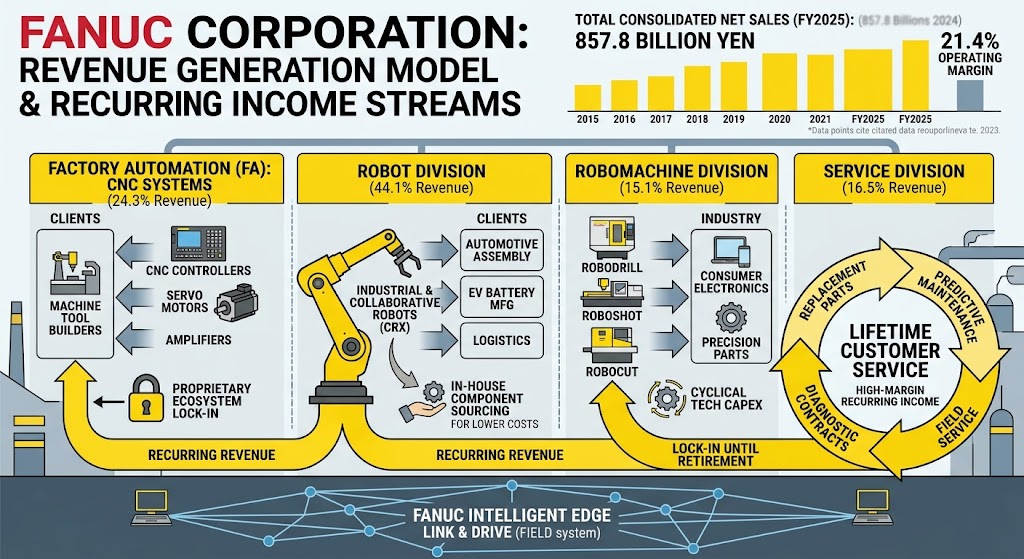
Fanuc generates revenue through hardware sales, proprietary firmware licensing, integrated machining systems, and recurring aftermarket services. In fiscal year 2025(ended March 31, 2026), Fanuc generated 857.8 billion yen in consolidated net sales with an operating income of 183.8 billion yen, delivering an operating margin of 21.4%. The company monetizes across four core divisions:
- Robot Division(44.1% of FY2025 Net Sales / 378.6 billion yen): Sells articulate industrial and collaborative robots to automotive, EV battery, logistics, and electronics manufacturers. High margins are sustained through internal parts sourcing(in-house servomotors and sensors) and extensive factory automation in Yamanashi.
- Factory Automation Division(24.3% of FY2025 Net Sales / 208.5 billion yen): Sells CNC systems, servo motors, amplifiers, and laser oscillators to machine tool builders. Fanuc locks machine builders into its proprietary hardware-software ecosystem; switching away requires redesigning entire machine control panels.
- Service Division(16.5% of FY2025 Net Sales / 141.1 billion yen): High-margin recurring revenue derived from replacement parts, diagnostic contracts, and lifetime maintenance. Fanuc commits to providing service and spare parts for as long as a customer uses its machines, ensuring long-term aftermarket cash flow even during cyclical downturns.
- Robomachine Division(15.1% of FY2025 Net Sales / 129.6 billion yen): Sells compact machining centers(Robodrill), electric injection molding machines(Roboshot), and wire-cut electrical discharge machines(Robocut). While subject to volatile tech capex cycles, this division provides high-volume, premium cash generation during device form-factor transitions.
Strategic development focuses on the “Reliable, Predictable, Easy to Use” doctrine, expanding collaborative robotics(CRX series) to address small and medium enterprise labor shortages, and keeping core manufacturing concentrated in Japan to protect intellectual property.
Business Model Information Sources
- https://www.fanuc.co.jp/en/ir/announce/pdf/2026/financialresult202603_e.pdf
- https://www.fanuc.co.jp/en/ir/announce/pdf/2026/reference202603_e.pdf
- https://www.tradingview.com/symbols/TSE-6954/financials-segments/
AI Strategy, Budget, and Key Collaborations
Fanuc approaches artificial intelligence as an operational, edge-computing feature rather than an abstract cloud service, focusing on “Physical AI” to minimize assembly line downtime and eliminate manual robot teaching.
Strategic Focus
- Zero Down Time(ZDT): Embedded machine learning models monitor sensor vibration, current spikes, and thermal anomalies in robotic joints and servo drives to schedule predictive maintenance before mechanical failure occurs.
- Autonomous Bin Picking and Visual Recognition: Deep learning models integrated into Fanuc 3D vision sensors allow robots to detect, sort, and grasp randomly piled, unoriented parts in unstructured warehouse and factory setups.
- Digital Twins and Real-to-Sim Translation: Replicating physical robot kinematic software inside virtual simulation environments to program and validate manufacturing cells without stopping real production lines.
R&D Budget
Fanuc maintains an R&D budget typically exceeding 50 to 60 billion yen annually(representing approximately 6% to 8% of consolidated net sales), with an increasing portion diverted to industrial AI, software architectures, edge inference controllers, and sensor processing algorithms.
Key Partners and Investments
- NVIDIA: In early 2026, Fanuc deepened its strategic alliance with NVIDIA to accelerate physical AI deployment. Fanuc integrated its proprietary ROBOGUIDE simulation engine with the NVIDIA Omniverse and Isaac Sim platforms, publishing digital twins of its industrial robot line as OpenUSD SimReady assets. Robot vision compute leverages NVIDIA Jetson edge systems for real-time path replanning.
- Preferred Networks(PFN): Fanuc took an equity stake in leading Japanese AI firm Preferred Networks(investing over 900 million yen originally and maintaining an active shareholding) to jointly develop reinforcement learning algorithms. This collaboration enabled industrial robots to learn complex bin-picking tasks autonomously through repeated physical trial and error without manual kinematic code.
- Cisco Systems and Rockwell Automation: Long-term architectural partners for the FIELD system platform and industrial edge networking, providing cybersecurity protocols and industrial Ethernet infrastructures to transmit real-time telemetry from CNC controllers to plant-level AI inference engines.
back to Fanuc