
Corporate History
Founding and Ferrite Pioneer(1935–1950s)
TDK was established in 1935 as Tokyo Denki Kagaku Kogyo K.K. by Kenzo Saito and Yogoro Kato to commercialize ferrite, a magnetic material invented at the Tokyo Institute of Technology. During World War II and the immediate postwar reconstruction, ferrite cores were deployed in military radios, civilian telecommunication equipment, and early consumer radio sets.
Consumer Audio and Global Magnetic Media Expansion(1960s–1990s)
In 1968, TDK pioneered high-fidelity cassette tape technology with the release of the “SD” compact cassette, propelling the brand into a household name worldwide. Throughout the 1970s and 1980s, the company dominated cassette tapes, VHS videotapes, and floppy disks, while simultaneously building passive component lines(capacitors and inductors) for televisions and personal computers.
Transition to Digital Hard Disk Drives and Strategic Restructuring(2000s)
As magnetic tape media faced obsolescence due to flash memory and digital streaming, TDK pivoted heavily toward magnetic recording heads for hard disk drives(HDDs). In 2005, TDK executed a transformative acquisition by purchasing Hong Kong-based Amperex Technology Limited(ATL) for approximately $100 million, laying the foundation for its lithium-ion polymer pouch battery dominance. In 2008, it expanded passive component offerings by acquiring Germany’s EPCOS AG for €1.2 billion.
Sensor Diversification and AI/Mobility Pivot(2010s–Present)
To diversify away from slowing smartphone unit growth, TDK acquired MEMS motion-sensor leader InvenSense for $1.3 billion in 2017. Under its ongoing Medium-Term Management Plans, TDK has shifted capital intensity toward energy transformation(EX) and digital transformation(DX), positioning itself in electric vehicle power management, edge-AI sensor modules, all-solid-state micro-batteries, and AI data center power delivery systems.
Business Model and Strategic Monetization
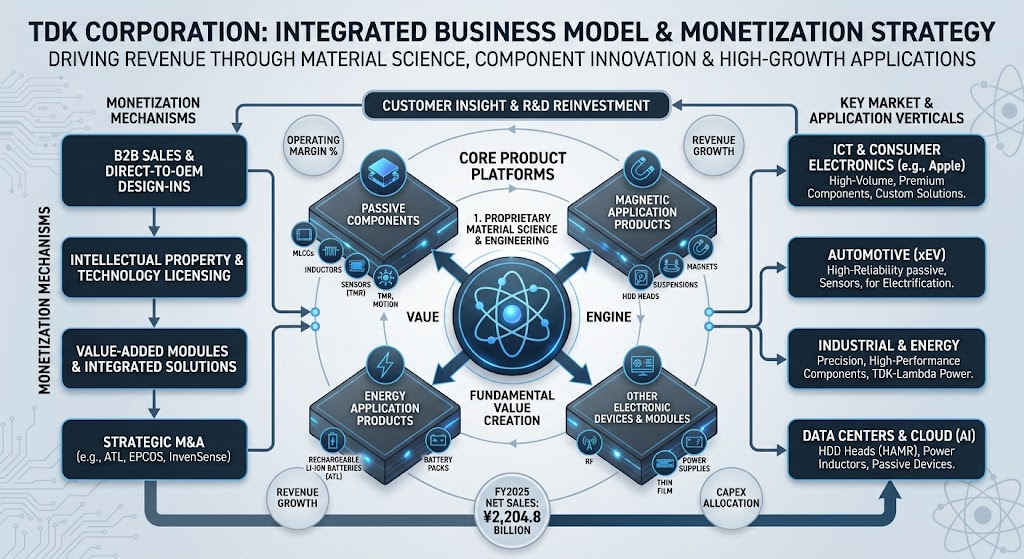
TDK generates revenue through the high-volume precision manufacturing and direct B2B sale of core materials, electro-mechanical sub-assemblies, and power units. For FY March 2025, TDK achieved net sales of ¥2,204.8 billion and an operating profit of ¥224.2 billion(an operating profit margin of 10.2%). The company monetizes across four primary business segments:
- Energy Application Products(53.4% of net sales, ¥1,176.5 billion in FY2025): The principal profit driver. Through ATL, TDK sells custom-engineered lithium-ion polymer batteries to tier-1 smartphone OEMs, tablet makers, and notebook manufacturers. It earns high gross margins on proprietary chemistries, high energy densities, and fast-charging silicon-carbon anode formulations, while expanding industrial power supply systems(TDK-Lambda).
- Passive Components(25.4% of net sales, ¥559.6 billion in FY2025): Produces multilayer ceramic capacitors(MLCCs), inductors, aluminum electrolytic capacitors, and piezoceramic actuators. Revenue is captured by securing design-ins on high-margin automotive platforms(xEV powertrains, ADAS) and industrial machinery, offsetting commodity pricing volatility in basic ICT components.
- Magnetic Application Products(10.5%–11% of net sales): Primarily high-precision HDD magnetic recording heads and suspension assemblies sold to enterprise storage leaders(Western Digital, Seagate). The business model monetizes server storage expansion via Heat-Assisted Magnetic Recording(HAMR) heads, capturing higher ASPs per drive as enterprise hyperscalers build out nearline capacity.
- Sensor Application Products(8.6% of net sales, ¥189.5 billion in FY2025): Supplies 6-axis MEMS inertial sensors, magnetic TMR angle sensors, pressure sensors, and microphones to automotive, mobile, and industrial markets. Monetization centers on integrated sensor-software packages and edge-processing sensor hubs that carry superior margins compared to standalone silicon dies.
Strategically, TDK leverages a “Ferrite Tree” operational model: taking fundamental proprietary materials science(magnetic ferrite, dielectric ceramics, lithium compounds), scaling process engineering, and expanding downstream applications through disciplined M&A to secure sole-source or dual-source supplier status with top global hardware OEMs.
Information Sources
- https://www.tdk.com/en/ir/ir_library/annual/index.html
- https://www.tdk.com/system/files/integrated_report_pdf_2025_en.pdf
- https://www.tdk.com/en/ir/individual_investors/index.html
- https://www.tdk.com/en/ir/tdk_management_policy/policy/index.html
AI Strategy, Capital Budget, and Industry Partnerships
TDK approaches artificial intelligence on two distinct fronts: providing the specialized physical hardware infrastructure required by AI hyperscalers and integrating edge-AI capability directly onto sensor silicon.
Targeted AI Revenue and Growth Runway
AI-related revenue accounted for just over 10% of total group sales in FY2025. Management has guided for a 25%–30% compound annual growth rate(CAGR) in AI-driven hardware demand through FY2031, aiming for AI systems to generate substantial corporate cash flows.
AI Data Center and Server Power Architectures
High-performance AI clusters(e.g., Nvidia GB200/B200 GPU platforms) face severe thermal and voltage-drop constraints under 1,000W+ per-chip TDP demands. TDK monetizes this by delivering ultra-low DC resistance power inductors(such as the VLBUC and ERUC series) and thin-profile MLCCs placed directly adjacent to server accelerator substrates to smooth transient power spikes. In optical transceiver interconnects (800G and 1.6T modules), TDK supplies wire-bonding NTC thermistors, thin-film capacitors, and compact power inductors. For rack-level power, TDK-Lambda develops solid-state transformer(SST) power conversion and uninterruptible power supply(UPS) backup modules.
Edge AI Sensing and Smart AR Wearables
Through its subsidiary TDK SensEI, TDK commercialized the “edge RX” predictive maintenance system, packaging vibration sensors with onboard edge-AI anomaly detection algorithms to process machine health locally without cloud latency. For multimodal generative AI wearables, TDK acquired San Diego-based smart glasses software/AI specialist SoftEye in June 2025 to combine with its ultra-compact Full-Color Laser Module(FCLM), MEMS microphones, and CeraCharge ceramic solid-state micro-batteries.
Capital Expenditure, R&D Budget, and CVC Alliances
Under its Medium-Term Management Plan, TDK directs annual R&D expenditures at approximately 8.5%–9.0% of net sales(amounting to ¥201.0 billion in FY2025) and allocates annual CapEx exceeding ¥200 billion toward next-generation battery chemistry, ceramic substrates, and cleanroom automation. Through its corporate venture arm, TDK Ventures, the company operates a multi-fund structure backed by over $350 million in managed capital. TDK Ventures has executed strategic equity investments in more than 45 deep-tech and AI startups, co-investing alongside entities like NEA, Lightspeed, and Intel Capital in compute hardware, robotic autonomy, clean tech, and advanced material platforms.
back to TDK