
Market Position & Market Share
Resona Holdings, Inc.(TYO:8308)is Japan’s 4th largest commercial banking group by asset size, ranking immediately behind the three Japanese “megabanks”(Mitsubishi UFJ Financial Group, Sumitomo Mitsui Financial Group, and Mizuho Financial Group). In broader industry tables that incorporate public deposit gatherers like Japan Post Bank and dedicated trust groups such as Sumitomo Mitsui Trust Holdings, Resona ranks 5th to 6th nationwide. It holds consolidated total assets of approximately ¥76 trillion to ¥77 trillion, a deposit base of ¥63.7 trillion, and a total loan balance exceeding ¥44 trillion.
Unlike the global-scale megabanks, Resona operates primarily as a domestic “super-regional” bank with a dual-hub presence centered in Japan’s two largest metropolitan economic zones: the Greater Tokyo area and the Kansai region.
- Saitama Prefecture Dominance: Operating through subsidiary Saitama Resona Bank, Resona holds an effective regional monopoly with an estimated ~40% to ~45% market share in local bank deposits and loans, serving as the designated financial institution for Saitama prefectural and municipal authorities.
- Kansai & Osaka Foothold: Through Resona Bank, Kansai Mirai Bank, and Minato Bank(Hyogo Prefecture), the group controls roughly ~15% to ~20% of the regional deposit and lending market in Kansai, ranking 1st among regional bank institutions in Osaka and Hyogo.
- Main Bank Market Share:Across corporate Japan, approximately 69,000 companies designate a Resona group bank as their primary financial partner(“main bank”), ranking the group 3rd nationally and surpassing several megabank operating units in domestic corporate coverage count.
- Retail & Trust Capabilities:Resona is unique among Japanese city banks in having retained full commercial trust banking capabilities within its main banking unit(originating from Daiwa Bank).Retail lending to individuals and small-to-medium enterprises(SMEs)accounts for approximately 80% of its overall loan portfolio.
Upstream & Downstream Supply Chain Analysis
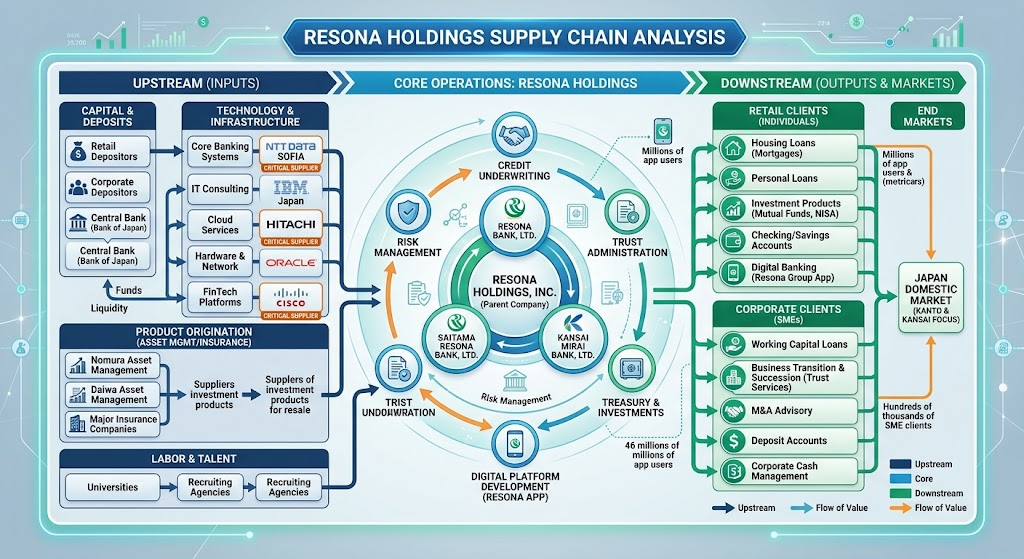
In banking and financial services, the supply chain is defined by capital procurement, technology/infrastructure sourcing, transaction settlement, and product delivery to end-borrowers and wealth management clients.
Upstream Capital & IT Infrastructure
  ├── Capital Providers (Retail Savers, Corporate Treasuries, BOJ Liquidity Facilities)
  └── Technology & Sourcing (NTT DATA Core Systems, IBM, FinTech API Platforms)
          │
          ▼
Resona Holdings (Core Processing & Underwriting Engine)
  ├── Credit Underwriting, Trust Administration & Treasury Asset Allocation
  └── Multi-Entity Network: Resona Bank, Saitama Resona, Kansai Mirai, Minato Bank
          │
          ▼
Downstream Channels & End Clients
  ├── Retail Clients (16M Customers: Mortgages, Installment Loans, App Ecosystem)
  └── Corporate Clients (500K SMEs/Corporates: Working Capital, Trust, Succession Planning)
Upstream Dynamics & Key Vendors
- Capital & Deposit Procurement:The primary “raw material” of Resona’s operating model is its retail deposit network across 16 million retail individual customers and 500,000 corporate clients. With Japanese domestic interest rates normalizing away from zero, low-cost “sticky” retail checking and savings accounts provide Resona with a relatively low funding cost compared to wholesale-funded peers. Secondary upstream funding includes central bank refinancing lines via the Bank of Japan(BOJ)and repo/call-money market liquidity.
- Core Banking IT & System Integration Vendors: Resona’s mission-critical transaction and core accounting systems are co-developed and maintained primarily through joint venture structures with NTT DATA via NTT DATA SOFIA Corporation. NTT DATA provides core banking software engines, account transaction platforms, and open API connectivity.
- Cloud & Workplace Infrastructure: Enterprise hardware and hybrid cloud environments are primarily sourced from IBM Japan and Hitachi, alongside global hyperscalers(Microsoft Azure and AWS)for non-core analytic workloads and digital client applications.
- Investment & Trust Product Sourcing: Upstream asset origination for resale includes asset management firms, ETF providers(e.g., Nomura AM, Daiwa AM), and life/property casualty insurers whose mutual funds and annuity products are distributed across Resona branches.
Downstream Distribution & Value Realization
- Omnichannel Branch & Platform Delivery:Resona reaches downstream consumers via physical branch networks across Kanto and Kansai, paired with its proprietary Resona Group App, which boasts over 3.4 million active users and debit accounts. Resona differentiates itself domestically by operating branches until 5:00 PM(compared to the traditional 3:00 PM Japanese banking cutoff).
- Retail Credit & Housing: Downstream retail assets are predominantly allocated into residential mortgages and personal unsecured loans in high-density urban corridors.
- SME & Business Transition Solutions: Resona deploys credit to small-and-medium businesses via structured working capital loans and asset-based lending, capturing downstream fee income by offering M&A advisory, corporate restructuring, and business succession trust services to graying Japanese business founders.
Competitor Analysis
Resona is evaluated against two tiers of competitors: the Japanese Megabanks(e.g., MUFG, SMBC, Mizuho)and the top Super-Regional Financial Groups(e.g., Concordia Financial Group, Mebuki Financial Group).
| Dimension / Metric | Resona Holdings(TYO:8308) | Megabanks(MUFG / SMBC) | Top Regional Banks(e.g., Concordia FG) |
| Domestic Asset Scale | ~¥76T–¥77T(4th nationwide) | ¥250T–¥400T+(Global G-SIBs) | ¥15T–¥25T(Leading Regional) |
| Retail/SME Exposure | ~80% of total loans | ~45%–55%(heavy global corporate) | ~75%–85%(localized regional) |
| Overseas Presence | Selective(13 Asian/US hubs; ~1%–3% rev) | Extensive global branch networks(30%–45% rev) | Virtually negligible domestic-only |
| ROE Target / Actual | ~10.6% actual / aiming for 12%–14% | ~9.0%–11.0% | ~6.5%–8.5% |
| CET1 Capital Ratio | ~10.1%(Domestic Standard focus) | 10.5%–11.5%(Fully loaded Basel III) | 9.5%–11.0% |
| Trust Banking License | Integrated directly into commercial bank | Separate trust banking entities | Absent or partnered externally |
Financial Comparison & Sensitivity
- Leverage to Rising Domestic Interest Rates:Resona holds the highest operational earnings leverage to Bank of Japan rate hikes among major banks.Because approximately 95% of its balance sheet is focused within Japan—with roughly 80% concentrated in retail and SME floating-rate loans funded by zero-to-low-cost retail deposits—net interest margin(NIM)widening flows directly to pre-provision operating profit without the foreign currency bond losses or offshore dollar funding stress that periodically impact MUFG or SMBC.
- Capital Efficiency:Resona generated an equity ROE of approximately 10.6% in FY2025, forecasting mid-cycle ROE targets between 12% and 14% as short-term policy rates approach 1.0%–1.5%. This places its capital returns close to top megabanks, while comfortably outperforming single-prefecture regional banks(which often hover between 5% and 8% ROE).
- Credit Quality & Cost of Risk: Resona maintains lower non-performing loan ratios than fragmented regional lenders due to stricter urban underwriting and a higher mix of secured residential collateral. However, it lacks the counter-cyclical syndicated fee income and foreign exchange trading revenues commanded by global megabanks.
Technological & Strategic Comparison
- Branch & Digital Transformation(DX): While megabanks like SMBC have heavily focused on aggressive app redesigns and global corporate cash management portals, Resona pioneered retail digital branch workflows in Japan. It replaced legacy paper-based seal(hanko)verification and signature slips with paperless tablet counter solutions, reducing back-office counter administrative hours by more than 30%.
- Trust & Commercial Hybrid Architecture: Unlike competitors that split their businesses across separate commercial banks and trust banking units(such as MUFG Bank vs. Mitsubishi UFJ Trust and Banking), Resona operates an integrated trust-commercial banking model. This allows loan officers in standard branches to directly propose inheritance trusts, estate planning, and real estate asset disposition without cross-entity regulatory friction.
Information Sources
- https://www.resona-gr.co.jp/holdings/english/about/glance/index.html
- https://www.resona-gr.co.jp/holdings/english/investors/ir/presentation/pdf/20260527_2a.pdf
- https://www.resona-gr.co.jp/holdings/english/investors/stock/meeting/pdf/report20260528.pdf
- https://www.resona-gr.co.jp/holdings/english/investors/financial/results_c/download_c/files/20260731_3a.pdf
- https://www.federalreserve.gov/newsevents/pressreleases/files/orders20240722a1.pdf
- https://www.morningstar.com/stocks/xtks/8308/quote
- https://www.forbes.com/companies/resona-holdings/
- https://www.nttdata.com/global/en/-/media/nttdataglobal/1_files/investors/stock-information/2023/business-report.pdf
back to Resona