
Market Position and Market Share
Toyota Industries Corporation(TICO) holds global leadership across several core business segments, primarily in materials handling equipment and automotive components.
- Materials Handling Equipment(Forklifts):Ranked No. 1 globally for over two decades. TICO commands approximately 26.8% to 28% of the global forklift and lift-truck market, maintaining a significant lead over secondary players such as KION Group(approx. 14.6%) and Jungheinrich(approx. 9.3%). Its position is reinforced through flagship brands including Toyota Material Handling, BT, Raymond, and system integrators like Bastian Solutions and Vanderlande.
- Car Air Conditioning Compressors:Ranked No. 1 globally. TICO captures roughly 40% to 45% of the worldwide automotive air conditioning compressor market, driven by its proprietary fixed-displacement, variable-displacement, and electric compressors deployed across hybrid and electric vehicles globally.
- Textile Machinery: Ranked among the top global manufacturers of air-jet looms and electronic yarn clearers, maintaining a commanding market share in specialized textile automation equipment.
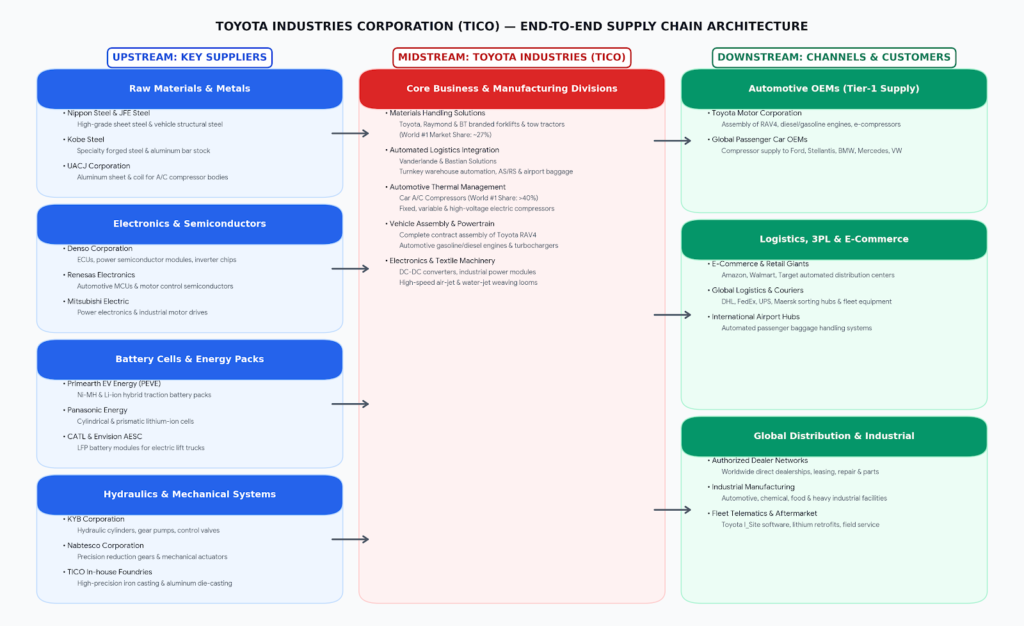
Upstream and Downstream Supply Chain Analysis
Toyota Industries operates as both a critical Tier-1/contract manufacturing cornerstone within the broader Toyota Group Keiretsu and an independent global industrial equipment OEM.
- Upstream(Raw Materials and Core Subsystems):
- Raw Materials: Relies on high-grade automotive sheet steel, forged structural components, and aluminum alloys for casting compressor housings, counterweights, and vehicle chassis. Key suppliers include Nippon Steel, JFE Steel, and Kobe Steel.
- Electronics, Inverters, and Motor Systems: High-voltage electronic drive units, power modules, and sensors are procured from internal Toyota Group partners and external specialists, including Denso Corporation and Renesas Electronics.
- Battery Cells and Packs: For electric lift trucks and vehicle assembly, cells and power packs are sourced primarily from Primearth EV Energy(PEVE), Panasonic Holdings, and CATL.
- Hydraulics and Mechanical Components: Precision hydraulic valves, pumps, and lift cylinders are supplied by specialized hydraulic manufacturers such as KYB Corporation alongside in-house precision casting facilities.
- Downstream(Integration, Distribution, and Customers):
- Automotive Segment: Downstream channels are anchored by long-term contract manufacturing and Tier-1 supply agreements with Toyota Motor Corporation(for complete vehicle assembly such as RAV4, internal combustion engines, and turbochargers) as well as global automotive OEMs(such as Stellantis, Ford, and BMW) for thermal management compressors.
- Materials Handling and Logistics Automation: Distributed downstream through an extensive global dealership network across North America, Europe, Asia, and Japan. End customers include major global logistics providers(DHL, FedEx), e-commerce fulfillment hubs(Amazon, Walmart), third-party logistics(3PLs), industrial manufacturing plants, and cold-chain facilities.
Competitor Analysis: Technical and Financial Perspectives
TICO faces stiff competition across distinct operating segments: KION Group and Jungheinrich in materials handling, and Denso and Hanon Systems in automotive thermal components.
- Technical Comparison:
- Materials Handling(TICO vs. KION vs. Jungheinrich): TICO’s technical edge stems from the Toyota Production System(TPS), delivering high mechanical durability, low total cost of ownership(TCO), and modular fleet serviceability. TICO expanded into end-to-end warehouse automation via acquisitions of Vanderlande and Bastian Solutions. However, Germany’s KION Group(via Dematic) and Jungheinrich maintain a slight edge in complex European warehouse automated guided vehicles(AGVs) and proprietary warehouse management software(WMS). In battery tech, TICO has transitioned rapidly to proprietary lithium-ion systems, matching Jungheinrich’s pioneering lithium-integrated chassis designs.
- Automotive Compressors(TICO vs. Denso vs. Hanon Systems): In electric compressors(e-compressors) for high-voltage BEVs and PHEVs, TICO excels in noise, vibration, and harshness(NVH) mitigation, scroll compressor volumetric efficiency, and thermal pump integration. Hanon Systems and Denso compete closely with integrated thermal management modules, whereas TICO’s advantage lies in high-volume, low-cost precision casting and scale.
- Financial Comparison:
- Revenue Scale: TICO generates roughly $25B–$28B+ in annual consolidated revenues, outpacing pure-play materials handling competitors like KION Group(~$12.5B–$13B) and Jungheinrich(~$5.5B–$6B).
- Profitability and Margins: TICO historically maintains operating margins between 5% and 7%, buoyed by resilient parts and aftermarket service revenues in its lift truck division. In contrast, European peers like KION have exhibited higher margin volatility during inflationary periods due to fixed-price turnkey automation project risks within their supply chain solutions units.
- Balance Sheet and Asset Strength: TICO holds substantial cross-shareholdings(notably a large equity stake in Toyota Motor Corporation and Denso), providing exceptional liquidity, high credit ratings(A/Aa grade), and conservative debt-to-equity ratios compared to the more leveraged capital structures of private-equity-influenced European industrial peers.
Sources
- https://toyotaliftne.com/blog-2/toyota-remains-the-number-one-forklift-in-the-world/
- https://www.gminsights.com/industry-analysis/automotive-ac-compressor-market
- https://www.zionmarketresearch.com/report/automotive-ac-compressor-market
- https://www.globaldata.com/company-profile/toyota-industries-corp/competitors/
- https://www.globaldata.com/company-profile/jungheinrich-ag/competitors/
- https://www.makesureiknowit.com/company/toyota-motor
back to Toyota Industries