
Market Position and Market Share
NEC Corporation (TYO: 6701) is a Japanese multinational information technology and electronics conglomerate headquartered in Tokyo. The company has transitioned from a traditional hardware electronics manufacturer into a provider focused on IT services, social infrastructure, digital identity, and telecommunications networks.
IT Services and Digital Transformation (Domestic Japan)
- Market Position:NEC ranks as the #2 to #3 IT services and system integration provider in Japan, competing directly against NTT DATA and Fujitsu.
- Market Share:In Japan’s IT services market (valued at approximately $67B–$75B), NEC commands an estimated 10%–12% market share (market share is estimated based on domestic segment revenues). It holds the dominant market position in Japanese public sector IT systems, government digital ID infrastructure (including the facial recognition backbone for the My Number system, covering over 90 million registrants), local government digitalization, and police/defense intelligence systems.
Submarine Cable Systems
- Market Position: Top 3 global supplier. The global subsea optical cable industry operates as an oligopoly dominated by three vendors: SubCom (USA), Alcatel Submarine Networks (ASN, France), and NEC Corporation (Japan).
- Market Share: NEC holds approximately 25%–30% of the global optical submarine cable transmission market (with over 400,000 km of subsea cable laid historically, particularly dominant across Trans-Pacific and intra-Asia-Pacific routes).
Biometric Identification and Computer Vision AI
- Market Position:Global #1 in algorithmic accuracy and evaluation standards.
- Market Share & Benchmarks: NEC’s facial recognition algorithm (NeoFace) has repeatedly ranked #1 in multiple benchmark evaluations conducted by the U.S. National Institute of Standards and Technology (NIST), including the Face Recognition Technology Evaluation (FRTE) 1:N search tests. In commercial automated fingerprint and facial recognition systems for law enforcement and border control (such as U.S. Customs and Border Protection and international airports), NEC holds an estimated 15%–20% global market share in high-accuracy government-grade deployments (estimated based on tier-one aviation and public safety deployments).
Telecommunications Networks (Open RAN and 5G)
- Market Position:Niche pioneer in Open RAN (Open Radio Access Network) and 5G Massive MIMO Radio Units (RUs).
- Market Share: In the overall global RAN market, NEC holds roughly 2%–3% share, trailing legacy end-to-end vendors (Huawei, Ericsson, Nokia, ZTE). However, within the emerging Open vRAN and disaggregated radio hardware niche, NEC has secured key commercial rollouts with NTT Docomo, Rakuten Mobile, Telefónica, and Vodafone.
Supply Chain Analysis and Key Suppliers
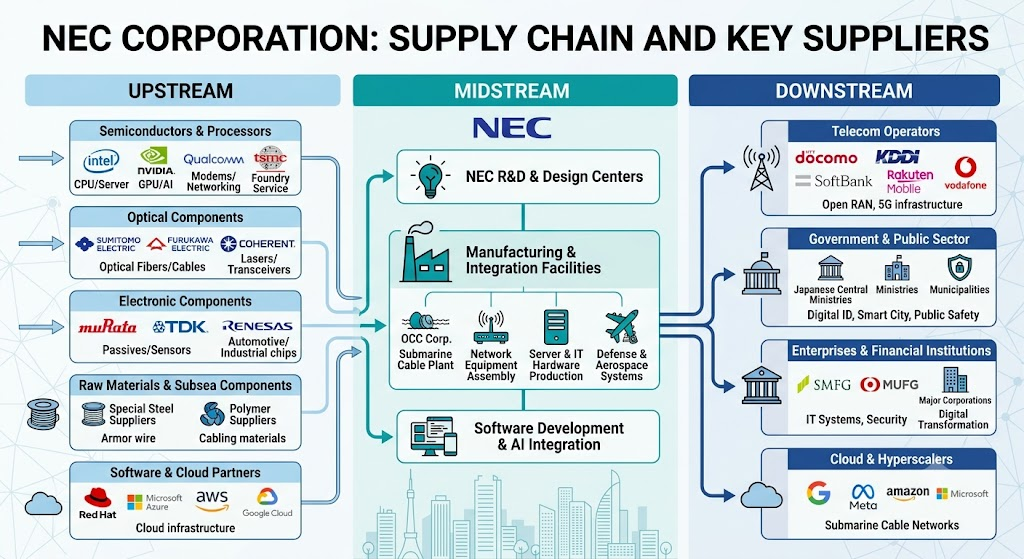
NEC operates across complex hardware manufacturing and software-driven systems integration, dividing its supply chain into distinct upstream component procurement, manufacturing integration, and downstream enterprise deployment.
Upstream Supply Chain
- Semiconductor and Processing Units: NEC relies on global semiconductor vendors for its servers, network appliances, and aerospace/defense systems. Key suppliers include:
- Compute and AI Processors: Intel and AMD (x86 server processors), NVIDIA (GPUs for NEC’s supercomputing clusters and generative AI development), and Qualcomm (specialized modems and processing silicon).
- Custom Silicon and Foundries: TSMC (contract manufacturing for NEC’s proprietary ASICs used in optical transmission and subsea cable repeaters) and Renesas Electronics (automotive and industrial microcontrollers).
- Optical Fibers and Physical Materials: For its submarine cable manufacturing (executed through its subsidiary OCC Corporation):
- Optical Fiber Cores: Sumitomo Electric Industries, Furukawa Electric, and Corning Inc. provide ultra-low-loss single-mode and multi-core optical fibers.
- Specialized Polymers and Steels: High-tensile galvanized steel wires, copper tubes, and high-density polyethylene (HDPE) compounds sourced from Japanese and global metallurgical suppliers to withstand deep-sea hydrostatic pressures down to 8,000 meters.
- Software and Cloud Platform Partners: Red Hat (Linux OS and OpenShift container engines used in NEC’s Open RAN software stack), Microsoft Azure, Amazon Web Services (AWS), and Google Cloud (for hybrid enterprise solutions and public-sector cloud migration).
Midstream Operations and Manufacturing
- NEC designs, integrates, and tests its equipment across domestic specialized plants:
- Subsea cables are manufactured at the OCC Corporation Kitakyushu facility (which features dedicated deep-water quayside facilities allowing direct spooling onto cable-laying ships).
- Defense radar, satellite payloads, and aerospace components are assembled at facilities in Fuchu, Sagamihara, and Tamagawa.
- IT hardware production has largely shifted toward outsourced contract manufacturers (EMS providers like Hon Hai/Foxconn) or specialized domestic assembly lines for ruggedized social infrastructure equipment.
Downstream Supply Chain and Distribution
- Direct Enterprise & Government Delivery: For systems integration and social infrastructure, NEC acts as a prime contractor. It delivers end-to-end solutions directly to Japanese central ministries, municipal governments, financial institutions (e.g., Sumitomo Mitsui Financial Group, MUFG Bank), and utility providers.
- Global Hyperscalers and Consortiums: For submarine systems, direct customers include global consortiums of telecom operators and hyperscale cloud providers (Google, Meta, Microsoft, and Amazon) that finance transoceanic data pipelines.
- Telecom Operators: Carrier-grade 5G base stations, core software, and optical transport systems are supplied to mobile operators including NTT Docomo, KDDI, SoftBank, Rakuten Mobile, and international operators like Telefónica.
Competitor Analysis
NEC operates in a hybrid space between IT system integrators, telecom network equipment manufacturers, and specialized security vendors. Its peer group differs across business domains.
Key Competitors by Domain
- Domestic IT Services & System Integration:NTT DATA Group, Fujitsu, Hitachi (Hitachi Digital Services), and IBM Japan.
- Telecommunications Equipment & Open RAN: Ericsson, Nokia, Huawei, and Samsung Electronics.
- Submarine Optical Networks: SubCom (USA) and Alcatel Submarine Networks (ASN, acquired by the French state from Nokia).
- Biometrics & Identity Verification: Idemia (France), Thales (France), and Dermalog (Germany).
Technological Comparison
- Biometrics and AI Moat: NEC holds an algorithmic advantage over competitors like Idemia and Thales. Its NeoFace engine achieves superior error rates under challenging conditions (poor illumination, high facial angle deviation, and low-resolution surveillance footage). Additionally, NEC developed proprietary large language models (cotomi) optimized specifically for Japanese enterprise and legal contexts, differentiating it from generic Western LLMs deployed by system integrators.
- Telecom Disaggregation vs. Proprietary Stacks: Unlike legacy giants (Ericsson, Huawei) that historically sold closed, integrated hardware-software network equipment, NEC embraced the O-RAN Alliance architecture. This allows NEC to sell modular Massive MIMO radio units that interoperate with third-party software stacks. However, its small global footprint in conventional base stations limits its pricing power compared to Ericsson and Nokia’s global scale.
- End-to-End Marine Systems: In submarine cables, NEC is one of the few vendors capable of manufacturing both the wet-plant equipment (cables, optical repeaters, branching units) and dry-plant terminal transmission equipment (Submarine Line Terminal Equipment / SLTE using Spatial Division Multiplexing—SDM technology).
Financial Comparison
- Revenue Scale:
- NEC Corporation: Generates annual consolidated revenue of approximately ¥3.4T–¥3.5T (around $23B–$24B).
- NTT DATA Group:Significantly larger in IT services, generating over ¥4.3T (over $28B).
- Fujitsu Limited: Comparable scale, generating approximately ¥3.7T (around $25B).
- Ericsson / Nokia: Network segment revenues range between $22B and $26B, but are concentrated entirely in telecommunications infrastructure.
- Profitability and Operating Margins:
- NEC: Adjusted Operating Profit Margin has historically ranged between 5.5% and 7.0%. NEC has undertaken portfolio restructuring (divesting low-margin hardware units such as Japan Aviation Electronics shares and legacy display operations) to target an operating margin above 7%.
- Peers:NEC’s profitability is on par with Fujitsu (6%–8% operating margin), slightly lower than NTT DATA’s core domestic margins, but significantly below global pure-play IT consultancies such as Accenture (which operates at 15%+ operating margins). In the telecom sector, Ericsson and Nokia experience cyclical margin fluctuations (5%–11%) based on global telco CapEx cycles.
- Balance Sheet and Capital Allocation:
- NEC maintains a stable balance sheet with interest-bearing debt of approximately ¥1.0T–¥1.1T and an investment-grade credit rating (A-range from domestic rating agencies JCR and R&I).
- R&D intensity stands at roughly 3.5%–4.5% of total revenue, which is lower than pure telecom equipment vendors (Ericsson and Nokia invest 15%–20% of revenue into R&D) but aligned with IT systems integration peers.
Sources
- https://www.nec.com/en/press/202307/images/1902-01-01.pdf
- https://group.nec/assets/global/en/about/ir/library/annual/pdf/2024/ar2024-e.pdf
- https://group.nec/assets/global/en/about/ir/library/annual/pdf/2025/ar2025-e.pdf
- https://www.swotanalysis.com/nec-corporation
- https://www.mordorintelligence.com/industry-reports/submarine-cabling-systems-market
- https://www.grandviewresearch.com/industry-analysis/submarine-cables-market
- https://www.mordorintelligence.com/industry-reports/japan-it-services-market
- https://www.astuteanalytica.com/industry-report/japan-it-services-market
- https://bullfincher.io/ranking/largest-it-services-companies-in-japan-by-market-cap
back to NEC