
Corporate History
- Phase 1: Foundation and Leasing Pioneering(1964–1970s)Founded in Osaka in 1964 as Orient Leasing Co., Ltd. by a consortium including Nichimen(now Sojitz)and Sanwa Bank, the company introduced modern lease financing to Japan during its rapid post-war industrialization. During the 1970s, it expanded domestically into auto leasing and launched its initial international operations across Hong Kong, Singapore, and Southeast Asia.
- Phase 2: Rebranding and Business Diversification(1980s–1990s)The firm broadened its reach beyond traditional equipment leasing into real estate financing, venture capital, and consumer lending. In 1989, it rebranded to ORIX Corporation to reflect its transformation into a comprehensive financial services group. It acquired a professional baseball franchise(now ORIX Buffaloes)in 1988, entered life insurance via ORIX Life in 1991, established ORIX Bank, and completed its NYSE listing in 1998.
- Phase 3: Global Expansion and Asset Diversification(2000s–2010s)ORIX aggressively diversified into non-bank alternative assets, environmental infrastructure, and global investments. It expanded heavily into utility-scale solar power and waste recycling across Japan. Globally, it scaled its aircraft leasing franchise, acquired Dutch asset manager Robeco in 2013(forming ORIX Europe), and broadened its U.S. commercial real estate and private credit footprint through ORIX USA.
- Phase 4: Capital Recycling and 2035 Value Realization(2020s–Present)ORIX initiated an aggressive capital-recycling and asset-light transformation. Notable moves include the ¥280 billion sale of its software subsidiary Yayoi Co., Ltd. in 2022 and major investments in renewable energy platforms such as Elawan Energy. Under its “Growth Strategy 2035,” ORIX aims to expand fee-generating alternative asset management, optimize its portfolio, and boost Group Return on Equity(ROE)from ~9% toward 15%.
Business Model and Strategic Growth
ORIX operates not as a standard commercial bank or pure leasing house, but as a specialized hybrid operator combining balance-sheet financing, operational capabilities, and alternative investment management.
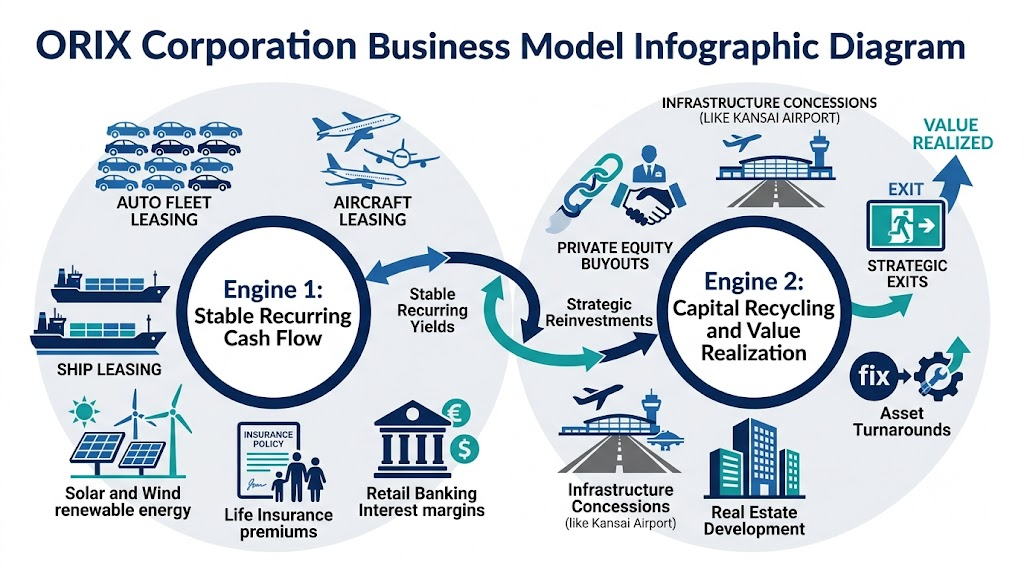
- The Dual Engine: Recurring Cash Flow and Capital RecyclingThe business model is built on two interdependent engines:
- Recurring Stable Yields: Generated through operational leasing(fleet vehicles, ICT equipment, industrial machinery), life insurance premiums, banking net interest margins, aircraft/ship charters, and feed-in-tariff solar electricity generation.
- Capital Recycling & Investment Exits: ORIX uses its proprietary balance sheet to acquire underperforming companies, infrastructure concessions(e.g., Kansai and Osaka International Airports), or distressed real estate. It operates and enhances their cash flows before exiting through trade sales, IPOs, or secondary securitizations to realize lumpy, high-margin capital gains.
- Core Financial Structure and ScaleFor the fiscal year ended March 31, 2025, ORIX generated total consolidated revenues of ¥2.87 trillion and achieved record net income attributable to shareholders of ¥351.6 billion, up from ¥346.1 billion in FY2024. Total assets stood at ¥16.87 trillion, supported by shareholders’ equity of ¥4.09 trillion(shareholders’ equity ratio of 24.2%). Profitability stood at an ROE of 8.8% and ROA of 2.12%.
- Segment Contribution and Revenue MechanicsThe group organizes its earnings across 10 distinct segments:
- Corporate Financial Services & Maintenance Leasing: Earns fee spreads, vehicle maintenance margins, and equipment rentals across SMEs in Japan.
- Real Estate & Concessions: Develops logistics hubs, office properties, and hotels, alongside revenue-sharing infrastructure concessions.
- Environment & Energy: Generates regulated and merchant electricity revenues from over 1 GW of operating solar, wind, and biomass installations.
- Aviation & Maritime: Monetizes global jet engine, narrowbody aircraft, and cargo vessel leases, coupled with residual value realization upon airframe secondary market sales.
- Global Asset Management(ORIX USA & ORIX Europe): Collects third-party management, advisory, and performance fees while reducing direct equity capital absorption.
- Growth Strategy: “Path to 2035”ORIX’s stated roadmap targets ¥1 trillion in consolidated net profit by FY2035. To bridge the gap from its current ~¥350 billion base, management has de-emphasized purely debt-funded balance-sheet expansion. Instead, it is shifting resources into third-party asset management fees, energy transition infrastructure(such as grid battery storage and European wind power), and strategic PE acquisitions in Japan benefiting from founder succession trends.
Business Model Information Sources
- https://www.orix.co.jp/grp/en/ir/financial/segment/
- https://www.orix.co.jp/grp/en/pdf/ir/library/financial_result/ORIXResults2025_4QE.pdf
- https://www.orix.co.jp/grp/en/orix_in_action/entry/2025/05/15/100000
- https://www.orix.co.jp/grp/en/pdf/ir/library/annual_report/AR2025E.pdf
- https://umbrex.com/resources/company-profiles/orix-corp/
AI Strategy, Investments, and Implementation
Rather than pursuing frontier AI foundational model research, ORIX focuses on a pragmatic, two-pronged AI strategy: implementing operational AI internally to accelerate productivity across its underwriting workflow, while commercializing AI hardware infrastructure and vertical SaaS solutions through specialized subsidiaries.
- AI Infrastructure & GPU Cloud CommercializationRecognizing the bottleneck in computational hardware across Asia, subsidiary ORIX Rentec(Japan’s leading industrial equipment and IT rental operator)launched dedicated GPU Cloud Services. ORIX procures high-end enterprise AI acceleration clusters(including NVIDIA HGX platforms)and leases bare-metal, high-performance computing resources via cloud subscription models to domestic tech firms, research labs, and enterprise clients training proprietary models. Additionally, subsidiary Yodogawa Transformer has expanded its high-voltage power transformation, uninterruptible power supply(UPS), and load-testing services specifically to meet the high-density power requirements of newly constructed AI data centers in Japan.
- Proprietary AI Applications and Vertical SaaSORIX developed and rolled out PATPOST, an enterprise cloud document management platform powered by proprietary AI-OCR technology. Designed to help Japanese SMEs comply with strict Electronic Books Preservation Act standards, the system automatically reads, indexes, and extracts transaction metadata(amounts, dates, counterparties)from unstructured invoices and contracts without manual human entry. Within its precision rental business, ORIX deployed 3D-FABs, an AI-driven online simulation platform that automatically parses uploaded 3D CAD engineering schematics, estimates manufacturing feasibility, and outputs algorithmic price quotes.
- Internal Automation, Underwriting, and PartnershipsAcross its corporate lending, credit verification, and insurance claim segments, ORIX integrates machine learning models to analyze portfolio credit risk, predict residual values for leased vehicles/aircraft, and automate claims processing. ORIX actively partners with global hyperscalers(such as Microsoft Azure and AWS)for enterprise cloud architecture, while allocating corporate venture capital through its Digital Transformation(DX)and ESG startup investment pools to source early-stage AI automation partners.
back to ORIX