
Corporate History
Founding and Early Domestic Expansion (1921–1945)
Komatsu originated in 1921 in Komatsu City, Ishikawa Prefecture, spinning off from Takeuchi Mining Co. to manufacture specialized mining tools and industrial machinery. In 1931, it produced Japan’s first agricultural tractor, followed by the development of Japan’s first crawler-type bulldozer (the Model 1 Ground Leveler) in 1943, establishing its core mechanical manufacturing identity.
Post-War Reconstruction and Total Quality Control (1946–1979)
Following World War II, Komatsu capitalized on Japan’s reconstruction boom, expanding into diesel engines and hydraulic excavators. During the 1960s, facing direct domestic competition from Caterpillar’s joint venture with Mitsubishi, Komatsu implemented rigorous Total Quality Control (TQC) programs. This operational transformation elevated product build quality to international standards, paving the way for full-scale export operations to Europe, the Americas, and Asia.
Global Manufacturing Diversification and M&A (1980–2000s)
The sharp appreciation of the Japanese yen in the 1980s prompted Komatsu to transition from an export-reliant framework to localized offshore manufacturing, establishing plants across North America and Europe. In 1998, the company pioneered machine telematics with KOMTRAX, making tracking and diagnostics standard equipment. The 2000s saw strategic portfolio rationalization, divesting non-core peripheral businesses to concentrate capital strictly on heavy construction and mining equipment.
Scale Expansion and Digital Mining Modernization (2010s–Present)
In 2017, Komatsu completed the landmark US$3.7 billion acquisition of Joy Global (now Komatsu Mining Corp.), securing dominant market share in underground mining machinery alongside its surface operations. The company subsequently scaled its Autonomous Haulage System (AHS) and rolled out “Smart Construction” software platforms to address global labor shortages and decarbonization imperatives.
Business Model and Strategic Direction
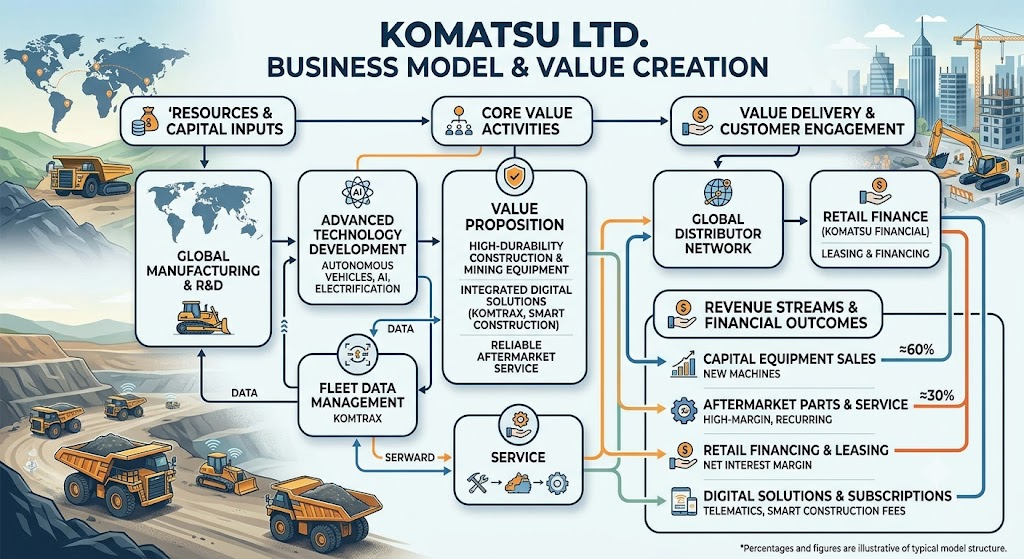
Komatsu generates revenue across three primary operating segments: Construction, Mining & Utility Equipment (representing approximately 90% of consolidated net sales), Retail Finance, and Industrial Machinery & Others. For FY2025 (ended March 31, 2025), consolidated net sales reached ¥4,132.8 billion, with an operating profit of ¥567.3 billion.
The core revenue engine relies on an installed-base lifecycle model:
- Hardware Asset Sales: Capital equipment sales (excavators, dump trucks, continuous miners, and wheel loaders) provide baseline revenue across infrastructure, commercial building, and extractives sectors.
- High-Margin Aftermarket Parts and Servicing: Replacement parts, wear items, consumables, and long-term service agreements generate recurring, counter-cyclical cash flow. Mining fleets operate continuously under extreme mechanical stress, yielding aftermarket lifetime revenues that frequently surpass the original machine purchase price.
- Retail Captive Financing: Komatsu Financial provides wholesale inventory financing to independent dealerships and equipment retail financing/leasing to end customers, capturing net interest margins while facilitating fleet purchases.
- Digital Solutions and Telematics Monopolization: The company monetizes software solutions through its Smart Construction platform, offering drone surveying, 3D project mapping, fleet management subscriptions, and remote diagnostic services. Over 1.4 million connected units feed live operating data into KOMTRAX, locking clients into proprietary dealership service channels and raising platform switching costs.
Strategic development targets under the current medium-term management plan (“Driving value with ambition”, FY2025–FY2027) center on three pillars: accelerating machine automation to secure long-term mining contracts, scaling modular zero-emission powertrain architectures (battery-electric and hydrogen fuel-cell haulers), and shifting customer relationships from transactional equipment sales toward outcome-based, productivity-linked service contracts.
Sources for Business Model Data
- https://www.komatsu.jp/en/ir/library/interview-movie/executive-insight-script_en_20260701
- https://www.komatsu.jp/en/ir/library/annual
- https://www.komatsu.jp/en/ir/library/annual/cfomessage
- https://www.komatsu.jp/en/-/media/home/ir/library/annual/2025/en/kr25e_value_02.pdf
- https://www.logisticsnavigators.com/businessbreakdowns/komatsu
- https://www.forbes.com/companies/komatsu/
AI Strategy, Budget, and Technology Partnerships
Komatsu positions artificial intelligence not as a standalone software venture, but as an operational layer integrated across physical machinery, edge sensors, and job-site digital twins.
Autonomous and Edge Robotics Integration
Komatsu’s Autonomous Haulage System (AHS) represents one of the largest production deployments of industrial robotic AI in the world. Deployed across more than 25 open-pit mine operations globally with approximately 900 autonomous trucks operating simultaneously, the platform uses sensor fusion, high-precision GNSS, obstacle-detection algorithms, and central pathfinding AI to operate unmanned super-class haulers around the clock, cutting fuel consumption by up to 10% and improving production throughput by roughly 15%.
Enterprise Partnerships and Edge Compute
- NVIDIA: Komatsu established an enterprise partnership with NVIDIA to embed the NVIDIA Jetson edge AI platform directly into machine cabs and exterior sensor arrays. Heavy equipment uses deep learning vision models for 360-degree real-time object classification to automatically detect personnel, estimate collision risks, and monitor blind zones.
- Skycatch & OPTiM: Through its Smart Construction ecosystem, Komatsu partnered with drone analytics startup Skycatch to process aerial photogrammetry via GPU clusters, generating centimeter-accurate 3D terrain models. Machine learning algorithms continuously compare drone elevation scans against BIM architectural plans to quantify cut-and-fill volume changes and idle equipment ratios automatically.
- AIM (Autonomous Intelligent Machines): Komatsu partners with autonomous construction technology specialists like AIM to advance machine guidance, auto-trenching, and semi-autonomous excavator path planning on civilian job sites to offset skilled operator shortages.
R&D Budget and Resource Allocation
Komatsu allocates between 2.7% and 3.0% of consolidated net sales annually toward research and development, representing an annual R&D expenditure exceeding ¥100 billion. R&D capital is prioritized toward autonomous algorithms, tele-operation control systems, sensor fusion hardware, and powertrain electrification. In tandem, Komatsu allocates capital via strategic venture investments and dedicated digital business units to support external tech integration, ensuring field data captured across millions of connected machines directly informs its predictive failure models and next-generation autonomous software stacks.
back to Komatsu