
Corporate History
Meiji Era Origins to Public Corporation (1871–2005)
Japan’s modern postal service was founded in 1871 by Maejima Hisoka, evolving through the Ministry of Posts and Telecommunications into a state-run system combining mail, postal savings, and postal life insurance. In 2003, as part of administrative reforms, operations transitioned to a public corporation, Nippon Yusei Kosha (Japan Post).
Privatization and the Triple IPO (2006–2015)
Under Prime Minister Junichiro Koizumi’s structural reform agenda, the Postal Privatization Act passed in 2005, formally establishing Japan Post Holdings Co., Ltd. in 2006. In October 2007, operations were partitioned into specialized operating units under the holding firm. In November 2015, the group executed an unprecedented simultaneous “triple IPO” on the Tokyo Stock Exchange, listing Japan Post Holdings, Japan Post Bank, and Japan Post Insurance to initiate phased government divestment.
Global Ambitions and Operational Setbacks (2016–2020)
Seeking growth beyond a saturated domestic market, Japan Post acquired Australian logistics provider Toll Holdings for approximately ¥620 billion in 2015. The acquisition faltered, resulting in a ¥400 billion impairment charge in 2017. In 2019, an aggressive quota-driven corporate culture culminated in a major scandal involving inappropriate sales of Japan Post Insurance policies, prompting regulatory suspensions, executive departures, and extensive operational remediation.
Restructuring and Digital Transition (2021–Present)
In 2021, the government reduced its stake in Japan Post Holdings to roughly one-third (the statutory minimum required by law). Under the medium-term management plans JP Vision 2025 and JP Vision 2025+, the group redirected capital toward balance sheet optimization, postal tariff increases to counter logistics inflation, domestic logistics alliances, and group-wide digital transformation.
Business Model and Growth Strategy
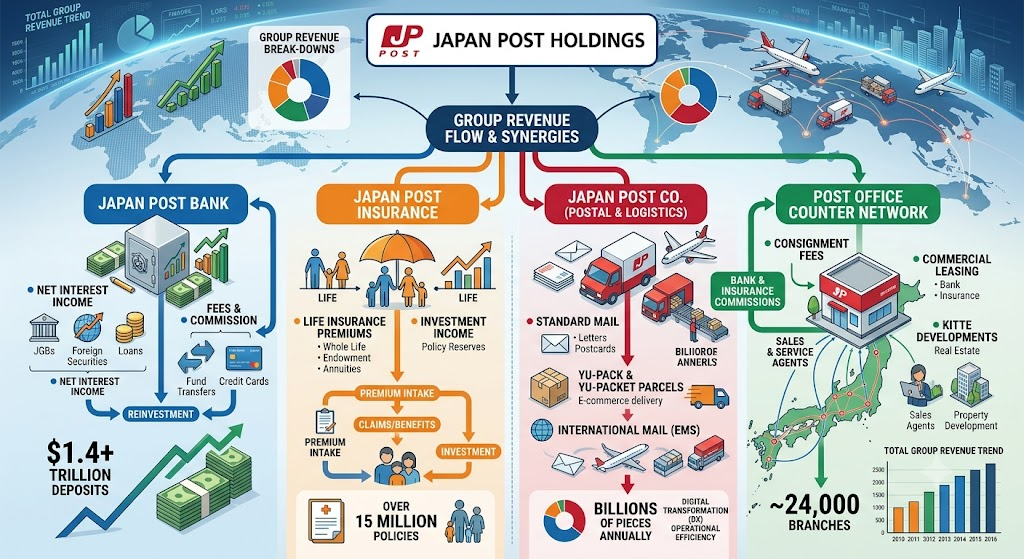
Japan Post Holdings operates primarily as a holding and capital-allocation vehicle that monetizes universal distribution through internal service commissions, asset management, and financial intermediary fees:
Banking Revenue (Japan Post Bank)
Japan Post Bank (Yucho Bank) represents the group’s financial engine, managing over ¥190 trillion in customer deposits. The bank earns the vast majority of its income through spread investing (net interest margin) and portfolio diversification. Rather than traditional corporate lending, Yucho Bank allocates liquidity across Japanese Government Bonds (JGBs), foreign securities, private equity funds, and syndicated loans. It also generates fee income via domestic fund transfers, agency fees, and cash handling.
Life Insurance Revenue (Japan Post Insurance)
Japan Post Insurance (Kampo) generates underwriting income through premiums from life, endowment, and annuity contracts, alongside investment spread earned on policyholder reserves exceeding ¥50 trillion. It relies heavily on counter sales across the post office network, paying agency commissions back to the postal operating unit.
Postal and Post Office Counter Operations (Japan Post Co.)
The postal unit operates on two fronts:
- Logistics & Parcels: Generating revenue from standard mail, express delivery (EMS), and e-commerce parcels (Yu-Pack and Yu-Packet). Because traditional mail volume declines by 2% to 5% annually, profitability has increasingly depended on parcel volume expansion and tariff increases (such as the autumn 2024 postage price revision).
- Post Office Counter Network: Japan Post Co. operates ~24,000 branches. Under internal agreements, Japan Post Bank and Japan Post Insurance pay consignment commissions (amounting to hundreds of billions of yen annually) to the post office network to service retail banking and insurance customers.
Real Estate and Value Creation
To monetize its prime downtown landholdings located beside major rail hubs across Japanese prefectures, the group develops commercial hubs (such as the KITTE shopping and office complexes), generating recurring commercial leasing and asset development income.
Strategic Trajectory
The group’s long-term plan focuses on reducing its equity stakes in Japan Post Bank and Japan Post Insurance to improve managerial independence and unlock capital. In logistics, Japan Post has pivoted from costly standalone overseas expansions to domestic co-loading agreements (e.g., handling small parcels for Yamato Transport) to optimize terminal network efficiency.
Sources
- https://www.japanpost.jp/en/ir/library/disclosure/2021/pdf/04.pdf
- https://www.japanpost.jp/en/ir/library/presentation/pdf/20240515_03_correction.pdf
- https://www.jp-life.japanpost.jp/english/aboutus/financial/assets/pdf/2021/disc21-04.pdf
- https://www.post.japanpost.jp/index_en.html
- https://en.wikipedia.org/wiki/Japan_Post_Holdings
Artificial Intelligence Strategy, Budget, and Partnerships
Facing severe structural labor shortages across Japan’s transportation sector (exacerbated by legal overtime caps on truck drivers) and a declining working-age demographic, Japan Post has made AI, robotics, and workflow automation foundational to its JP Vision 2025+ digital transformation roadmap.
Capital Commitments and Investment Budget
Japan Post allocated extensive resources to IT infrastructure and digital transformation across the group. Most notably, in March 2021, Japan Post executed a landmark ¥150 billion capital and business alliance with e-commerce giant Rakuten Group (acquiring an approximate 8.3% equity stake) specifically designed to share digital infrastructure, artificial intelligence algorithms, and automated fulfillment technology. In addition, Japan Post Capital operates corporate venture capital programs funding seed-to-growth startups in logistics automation, AI, and enterprise software.
Strategic Partnerships and Deployments
- Rakuten Alliance: Joint development of next-generation logistics hubs using AI-driven demand forecasting, shared warehousing data, and algorithmic delivery routing to cut redelivery rates.
- Automated Last-Mile Delivery: Japan Post has partnered with autonomous mobility developers, including ZMP Inc., to test self-driving delivery robots (such as DeliRo) on public roads and inside residential high-rises in Tokyo and Chiba. These delivery units integrate with building elevator control systems over LTE networks to conduct unattended package handoffs directly to apartment doors.
- Drone Transport: Conducting Level 4 autonomous drone delivery trials over unpopulated and mountainous terrain in Okutama, Tokyo, and Fukushima Prefecture to address route inefficiency in rural distribution.
- Sorting Center Machine Vision: Implementing high-speed optical character recognition (OCR) and deep-learning vision models across sorting hubs to decipher handwritten addresses, sort irregularly shaped parcels, and route items automatically without human intervention.
- Operational Generative AI: Deploying secure enterprise generative AI models internally to assist branch employees with regulatory compliance queries, insurance policy summarization, and customer support triage, significantly lowering average call-handling times and administrative overhead.
back to Japan Post Holdings