
Market Position and Market Share
Toyota Tsusho Corporation is the dedicated trading arm and general trading company(sogo shosha)of the Toyota Group. Among Japan’s traditional “Seven Major Sogo Shosha”(Mitsubishi Corporation, Mitsui & Co., Itochu, Sumitomo Corporation, Marubeni, Toyota Tsusho, and Sojitz), Toyota Tsusho consistently ranks 6th by revenue and net profit, ahead of Sojitz.
- Sogo Shosha Ranking and Financial Scale:In terms of consolidated revenue, Toyota Tsusho generated over ¥10.31 trillion in FY2025, with profit attributable to owners of the parent reaching ¥370.5 billion. Within the aggregate net earnings pool of the seven major trading houses(which totals approximately ¥4.5 trillion to ¥5.5 trillion annually), Toyota Tsusho holds an estimated net income share of approximately 7% to 8%.
- Automotive Sogo Shosha Dominance: Unlike peer trading companies that heavily lean into energy, LNG, or mining commodities, Toyota Tsusho derives over 65% to 70% of its operating throughput from automotive-related value chains. In global Tier-1 automotive raw materials procurement(such as specialized automotive sheet steel and aluminium blanks)for Toyota Group production, Toyota Tsusho commands a virtual monopoly, handling upwards of 80% to 90% of Toyota Motor Corporation’s inbound factory logistics and scrap recycling loops.
- Regional Market Dominance in Africa: Following its acquisition of CFAO(Compagnie Française de l’Afrique Occidentale), Toyota Tsusho established itself as the #1 automotive distributor across the African continent, covering 54 African countries with a market share exceeding 20% to 25% of all new vehicle sales in key sub-Saharan and West African markets.
- Lithium and Clean Energy: Through its joint venture with Arcadium Lithium(formerly Allkem/Orocobre)at the Olaroz Lithium Facility in Argentina, Toyota Tsusho secures captive lithium carbonate and lithium hydroxide feedstocks for Prime Planet Energy & Solutions(PPES)and Toyota Battery Manufacturing North Carolina(TBMNC). In renewable energy, its 100% owned subsidiary Eurus Energy Holdings is Japan’s #1 wind power generator by operational capacity.
Supply Chain Analysis and Key Suppliers
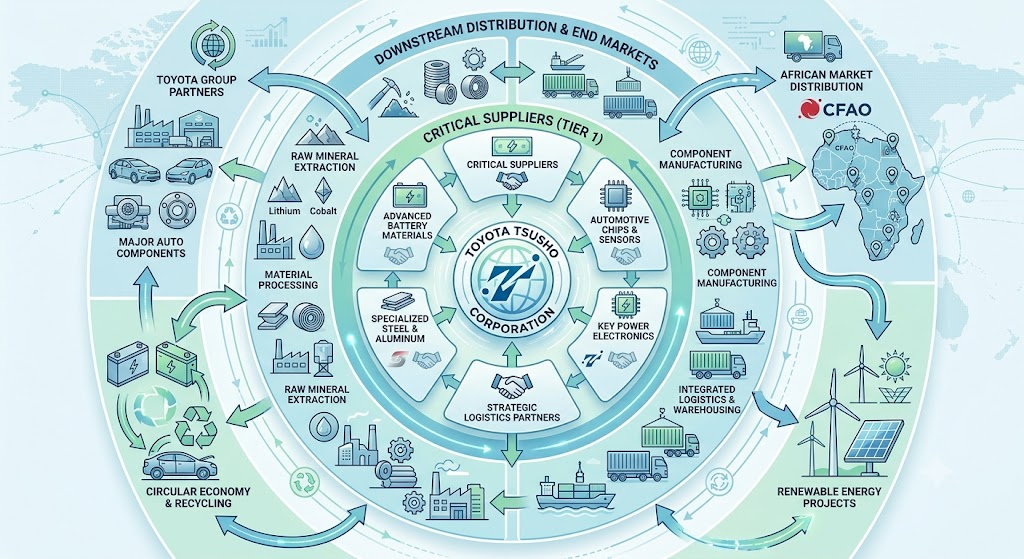
Toyota Tsusho operates across an integrated value chain that spans upstream raw mineral extraction, midstream component kitting and processing, and downstream automotive vehicle assembly, distribution, and end-of-life recycling.
- Upstream(Raw Materials and Energy):
- Critical Battery Minerals: Secures battery-grade lithium carbonate and hydroxide via direct equity stakes, notably in the Sales de Jujuy joint venture(Olaroz project in Argentina)alongside Arcadium Lithium. It also procures cobalt, nickel, and battery precursor materials for battery cell manufacturing lines.
- Automotive Metals: Procures flat-rolled automotive steel and high-tensile steel sheets directly from Nippon Steel and JFE Steel Corporation, alongside aluminium ingots from global smelters.
- Key Suppliers: Arcadium Lithium(lithium), Nippon Steel, JFE Steel, Rio Tinto, BHP(metals and industrial minerals), and Renesas Electronics(automotive microcontrollers and semiconductors).
- Midstream(Processing, Semiconductor Distribution, and Logistics):
- Steel & Aluminium Coil Centers: Operates over 100 processing centers globally that cut, blank, and slit coils to exact press-shop tolerances before feeding them to Toyota and supplier assembly lines.
- Semiconductor and Electronics Logistics:Conducted primarily via its specialized electronic components trading subsidiary, NEXTY Electronics. NEXTY serves as a primary distributor for Tier-1 automotive microcontrollers, power modules(SiC/GaN), and sensor modules, maintaining vendor-managed inventory(VMI)hubs near assembly plants.
- Sub-Assembly and Kitting: Operates localized logistics centers that kit interior parts, wiring harnesses, and chassis components into sequenced deliveries(Just-in-Time / Kanban)directly into OEM factories.
- Key Midstream Partners: Denso Corporation, Aisin Corporation, Toyota Boshoku, and JTEKT Corporation.
- Downstream(OEM Assembly Integration, Retail, and Circular Recycling):
- OEM Integration: Directly feeds assembly lines operated by Toyota Motor Corporation, Daihatsu, and Hino Motors.
- Automotive Dealership & Distribution Networks: Manages authorized dealership networks and logistics across emerging markets, most notably through CFAO across Africa and distributor networks in Oceania and Latin America.
- Circular Economy & Scrap Recovery: Recycles automotive metal scrap generated during stamping operations back into steel and aluminium smelters. Through subsidiaries like Radius Recycling(acquired via Toyota Tsusho America) and battery recycling partnerships(such as Redwood Materials and Cirba Solutions), it reclaims black mass, lithium, and base metals to re-enter upstream manufacturing pipelines.
Competitor Analysis: Technical and Financial Comparison
Toyota Tsusho competes directly against Japan’s general trading houses, primarily Mitsubishi Corporation, Mitsui & Co., and Itochu Corporation.
Comparative Financial Profile
| Metric | Toyota Tsusho(8015.T) | Mitsubishi Corp(8058.T) | Mitsui & Co(8031.T) | Itochu Corp(8001.T) |
| Consolidated Revenue(FY2025) | ~¥10.31 Trillion | ~¥19.5 Trillion | ~¥13.8 Trillion | ~¥14.5 Trillion |
| Net Profit attributable to Parent | ~¥370.5 Billion | ~¥1.00 – ¥1.18 Trillion | ~¥1.05 – ¥1.13 Trillion | ~¥800 – ¥880 Billion |
| Return on Equity(ROE) | ~14.0% – 14.5% | ~13.5% – 14.0% | ~16.0% – 17.0% | ~15.5% – 16.5% |
| Primary Revenue Driver | Mobility, Auto Logistics, Africa(CFAO) | Metallurgical Coal, LNG, Power | Iron Ore, LNG, Energy, Chemicals | Consumer, Retail(FamilyMart), Machinery |
Strategic and Technical Capabilities Comparison
- Value Chain Integration vs. Passive Concessions:
- Toyota Tsusho: Highly operational. Unlike traditional trading houses that often function as asset managers holding minority equity stakes in mining concessions, Toyota Tsusho acts as an operating partner. It integrates deeply into factory floors, managing physical inventory, coil slitting, sub-assembly kitting, and line-side Just-in-Time deliveries.
- Competitors(Mitsubishi, Mitsui): Focus on large-scale natural resource concessions(e.g., BHP Mitsubishi Alliance for coking coal; Sakhalin-2 or Australian LNG projects for Mitsui). Their earnings demonstrate higher cyclical volatility tied to global commodity indices, whereas Toyota Tsusho’s baseline earnings track global automotive vehicle build rates and content-per-vehicle expansion.
- Electronics and Digital Architecture:
- Toyota Tsusho: Through NEXTY Electronics, it possesses specialized embedded software engineering, model-based development support, and core semiconductor distribution tailored strictly for autonomous driving, ADAS, and electrified xEV architectures.
- Competitors(Itochu, Sumitomo): Itochu focuses heavily on consumer touchpoints, retail IT, and downstream telecom integration. Sumitomo operates tech distribution via SCSK Corporation, which provides broader corporate enterprise IT software rather than automotive-grade embedded component logistics.
- Energy Transition Positioning:
- Toyota Tsusho: Centers its decarbonization strategy around green mobility: closed-loop circular battery recycling, renewable power generation via Eurus Energy, and hydrogen refueling corridors for heavy-duty commercial transport.
- Competitors(Mitsui, Mitsubishi): Developing utility-scale blue/green ammonia import terminals, LNG value chains, hydrogen maritime transport, and carbon capture and storage(CCS)infrastructure designed for heavy industrial utilities.
Information Sources
- https://www.toyota-tsusho.com/english/press/detail/260430_006831.html
- https://www.toyota-tsusho.com/english/press/detail/260731_006886.html
- https://the-shashi.com/en/tse/8015/
- https://en.wikipedia.org/wiki/Sogo_shosha
- https://www.taiamerica.com/supply-chain/
- https://global.toyota/pages/global_toyota/ir/financial-results/2025_4q_presentation_2_en.pdf
back to Toyota Tsusho