
Market Position and Market Share
SoftBank Group Corp. is a preeminent Japanese multinational investment holding company and one of the world’s largest technology-focused investors.Headquartered in Tokyo, Japan, the corporation operates primarily through its asset management arms, notably the Vision Fund 1 and Vision Fund 2, which historically commanded over $100 billion and $40 billion respectively in peak committed capital. As a premier global tech investor, SoftBank holds a dominant footprint in artificial intelligence, semiconductor design, and high-growth internet unicorns. Its crown jewel asset, Arm Holdings PLC (wherein SoftBank retains a controlling majority stake of approximately 90%), commands a near-monopoly market share of over 99% in mobile application processor CPU architecture and a rapidly expanding presence in automotive and hyperscale cloud infrastructure chips, boasting a market capitalization exceeding $100 billion. Furthermore, SoftBank occupies a massive global venture capital tier, ranking among the top institutional backers of private artificial intelligence pioneers, anchored by its multi-billion-dollar capital commitments to foundational AI entities such as OpenAI.
Supply Chain Ecosystem and Key Suppliers
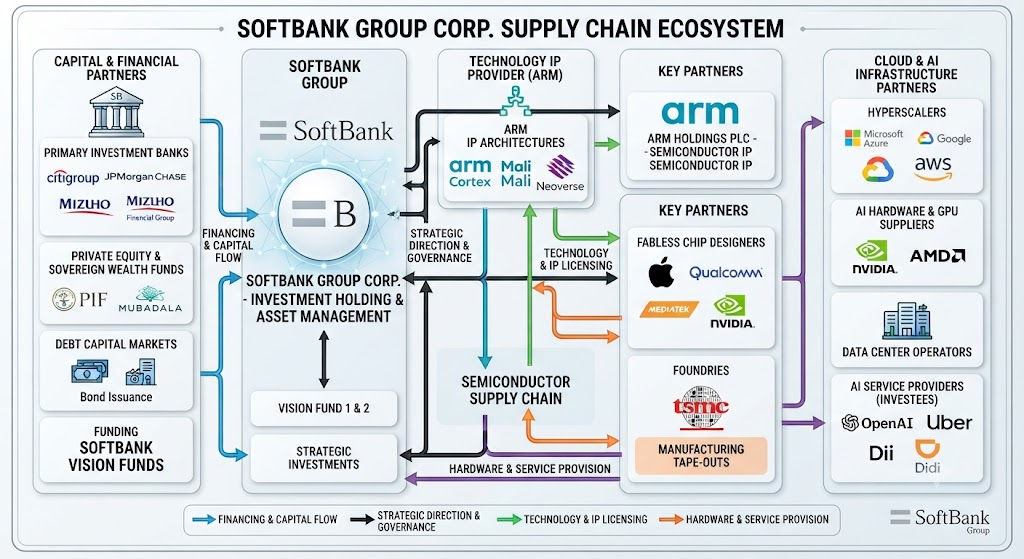
As an investment holding and asset management conglomerate rather than a traditional heavy manufacturer, SoftBank’s “supply chain” reflects a deeply integrated web of financial institutions, technology partners, cloud providers, and semiconductor intellectual property licensees.
- Financial and Capital Partners: SoftBank relies heavily on international investment banks and credit facilities for liquidity, leveraging primary underwriters such as Citigroup, JPMorgan Chase, and Mizuho Financial Group to orchestrate multi-billion-dollar bond issuances, syndicated loans, and bridge financing to fund massive tech investments.
- Semiconductor and IP Supply Chain (via Arm): Arm acts as the foundational technology provider for hundreds of fabless semiconductor companies—including Apple, Qualcomm, MediaTek, and Nvidia—supplying processor architectures and instruction set architectures (ISAs) while partnering closely with global foundries like Taiwan Semiconductor Manufacturing Company (TSMC) for physical implementation and manufacturing tape-outs.
- Cloud and Artificial Intelligence Infrastructure Partners: Through its ecosystem of investees and operational partners, SoftBank depends on elite hyperscalers and hardware fabricators—including Microsoft, NVIDIA, and major data center operators—to supply advanced graphics processing units (GPUs) and high-performance computing clusters necessary for next-generation artificial intelligence deployments.
Competitor Analysis
SoftBank occupies a unique hybrid category as a publicly traded investment holding company, facing distinct competitors across both global investment management and specialized semiconductor design.
- Investment and Venture Capital Competitors: Major global peers include Berkshire Hathaway, Prosus, and sovereign wealth funds such as the Public Investment Fund (PIF) of Saudi Arabia and Mubadala Investment Company. Financially, unlike Berkshire Hathaway’s cash-generative insurance float and stable value-equity portfolio, SoftBank exhibits higher earnings volatility, driven by aggressive growth-stage tech valuations and public market swings in its Vision Fund portfolio. While sovereign wealth peers rely on state-backed endowments, SoftBank increasingly utilizes debt capital markets and asset monetization (such as reducing legacy stakes in Alibaba and T-Mobile) to fund its aggressive pivot into generative artificial intelligence.
- Semiconductor Technology Competitors (via Arm): Arm’s primary architectural competitor is the open-source RISC-V architecture, alongside traditional x86 ecosystems dominated by Intel and Advanced Micro Devices (AMD). Technically, Arm maintains a dominant edge in energy efficiency and mobile performance-per-watt metrics, though RISC-V is rapidly gaining traction in embedded systems and microcontrollers due to its royalty-free licensing model. Financially, Arm outperforms traditional hardware design competitors through high-margin royalty and licensing revenue models, achieving gross margins consistently exceeding 95%.
- https://group.softbank/en
- https://www.manilatimes.net/2026/09/22/business/foreign-business/softbank-group-launches-over-10-billion-in-bonds-for-openai-investment/2429534
- https://www.google.com/finance/quote/9984:TYO
back to Softbank Group