
Corporate History
SoftBank’s history can be categorized into four major stages of evolution:
- Foundation and Telecom Era (1981-1999): Started as a computer software distributor, SoftBank quickly expanded into publishing and joint ventures, notably investing early in Yahoo! Japan and Alibaba, which laid the groundwork for its future wealth.
- Internet and Broadband Expansion (2000-2015): Following the dot-com bubble crash, SoftBank rebuilt its financial standing by entering the broadband market with Yahoo! BB and successfully acquiring Vodafone Japan in 2006, transforming into a major domestic mobile carrier.
- The Vision Fund and Mega-Venture Era (2016-2022): SoftBank launched the unprecedented 100 billion dollar SoftBank Vision Fund in 2017, shifting its core identity entirely toward global venture capital investment, backing hundreds of late-stage tech unicorns with mixed financial results.
- Artificial Intelligence Pivot and Heavy Debt Restructuring (2023-Present): Following significant write-downs and asset monetization phases, SoftBank pivoted its strategy toward artificial intelligence, semiconductor leadership via Arm Holdings, and massive debt-financed capital commitments into generative AI ecosystems.
Business Model and Growth Strategy
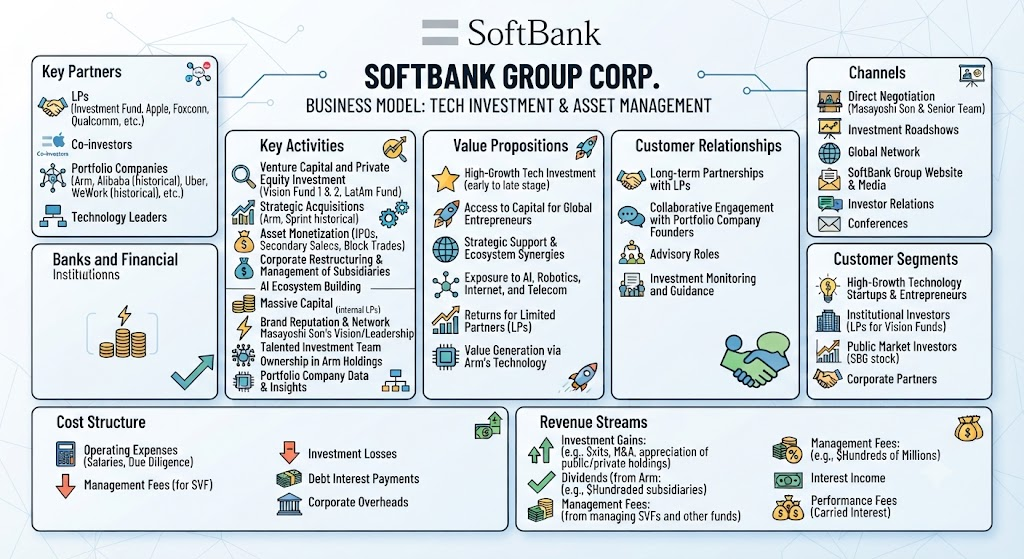
SoftBank operates primarily as an investment holding and asset management enterprise rather than a traditional operating company. Its primary monetization model revolves around capital appreciation, equity value generation, and strategic monetization of portfolio companies through initial public offerings, secondary sales, or corporate mergers. The group generates income through investment gains (or losses) from the SoftBank Vision Funds, dividend streams from consolidated subsidiaries like Arm Holdings and domestic telecom operations, and management fees derived from managing external institutional capital within its investment funds. Rather than relying on standard product supply chains, SoftBank captures economic value by acting as a master allocator of global tech capital, utilizing aggressive debt financing, margin loans backed by core asset holdings (such as Arm shares), and strategic asset monetization to fuel continuous cycles of high-risk, high-reward technology investments.
Artificial Intelligence Strategy and Execution
SoftBank has aggressively concentrated its future strategy on artificial intelligence and artificial general intelligence infrastructure, pivoting its entire balance sheet toward this sector. Under Masayoshi Son’s direction, the company has committed tens of billions of dollars into generative AI frontrunners, most notably leading massive funding rounds and raising multi-billion dollar debt facilities and bond issuances to fund multi-billion dollar commitments into OpenAI. At the core of SoftBank’s AI hardware and ecosystem strategy is Arm Holdings, its semiconductor subsidiary whose energy-efficient chip designs power the vast majority of global mobile devices and increasingly data center AI workloads. SoftBank leverages its substantial borrowing capacity—raising over $10 billion in recent bond offerings and structuring massive margin loans backed by its Arm stake—to secure its position at the center of the global AI hardware, software, and infrastructure revolution.
back to Softbank Group