
Market Position and Market Share
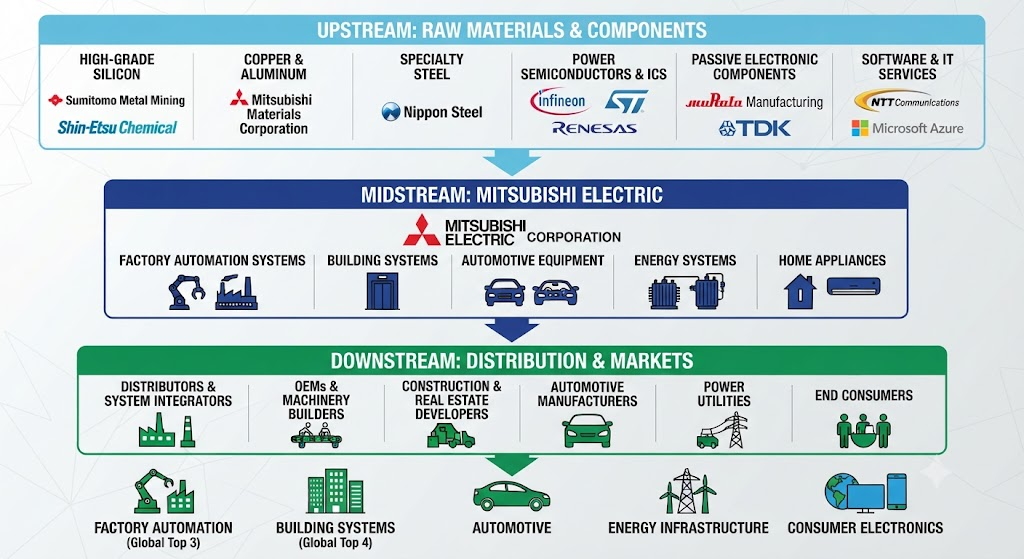
Mitsubishi Electric Corporation is a global leader in electrical and electronic equipment manufacturing, holding prominent market positions across several core business segments. In the global Factory Automation (FA) systems market—which includes Programmable Logic Controllers (PLCs), servo motors, and computerized numerical controllers (CNCs)—Mitsubishi Electric consistently ranks among the top three worldwide, competing closely with Siemens, Rockwell Automation, and Fanuc, holding an estimated global market share of roughly 15% to 20% in industrial automation components.
In the building systems sector, it is a dominant top-tier global manufacturer of elevators and escalators, securing a top-four position worldwide alongside Otis, KONE, and Schindler, with a particularly strong foothold and leading market share within the Asia-Pacific region. Furthermore, in heavy electrical equipment, power distribution systems, and automotive electrical components, Mitsubishi Electric maintains a multi-billion dollar revenue scale (with trailing twelve-month revenues exceeding USD 35 billion) and serves as a vital pillar of the broader Mitsubishi industrial group.
Supply Chain Analysis and Key Suppliers
Mitsubishi Electric operates an extensive, globalized manufacturing and procurement supply chain designed to support heavy machinery, precision factory automation gear, and consumer electronics.
- Raw Materials and Core Metals: Upstream procurement relies heavily on major industrial commodity suppliers for high-grade silicon, copper, aluminum, and specialty steel alloys. Key partners include major metal producers such as Mitsubishi Materials Corporation and Nippon Steel, which supply specialized materials essential for heavy-duty transformer cores, motor windings, and semiconductor packaging substrates.
- Semiconductors and Electronic Components: Given its heavy involvement in power electronics, factory automation, and automotive systems, Mitsubishi Electric procures advanced microcontrollers, power semiconductor devices, and passive components from leading semiconductor foundries and electronic component distributors. Key suppliers include major silicon providers and internal semiconductor divisions, complemented by external electronic component giants like Murata Manufacturing and TDK for specialized passive elements.
- Software, IT Infrastructure, and Digital Solutions: To drive its transition toward advanced digital-engineering and smart-factory integration under its Serendie framework, Mitsubishi Electric collaborates with major IT and cloud infrastructure providers such as NTT Communications and SK C and C to track supply chain carbon footprints and build enterprise-wide IoT connectivity platforms.
Competitor Analysis: Technology and Financial Comparison
Mitsubishi Electric competes across diverse, highly competitive industrial and technological landscapes against global conglomerates like Siemens, Hitachi, and Daikin.
- Technological Comparison: In Factory Automation, while Siemens emphasizes open software-defined ecosystems and end-to-end digital twin architectures (Industrial Edge and Totally Integrated Automation), Mitsubishi Electric focuses on high-speed hardware reliability, deterministic real-time control via proprietary networks like CC-Link IE, and extreme durability in harsh manufacturing environments. Compared to pure-play automation rivals like Fanuc or Yaskawa, Mitsubishi offers a vastly broader product portfolio spanning consumer HVAC, elevators, and public infrastructure systems. In HVAC and air conditioning, it competes directly with Daikin and Panasonic, leveraging proprietary inverter technologies and energy-saving compressor designs.
- Financial Comparison: From a financial performance perspective, Mitsubishi Electric maintains a robust balance sheet with stable operating margins typically ranging between 6% and 8%, moving toward its medium-term targets of a 10% operating profit margin and 10% ROE. Its gross margins hover around 32%, reflecting a healthy mix of high-margin factory automation components and recurring revenue from building maintenance and elevator servicing contracts. While software-heavy competitors like Siemens or specialized tech giants may command higher software-driven valuation multiples, Mitsubishi Electric relies on diversified industrial exposure and disciplined asset efficiency to deliver steady cash generation (targeting cumulative cash generation of over 3 trillion yen across mid-term plans).
Sources
- https://www.mitsubishielectric.com/en/sustainability/social/supply-chain-management/
- https://www.mitsubishielectric.com/investors/library/integrated-report/pdf/2024/3-2_en.pdf
- https://www.kenresearch.com/global-industrial-elevator-market
- https://dahebtech.com/blog/choosing-the-right-plc-for-your-industry-why-mitsubishi-electric-stand-out
- https://companiesmarketcap.com/mitsubishi-electric/revenue/
back to Mitsubishi Electric