
Corporate History
Japan Tobacco’s corporate lineage traces back to the government-run monopolies established in the late nineteenth century to manage domestic leaf production and sales.
In 1949, the monopoly was restructured under the ownership of the Japanese government as the Japan Tobacco and Salt Public Corporation, operating as a strict state-sanctioned monopoly over domestic tobacco manufacturing, importation, and pricing.
In 1985, following the privatization wave of public enterprises, the monopoly was dissolved and transformed into the modern joint-stock entity Japan Tobacco Inc., allowing private share ownership while the Japanese Ministry of Finance retained a statutory majority stake.
During the late 1990s and 2000s, the company embarked on an aggressive international expansion strategy to offset shrinking domestic smoking rates caused by Japan’s aging demographics. This culminated in the landmark 2007 acquisition of RJ Reynolds’ international tobacco business for approximately 9.4 billion US dollars, establishing Japan Tobacco International (JTI) as a formidable global competitor.
In subsequent decades, the company continued expanding its global footprint through geographic diversification and targeted acquisitions, including the purchase of Natural American Spirit’s international business in 2015 and the acquisition of United States-based Vector Group in late 2024 to capture stable cash flows in the American market.
Business Model and Growth Strategy
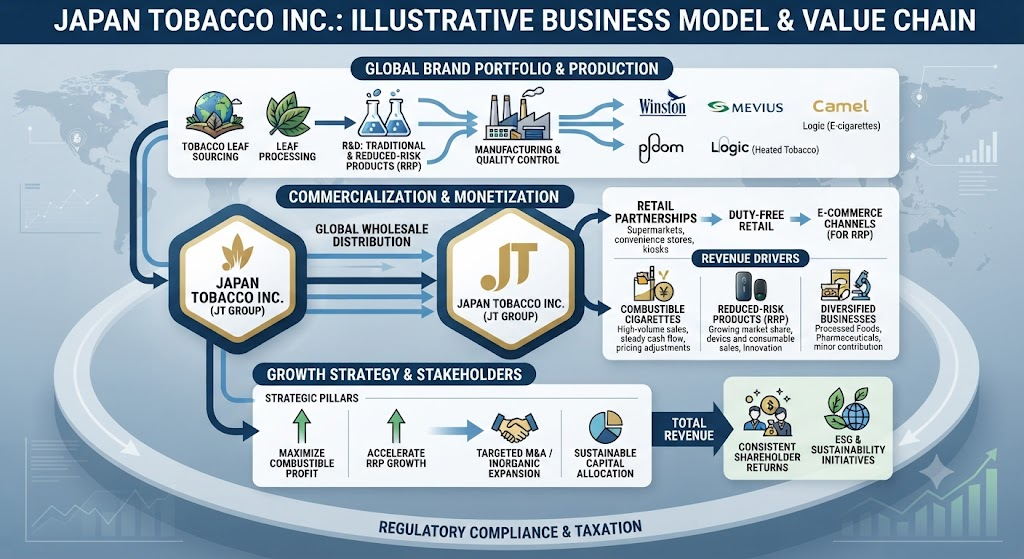
Japan Tobacco generates its revenue primarily through the manufacture, marketing, and sale of traditional combustible cigarettes and reduced-risk products, supplemented by smaller operations in processed foods and pharmaceuticals. Its core economic engine relies on high-margin consumer brand loyalty, geographical revenue diversification across more than 130 countries, and systematic pricing adjustments designed to offset volume declines.
The company’s commercial monetization model centers on high-volume wholesale distribution and direct retail supply chains. In its dominant Tobacco segment—which accounted for approximately 3.31 trillion Japanese Yen out of total consolidated revenues of 3.47 trillion Japanese Yen—profitability is driven by disciplined cost management, continuous return on investment (ROI) optimization in traditional combustibles, and premium brand positioning.
To sustain top-line expansion amidst global anti-smoking policies, Japan Tobacco deploys a multi-polarized growth strategy:
- Maximizing operating cash flow from traditional combustibles through strategic price increases and portfolio strengthening.
- Accelerating consumer acquisition in reduced-risk products (RRP), such as heated tobacco devices under the Ploom brand, though capital expenditures here lag behind early industry movers.
- Expanding inorganic market presence through targeted regional consolidation, demonstrated by the integration of Vector Group to secure domestic US market share and reinforce shareholder returns.
- Maintaining a balanced capital allocation framework that prioritizes business investments alongside consistent shareholder return policies.
Sources
- https://www.jt.com/investors/results/integrated_report/pdf/2025/integrated2025_E_all.pdf
- https://www.jt.com/investors/results/integrated_report/report/2025/business/domain-tobacco/index.html
- https://www.tradingview.com/symbols/TSE-2914/financials-segments/
Artificial Intelligence and Digital Transformation Strategy
Japan Tobacco approaches artificial intelligence and digital transformation primarily as operational optimization tools rather than core product pivots, integrating automation to streamline supply chains, demand forecasting, and enterprise resource planning.
The company has rolled out enterprise-wide digital platforms, including standardized SAP environments supported by advanced test management and automated workflow integration across JTI hubs. These deployments leverage data analytics to monitor real-time inventory adjustments, reduce factory downtime, and track complex regulatory compliance requirements across multiple international jurisdictions.
In research, development, and supply chain logistics, Japan Tobacco utilizes predictive data models to analyze consumer preferences, optimize leaf blending processes, and manage complex global sourcing networks subject to climate and agricultural volatility. While specific multi-million-dollar AI budget allocations or breakthrough proprietary generative models are not heavily spotlighted in corporate disclosures compared to tech-sector peers, the company consistently applies machine learning algorithms to optimize trade marketing effectiveness, retail slotting efficiency, and localized pricing elasticity. Collaborative technology initiatives focus largely on enterprise cloud migrations and digital twin modeling for manufacturing facilities to curb operational waste and lower greenhouse gas emissions in alignment with its climate transition roadmap.
back to Japan Tobacco