
Market Position and Market Share
Japan Post Bank (株式会社ゆうちょ銀行) is one of the largest financial institutions in Japan and globally, functioning as the banking arm of the Japan Post Group.The bank holds a dominant market position driven by its extensive integration with the national postal network.
- Customer Base and Deposit Share:Japan Post Bank maintains over 120 million individual accounts, covering nearly the entire population of Japan.It commands a massive share of household deposits in Japan, holding approximately 186 trillion yen in total deposits, which accounts for roughly 20% of all household deposits in the country.
- Asset Size and Ranking:Total assets stand at over 240 trillion yen (approximately 1.6 trillion USD), ranking it among the top banks in Japan and the world by asset size.
- Universal Network:Operating through a nationwide network of nearly 24,000 post office branches and roughly 30,000 ATMs, Japan Post Bank provides crucial financial access, particularly in rural and aging communities where traditional commercial bank branches are absent.
Supply Chain and Key Providers
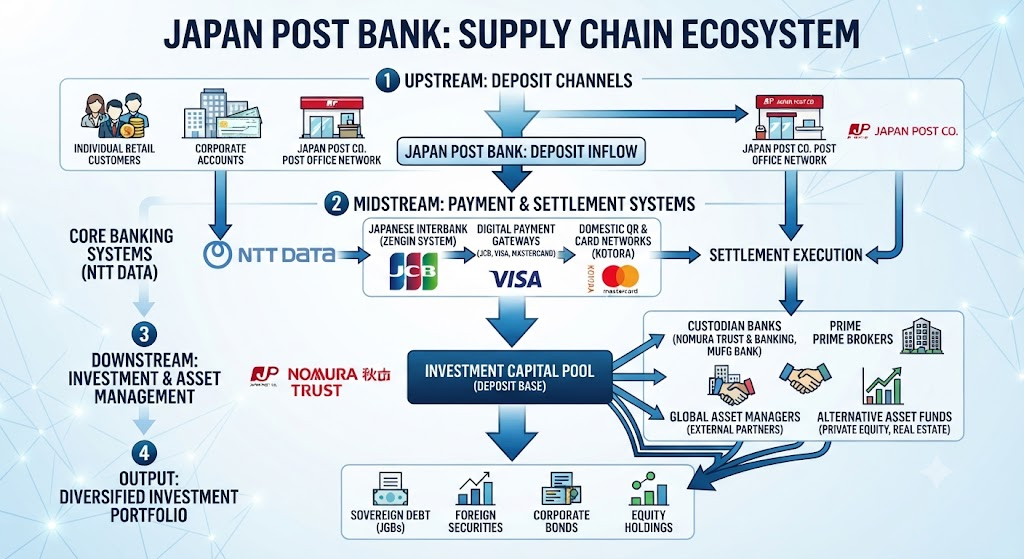
Unlike manufacturing firms, a retail and institutional bank like Japan Post Bank operates within a financial services ecosystem defined by deposit inflows, payment infrastructure, and investment execution partners.
- Deposit Inflow Channels (Upstream):The primary source of funds consists of individual retail depositors and corporate accounts serviced through Japan Post Co.’s nationwide post office counters and proprietary digital mobile applications (such as the Japan Post Bank Passbook App).
- Payment and Settlement Networks (Midstream): For domestic interbank settlements, the bank relies on the Nippon Clearing Corporation and the Data Telecommunications System of All Banks in Japan (Zengin System). For digital and card payments, it collaborates with major payment schemes including JCB, Visa, and domestic QR networks like Kotora.
- Investment and Asset Management Partners (Downstream):Because retail loan demand in Japan is relatively saturated, Japan Post Bank deploys its massive deposit base through its Market Business segment (which generates a significant majority of its revenue). It relies on global asset managers, custodian banks (such as Nomura Trust and Banking and MUFG Bank), prime brokers, and external private equity/real estate fund managers to execute its diversified domestic and international securities portfolios.
- Technology Infrastructure Providers: Core banking systems, network architecture, and security layers are maintained alongside major Japanese technology conglomerates and system integrators (such as NTT Data) to ensure uninterrupted nationwide operations.
Competitor Analysis
Japan Post Bank competes with Japan’s mega-banks and regional financial institutions, though its business model heavily skews toward institutional investing rather than traditional commercial lending.
- Competitor Comparison (Peers): Primary competitors include the three Japanese mega-bank groups—Mitsubishi UFJ Financial Group (MUFG), Sumitomo Mitsui Financial Group (SMFG), and Mizuho Financial Group.
- Business Model and Technology Comparison:
- Asset Allocation: Unlike MUFG or SMFG, which derive substantial revenue from traditional commercial lending, corporate banking, and global project finance, Japan Post Bank historically holds strict caps on risk assets and relies heavily on sovereign debt (JGBs) and foreign securities. However, under recent medium-term management plans, it has aggressively expanded into alternative assets (private equity and real estate funds) to chase higher yields, closing the strategic gap with mega-bank investment arms.
- Retail Reach: Japan Post Bank outperforms all mega-banks in sheer domestic branch density and retail penetration, giving it a virtually unmatched, low-cost stable funding base (deposits).
- Profit Structure: Approximately 88% of Japan Post Bank’s revenue originates from its Market Business (securities investments and interest rate management), compared to an average of around 63% for major global financial peers, exposing its profitability more directly to global bond yields and currency fluctuations.
Information Sources
back to Japan Post Bank