
Market Position and Market Share
Murata Manufacturing Co., Ltd. is the undisputed global market leader in the passive electronic components industry, specifically renowned for its dominance in Multilayer Ceramic Capacitors (MLCCs). The company commands over 15% of the total global ceramic capacitor market share, securing the top ranking worldwide. In high-end and ultra-miniaturized MLCC segments—which are critical for advanced smartphones, automotive powertrain systems, and high-performance computing infrastructure—Murata’s market share exceeds 30% to 40%. Its primary competitive moat stems from proprietary material science capabilities, allowing them to engineer ultra-thin dielectric ceramic layers and maintain superior capacitance stability under extreme voltage and thermal conditions.
Supply Chain Analysis and Key Suppliers
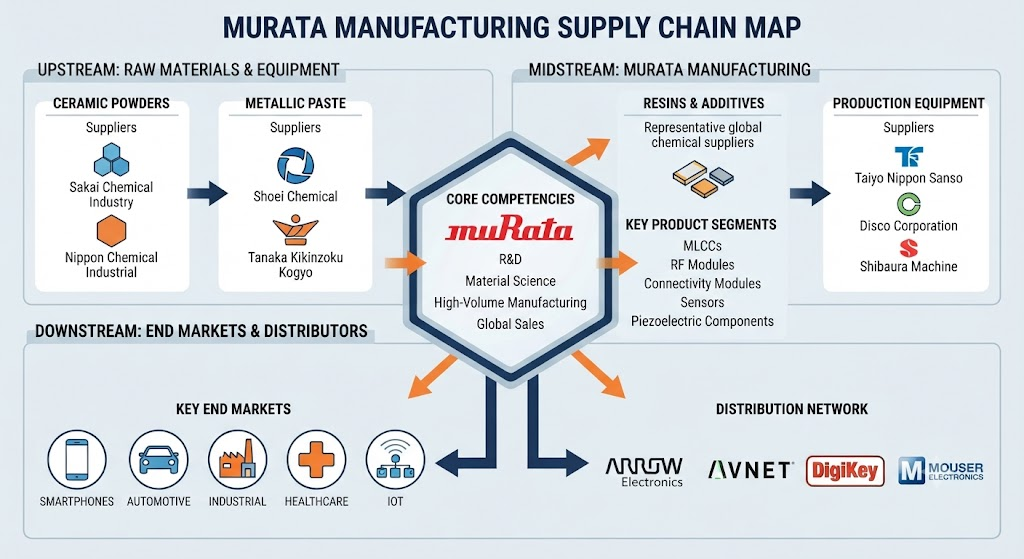
Murata operates an integrated supply chain model that spans fundamental raw material processing, proprietary powder synthesis, precision manufacturing machinery, and a vast global distribution network.
- Upstream Suppliers (Raw Materials and Equipment): The upstream segment focuses on high-purity ceramic raw materials, including barium titanate powders, metallic paste (nickel, copper, and palladium for internal electrodes), and specialized resins. Key upstream material providers include specialized chemical and material enterprises such as Sakai Chemical Industry and Nippon Chemical Industrial, which supply fine-purity ceramic powders vital for layer miniaturization. Additionally, Murata relies on precision machinery and sintering furnace providers (such as Taiyo Nippon Sanso and various Japanese factory automation specialists) to construct its proprietary high-speed green sheet casting and stacking lines.
- Midstream (Internal Manufacturing): Murata maintains strict vertical integration by synthesizing its own ceramic powders and designing specialized production equipment internally, protecting its core manufacturing know-how from external leakage.
- Downstream and Distribution: Downstream customers include tier-1 global smartphone manufacturers (such as Apple), major automotive electronics suppliers, and industrial automation firms. To service these global electronics ecosystems, Murata utilizes prominent authorized global distributors such as Arrow Electronics, Avnet, DigiKey, and Mouser Electronics.
Competitor Analysis: Technical and Financial Comparison
Murata’s primary global competitors in ceramic capacitors and advanced electronic modules include TDK Corporation, Samsung Electro-Mechanics, and Taiyo Yuden.
- Technical Comparison: Murata maintains a structural technological advantage in volumetric efficiency and high-reliability automotive-grade MLCCs, consistently leading competitors in launching ultra-small case sizes (such as 0201 or 01005 dimensions) with high capacitance ratings. While Samsung Electro-Mechanics has aggressively gained ground in high-capacitance consumer electronics MLCCs and TDK excels in magnetic materials and inductive components, Murata holds a distinct edge in high-frequency radio frequency (RF) modules, piezoelectric components, and sensor technology.
- Financial Comparison: From a financial perspective, Murata demonstrates robust profitability and scale. For the fiscal year, Murata generated massive revenues supported by a solid gross profit exceeding 928 billion Japanese Yen and a net income of approximately 233 billion Japanese Yen. Compared to competitors like TDK and Taiyo Yuden, Murata exhibits superior operating margins and capital expenditure discipline, driven by its high mix of proprietary high-margin automotive and industrial components that shield it from severe commoditization pressures in lower-end consumer electronics.
Information Sources
- https://www.gminsights.com/industry-analysis/asia-pacific-ceramic-electric-capacitor-market
- https://www.coherentmarketinsights.com/industry-reports/electric-capacitors-market
- https://craft.co/murata-manufacturing/competitors
- https://www.murata.com/en-us/support/contactinformation
back to Murata Manufacturing