
Market Position And Market Share
Mitsubishi Heavy Industries (MHI) is a premier global industrial heavyweight and Japan’s largest defense contractor, commanding a robust market capitalization exceeding 12 trillion JPY (roughly 80 billion USD). MHI holds a dominant global market position in heavy machinery, gas turbines, and thermal power systems, where it competes head-to-head with Siemens Energy and GE Vernova, capturing a leading tier share of approximately 30% to 35% in the high-efficiency gas turbine (HEGT) market. In the defense and aerospace sector, MHI acts as the prime contractor for Japan’s Ministry of Defense, holding an undisputed domestic monopoly on fighter jet development (such as the next-generation fighter program) and a top-tier standing in commercial spacecraft components and naval shipbuilding. Furthermore, in logistics and environmental systems, its fork-lift and carbon capture technologies rank among the top global market leaders.
Supply Chain Analysis And Key Suppliers
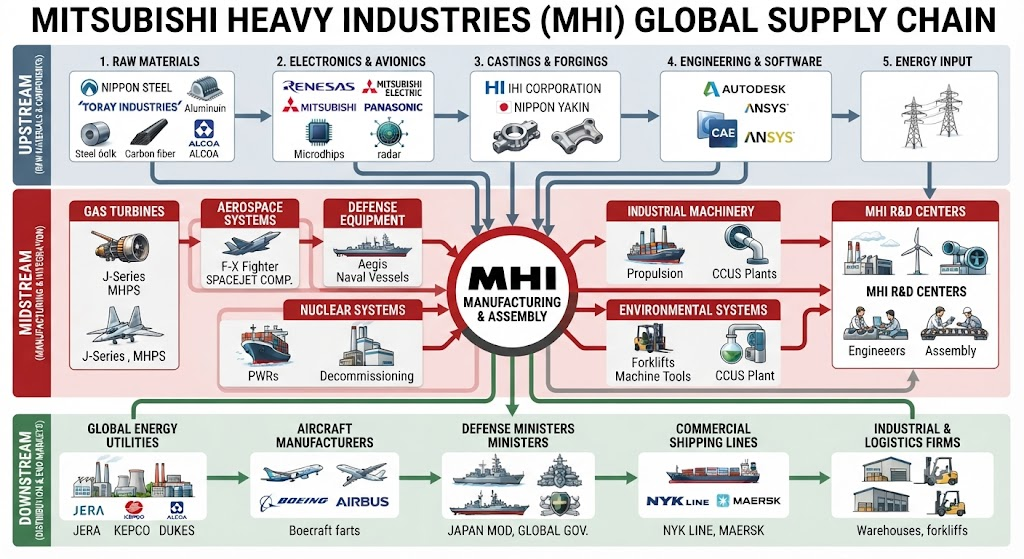
MHI manages a complex, multi-tiered global supply chain characterized by tight technological integration and stringent national security compliance. Upstream suppliers consist of specialized raw material providers delivering high-grade titanium alloys, superalloys, and carbon-fiber-reinforced polymers essential for extreme aerospace and turbine operating conditions. Key material suppliers include major steelmakers and chemical conglomerates such as Nippon Steel and Toray Industries. Midstream component fabrication involves precision casting, forging, and electronic sub-assemblies handled by specialized domestic and international partners, including Kobe Steel for large-scale forgings and various electronics vendors for defense-grade avionics and radar modules. Downstream distribution reaches commercial airlines, global energy utilities, and the Japan Ministry of Defense. MHI maintains deep vertical integration for core intellectual property—such as turbine blade cooling design and nuclear reactor pressure vessels—while outsourcing non-core machining to a trusted network of domestic subcontractors.
Competitor Analysis
MHI faces intense international rivalry across its diversified operating segments, competing primarily against GE Vernova and Siemens Energy in energy systems, and Lockheed Martin and Boeing in aerospace and defense. Technologically, MHI leads the industry in gas turbine thermal efficiency (boasting record-breaking turbine inlet temperatures above 1,600°C) and is a pioneer in hydrogen-ready combustion technologies and carbon capture, utilization, and storage (CCUS) solutions. Financially, MHI exhibits strong operational resilience compared to its European peers; it commands a Price-to-Earnings (P/E) ratio hovering around 31.3x and a Price-to-Sales (P/S) ratio of roughly 2.6x, outperforming several legacy European energy conglomerates in structural profitability and margin recovery. While competitors like GE Vernova focus heavily on pure-play energy transitions, MHI’s diversified conglomerate model—spanning defense, nuclear, marine, and logistics—buffers cyclical downturns, though it historically trades at a slightly lower conglomerate valuation multiple relative to pure-play American defense primes.
Information Sources
- https://companiesmarketcap.com/mitsubishi-heavy-industries/marketcap/
- https://www.investing.com/pro/TSE:7011/compare/TSE:7012TSE:7013TSE:6501TSE:6361SEHK:2338
- https://seekingalpha.com/symbol/MHVIY/peers/comparison
back to Mitsubishi heavy industries