
Company History
- Foundation and Early Expansion: Founded in 1884 when Yataro Iwasaki acquired the Nagasaki Shipyard from the Japanese government, laying the groundwork for heavy shipbuilding and industrial manufacturing.
- Post-War Division: Formed as an integrated entity that was temporarily split into three separate regional companies in 1950 due to anti-monopoly occupation policies, before recombining in 1964 as Mitsubishi Heavy Industries.
- Diversification and Modern Scaling: Expanded aggressively throughout the late 20th century into nuclear power, thermal power systems, aerospace rocketry, and commercial aviation components.
- Strategic Restructuring: Marked by the painful termination of the SpaceJet regional aircraft program following cumulative losses exceeding one trillion yen, leading to a strategic pivot toward high-margin defense sectors, decarbonization technologies, and disciplined capital allocation.
Business Model and Growth Strategy
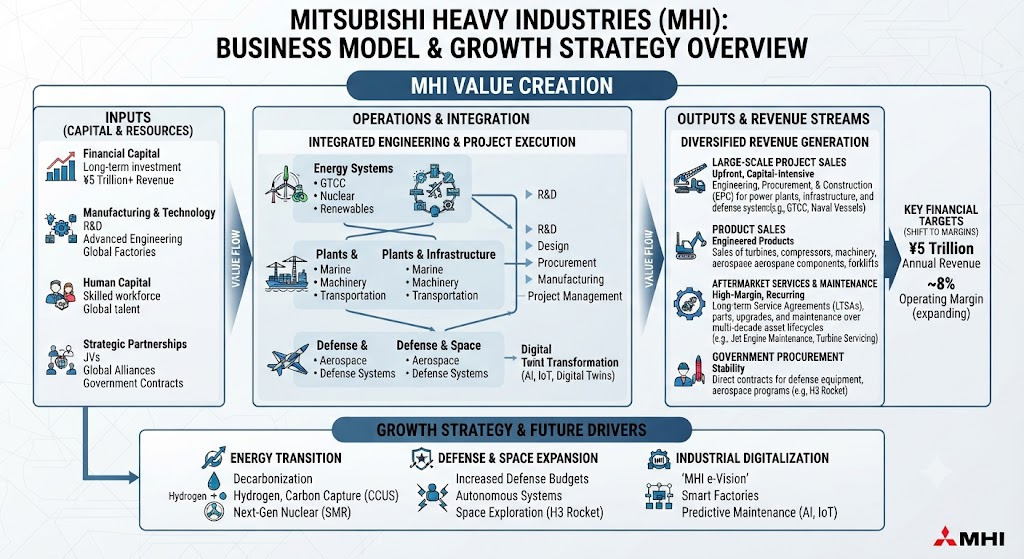
Mitsubishi Heavy Industries generates revenue through capital-intensive, long-cycle engineering projects, engineered product sales, long-term maintenance services, and direct government procurement contracts. The company operates primarily through major segments including Energy Systems, Plants and Infrastructure, and Defense and Space. Monetization relies on securing massive upfront engineering, procurement, and construction contracts, followed by high-margin recurring aftermarket servicing and replacement parts agreements over the multi-decade operational life of the assets.
For instance, its Gas Turbine Combined Cycle (GTCC) systems command substantial global market share, where equipment sales are paired with long-term maintenance service agreements that produce steady cash flow. The company’s financial profile demonstrates a deliberate shift toward margin expansion over sheer top-line volume; consolidated revenue anchors around ¥5 trillion annually, while operating margins have expanded structurally toward roughly 7% to 8.6% driven by disciplined bidding and rigorous project risk management. Growth strategy hinges on capitalizing on global defense budget expansions, decarbonization infrastructure such as hydrogen co-firing and carbon capture, and nuclear power plant modernizations.
Information Sources
- https://www.mhi.com/company/overview/history.html
- https://umbrex.com/resources/company-profiles/mitsubishi-heavy-industries-ltd/
- https://www.fse.or.jp/files/lis_tkj/25110770111.pdf
Artificial Intelligence Strategy and Implementation
Mitsubishi Heavy Industries integrates artificial intelligence and digital transformation deeply into its heavy manufacturing, plant operations, and autonomous defense systems through its proprietary digital platforms like “MHI e-Vision” and collaborative industrial IoT frameworks. Rather than pursuing consumer-facing generative applications, the company deploys AI for predictive maintenance in gas turbines and jet engines, digital twin simulations for complex nuclear and thermal plants, and automated defect detection in heavy fabrication welding.
Budgetary allocation focuses heavily on industrial digital infrastructure and smart factory upgrades across core domestic shipyards and aerospace manufacturing facilities. Key execution partnerships involve global enterprise software and cloud leaders, utilizing advanced sensor analytics and machine learning algorithms to monitor real-time stress, thermal fatigue, and operational efficiency across mission-critical hardware deployed worldwide.
back to Mitsubishi heavy industries