
Corporate History
Founding and Early Growth (1879–1945)
Established in 1879 as Tokyo Marine Insurance Company, it was Japan’s first modern non-life insurer. The firm initially focused on marine hull and cargo policies to facilitate Japan’s rapid Meiji-era industrialization and foreign trade expansion, eventually affiliating closely with the Mitsubishi zaibatsu.
Post-War Reconstruction and Domestic Expansion (1946–2000)
Following World War II, the company rebuilt its core operations around personal auto, fire, and industrial casualty underwriting. As vehicle ownership surged in post-war Japan, Tokio Marine became an indispensable risk carrier for Japanese corporations and retail consumers alike, cementing its status as an industry leader.
Holding Structure and Global Consolidation (2001–2015)
In 2002, the firm merged operations with Nichido Fire to establish Millea Holdings (rebranded as Tokio Marine Holdings in 2008). Facing long-term domestic demographic headwinds, the group initiated a multi-billion-dollar overseas acquisition strategy, acquiring key specialty carriers including Kiln in the UK (2008), Philadelphia Consolidated in the US (2008), and Delphi Financial Group (2012).
Global Maturation and Specialty Expansion (2016–Present)
The group acquired HCC Insurance Holdings in 2015 and Pure Group in 2020, solidifying its presence in high-margin North American specialty lines and high-net-worth personal insurance. Recent milestones include unwinding policyholder cross-shareholdings and securing strategic alliances, such as Berkshire Hathaway’s multi-billion dollar capital tie-up in 2026.
Business Model and Strategy
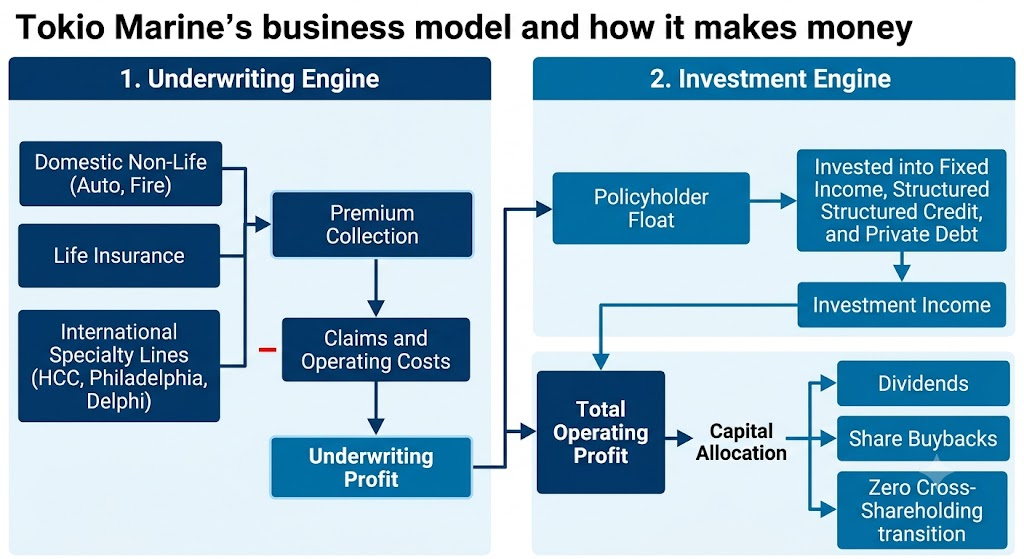
Tokio Marine generates revenue through two distinct mechanisms: the insurance underwriting engine (net earned premiums minus claims paid and operational expenses) and the investment engine (deploying policyholder float and shareholder capital into fixed-income securities, alternatives, and equity markets).
Underwriting Economics and Diversification
The group has systematically rebalanced away from low-margin standard personal auto lines toward specialty commercial underwriting. In fiscal 2025, international business generated net written premiums of ¥3,574 billion (growing roughly 4.6% year-on-year excluding foreign exchange impacts). Its underlying business profit reached a record ¥711.6 billion, with overseas operations contributing more than half of overall group adjusted profit. North American units—principally Philadelphia Insurance, Tokio Marine HCC, and Delphi Financial—command disciplined specialty underwriting margins that yield combined ratios significantly below standard domestic Japanese non-life operations. Domestically, Tokio Marine & Nichido Fire leverages strong distribution networks to push product rate revisions in fire and auto insurance, delivering ¥173.2 billion in business unit profit.
Capital Management and Float Deployment
Tokio Marine utilizes its extensive cash reserves and policy float by allocating into private debt, US municipal bonds, structured credit, and global infrastructure. To optimize return on equity (targeting adjusted ROE above 12-14%), the group is actively divesting its multi-trillion-yen corporate cross-shareholdings (strategic equity holdings) toward a zero-balance target by FY2029. Proceeds are recycled into organic digital transformations, niche bolt-on acquisitions, share buybacks (projected at ¥400 billion for FY2026), and consecutive annual dividend increases.
Sources
- https://www.tokiomarinehd.com/en/ir/financial/
- https://www.insurancebusinessmag.com/uk/news/breaking-news/overseas-earnings-power-tokio-marine-to-record-fiscal-2025-576080.aspx
- https://www.tokiomarinehd.com/en/company/management/
AI Strategy, Investments, and Partnerships
Tokio Marine approaches artificial intelligence as an operational productivity lever and an underwriting tool designed to automate manual policy reviews and accelerate claims settlement.
Strategic Objectives and Resource Allocation
Under its medium-term management plans, the group allocates tens of billions of yen toward digital transformation (DX) and automated IT infrastructure. AI deployment focuses on three operational fronts: automated loss adjustment, conversational customer interaction, and underwriting risk modeling.
Proprietary Enterprise LLM Implementation
Working directly with Microsoft Japan and PKSHA Technology, Tokio Marine built a specialized enterprise-grade conversational AI deployed on Microsoft Azure. The system operates within an isolated tenant environment to ensure customer privacy and regulatory data compliance. The AI model is trained on internal product documentation, underwriting manuals, and regulatory clauses, enabling claims processors and sales agents to extract coverage details and generate policy documentation.
Computer Vision in Automated Claims Processing
Tokio Marine partnered with computer vision firm Tractable to deploy AI-based visual appraisal engines across its auto insurance operations. Using deep learning algorithms trained on millions of historical accident photos and expert adjuster assessments, the system analyzes vehicle damage photographs uploaded via mobile devices in real time. This has compressed settlement appraisal cycles—which previously took up to two to three weeks in Japan—down to touchless or near-instant claim assessments for standard repairs.
Embedded Ecosystems and Insurtech Investments
Beyond operational workflows, Tokio Marine participates in embedded underwriting models through minority investments in ventures like Singapore-based bolttech. Through its corporate venture capital (CVC) vehicles, the group deploys strategic capital into AI startups specializing in parametric climate modeling, fraud detection, and automated underwriting algorithms, integrating external machine learning capabilities across its global business units.
back to Tokio Marine