
History
Origins and Zaibatsu Foundation(1870–1945)
- Roots trace back to Tsukumo Shokai, a maritime shipping operation founded by Yataro Iwasaki in 1870, later renamed Mitsubishi.
- Rapidly expanded into coal mining, shipbuilding, banking, and insurance, growing into one of Imperial Japan’s dominant industrial conglomerates(zaibatsu).
- Played a central role in pre-war Japanese industrialization and logistics, but was formally dissolved by the Supreme Commander for the Allied Powers(SCAP) following World War II.
Post-War Reintegration and Trading Hub Era(1954–1980s)
- In 1954, more than 100 fractured Mitsubishi trading entities merged to re-establish Mitsubishi Corporation, listing on the Tokyo Stock Exchange.
- Served as the critical raw material procurement and export engine for post-war Japanese manufacturing, securing long-term foreign oil, iron ore, and food contracts.
- Transitioned from a pure commission-based broker into an integrated trading giant capable of financing complex cross-border transactions.
Transformation into an Investment and Operating Conglomerate(1990s–Present)
- Facing margin compression from disintermediation(“sogo shosha exclusion”), MC shifted capital toward upstream resource equity investments, acquiring key stakes in Australian metallurgical coal(BMA joint venture) and global LNG projects.
- Diversified downstream into retail, consumer food networks, and renewable energy, marked by the full consolidation of Lawson convenience stores.
- Accelerated portfolio transformation around Energy Transformation(EX) and Digital Transformation(DX), emphasizing active corporate stewardship and capital recycling.
Business Model and Strategy
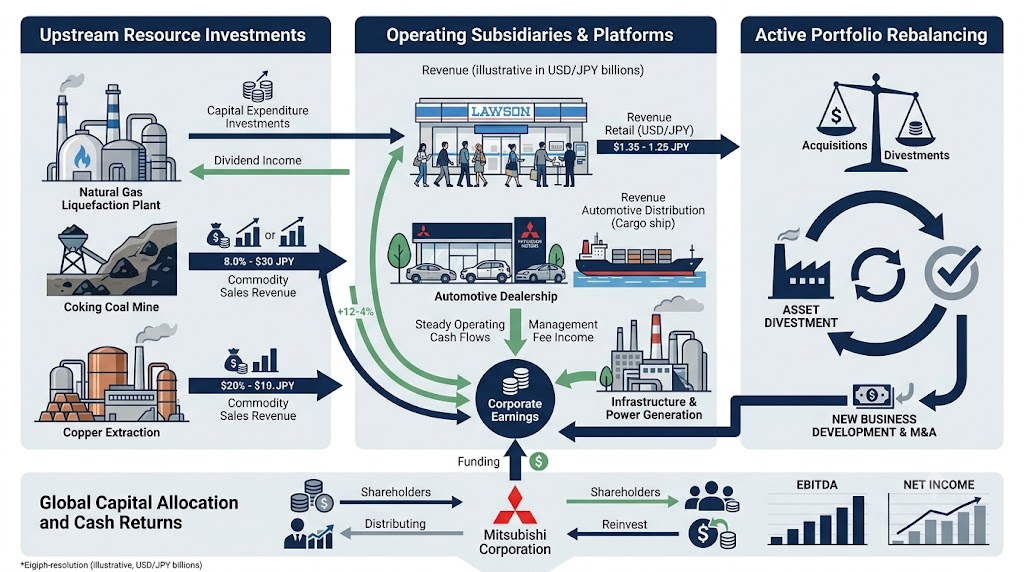
Mitsubishi Corporation does not make money as a simple middleman or distributor. It operates as an integrated principal investment and asset operator, deploying long-term balance sheet equity into operating entities, infrastructure concessions, and resource projects to extract returns through three distinct channels:
- Resource Equity Dividends and Upstream Returns: Takes minority or controlling stakes in tier-1 upstream extraction assets. Earnings derive directly from commodity sales profits and project-level dividend distributions. In peak commodity cycles, the Mineral Resources and Environmental Energy segments account for over 50% of group net profit, driven heavily by coking coal joint ventures with BHP in Australia and global LNG equity liquefaction volumes.
- Operating Subsidiary Cash Flows and Consolidation: Takes controlling or anchor positions in cash-generative industrial and retail assets. For instance, its partnership with KDDI over Lawson and its stakes in food distribution provide non-cyclical, recurring retail operational cash flow that dampens upstream commodity volatility.
- Active Portfolio Rebalancing and Capital Recycling: Continuously monetizes mature, low-return, or non-core assets to harvest substantial capital gains, redeploying proceeds into higher-yielding growth platforms. Under its corporate strategy, MC has divested mature coal mines and real estate asset management platforms while acquiring high-potential upstream assets(such as U.S. shale gas operations).
Financially, under its Midterm Corporate Strategy and Corporate Strategy 2027 frameworks, MC targets an underlying operating cash flow baseline of ¥1.0 trillion to ¥1.25 trillion and sustainable consolidated net income around ¥950 billion to ¥1.1 trillion. Growth capital allocation earmarks more than ¥3 trillion for growth investments, backed by strict discipline to maintain a net debt-to-equity ratio below 0.6x. The company operates a Value-Added Cyclical Growth Model divided into three strategic levers: “Enhance”(expanding existing high-margin core assets), “Reshape”(transforming business models and carrying out strategic M&A), and “Create”(incubating next-generation cross-industry platforms).
Sources
- https://www.mitsubishicorp.com/jp/en/ir/library/meetings/pdf/260501/20260501e.pdf
- https://finance.stockweather.co.jp/contents/dispPDF.aspx?disclosure=20250402507787
- https://quartr.com/events/mitsubishi-corporation-8058-q3-2026_F9lifrs6
- https://umbrex.com/resources/strategy-of-the-fortune-500/strategy-of-mitsubishi/
AI Strategy and Partnerships
Mitsubishi Corporation treats Artificial Intelligence not as an isolated software product, but as an operational force multiplier across its asset base, integrating AI with its broader Digital Transformation(DX) framework alongside its Energy Transformation(EX) initiatives.
- Capital Allocation and Digital Budgeting: MC committed approximately ¥3 trillion in total growth investments across its medium-term planning cycle, with hundreds of billions of yen allocated toward digital infrastructure, enterprise AI enablement, logistics orchestration, and data centers. A major portion of this capital focuses on power-dense data center development in Japan and overseas to capture surging compute demand driven by generative AI.
- Flagship Enterprise Partnership(Lawson & KDDI): In 2024, MC restructured Lawson into a 50:50 joint ownership vehicle with telecommunications giant KDDI. This alliance deploys edge AI cameras, autonomous shelf monitoring, demand-forecasting predictive algorithms, and smart logistics across 14,000+ convenience stores, directly curbing supply chain food loss and reducing store-level labor overhead.
- Industrial AI and Supply Chain Automation: Through dedicated DX operational subsidiaries such as MC Digital, MC develops proprietary algorithmic toolkits for its portfolio companies. Key implementations include predictive maintenance models in heavy industrial machinery, dynamic routing software in maritime shipping, and algorithmic trading models in commodity risk management.
- Global Tech Infrastructure and Hyperscale Alliances: MC collaborates with global cloud providers and technology consortiums to build next-generation green data centers, matching hyperscale AI infrastructure compute loads directly with MC’s captive renewable energy and next-generation power supply agreements.
back to Mitsubishi Corporation