
Corporate History
Origins and Legacy Mergers(1873–2000)
Mizuho traces its lineage back to Japan’s earliest modern financial institutions, including the Dai-Ichi Bank founded by Shibusawa Eiichi in 1873. The contemporary conglomerate took shape through the historic 2000 consolidation agreement combining three major commercial pillars: Dai-Ichi Kangyo Bank(DKB), Fuji Bank, and the Industrial Bank of Japan(IBJ).
Establishment and Early IT Turmoil(2000–2011)
In 2002, the three entities reorganized into Mizuho Bank(retail and SME banking) and Mizuho Corporate Bank(large corporate and institutional clients). The launch in April 2002 was immediately overshadowed by widespread computer network glitches that disrupted ATMs and money transfers nationwide. During the 2008 global financial crisis, Mizuho absorbed significant write-downs from subprime asset exposure. A second major systemic outage followed the 2011 Great East Japan Earthquake, underscoring ongoing IT integration vulnerabilities across the legacy bank platforms.
Restructuring and Modernization(2012–2021)
In 2013, Mizuho merged its retail and corporate banking arms into a single Mizuho Bank to eliminate duplicated overhead. The group invested more than ¥400 billion into building a unified, modern core-banking platform codenamed “MINORI,” which finally completed rollout in 2019. Despite this overhaul, recurring operational glitches in 2021 led to FSA regulatory sanctions and forced a leadership transition, placing current Group CEO Masahiro Kihara at the helm in 2022 to reshape internal governance and risk culture.
Global Expansion and Capital Market Specialization(2022–Present)
Mizuho pivoted toward cross-border corporate and investment banking(CIB). In 2023, the group completed the acquisition of U.S. boutique investment bank Greenhill & Co. for approximately $550 million, significantly strengthening its cross-border M&A advisory and restructuring capabilities across North America and Europe. Under normalizing domestic interest rates, Mizuho redirected its balance sheet toward higher-yielding corporate originations and digital wealth solutions.
Business Model and Growth Strategy
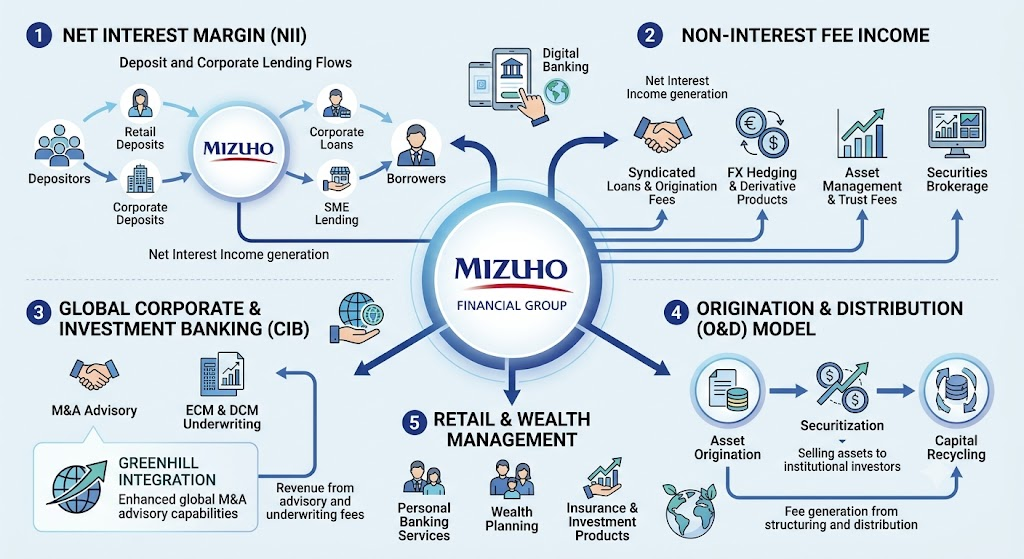
Mizuho generates earnings across five integrated operating segments: Retail & Business Banking, Corporate & Institutional Company, Global Corporate & Investment Banking, Global Markets, and Asset Management. The group operates with total assets exceeding ¥250 trillion and maintains an annual gross profit base surpassing ¥2.5 trillion.
Net Interest Margin and Balance Sheet Repricing
Lending remains the foundation of Mizuho’s income model. After years of negative interest rates, the Bank of Japan’s rate normalization has expanded net interest income(NII). Mizuho holds a loan-to-deposit ratio(LDR) of approximately 50% in yen, backed by a low-cost domestic deposit pool. Every 10-basis-point increase in policy rates translates to tens of billions of yen in net interest margin expansion. Concurrently, Mizuho shortened the duration of its Japanese Government Bond(JGB) holdings to approximately 0.8 years to shield capital reserves from bond depreciation while redeploying liquidity into higher-yielding sovereign and corporate debt.
Non-Interest Fee Income and Cross-Entity Syndication
Mizuho relies on fee generation from syndicated corporate loans, structured trade finance, foreign exchange hedging, asset management, and M&A advisory. By co-locating banking, trust banking, and securities teams under one account management framework, Mizuho monetizes corporate balance sheets across their full lifecycle—arranging initial credit facilities, managing treasury liquidity, underwriting public debt and equity offerings, and advising on succession or cross-border acquisitions.
Capital Recycling and CIB Expansion
Mizuho has transitioned toward an “origination-and-distribution” model to optimize risk-weighted assets(RWA). Rather than holding large syndicated corporate loans to maturity, Mizuho originates debt, structures high-yield bonds and private placements, and syndicates them out to institutional asset managers. Through the Greenhill acquisition, Mizuho has coupled balance-sheet financing with premium advisory fees, capturing cross-border transaction revenue across the United States, Europe, and Asia.
Expense Optimization and Shareholder Returns
Under its medium-term business plan, Mizuho has committed to structural cost discipline, targeting ¥150 billion in fixed-cost reductions through FY2028 by scaling back duplicated branch layouts, streamlining shared group functions, and leveraging operational hubs like Mizuho Global Services in India. The bank targets a Common Equity Tier 1(CET1) ratio between 9.5% and 10.5% and a consolidated total shareholder payout ratio of 50% or more through progressive dividends and tactical share buybacks.
Sources
- https://www.mizuhogroup.com/
- https://library.mizuhogroup.com/asset/2f9d9ed2-70eb-43b4-b9c4-3171415330bc/fg-investors-financial-briefing_20260907_1.pdf
- https://hk.investing.com/equities/mizuho-financial-group,-inc.
- https://en.wikipedia.org/wiki/Mizuho_Financial_Group
Artificial Intelligence Strategy, Budget, and Partnerships
Mizuho views artificial intelligence not merely as back-office tooling, but as a group-wide operating layer dubbed “AI Transformation”(AIX). In April 2024, the bank formally established the AIX Promotion Office, an agile cross-functional hub uniting commercial sales experts, software engineers from Mizuho Research & Technologies, and financial engineering specialists from Mizuho-DL Financial Technology to drive commercialization and operational rollouts.
Internal Generative AI Deployment and the Wiz Ecosystem
Mizuho was among the first Japanese megabanks to authorize group-wide generative AI access. In June 2023, the group introduced Wiz Chat, an enterprise generative AI assistant built on Microsoft Azure OpenAI Service. Initial rollout granted access to 45,000 employees across core lending and brokerage units. Mizuho expanded the Wiz ecosystem with customized enterprise applications:
- Wiz Search: An automated internal query engine that parses regulatory rulebooks, compliance workflows, and institutional procedures across legacy manuals.
- Wiz Create: A generative drafting engine tailored to automate corporate credit approval documentation, loan application memos, and customer proposals, substantially shortening lending appraisal cycles.
Proprietary Modeling and On-Premises Infrastructure
To satisfy stringent regulatory, compliance, and client-data isolation requirements, Mizuho expanded beyond public cloud APIs into proprietary model development. The bank developed Mizuho LLM, an on-premises, finance-specific large language model trained on proprietary financial terminology, transaction histories, and internal compliance benchmarks. Mizuho LLM is engineered to operate strictly within isolated corporate firewalls to process confidential banking transactions without external data leakage risks.
Hardware Partnerships and Security Guardrails
- NVIDIA: Mizuho partnered with NVIDIA to deploy on-premises DGX B200 systems, establishing dedicated GPU compute clusters for model training and ultra-low-latency inference. Concurrently, Mizuho implemented NVIDIA NemoClaw to construct isolated sandbox environments, test network access controls, and verify complete audit logs for autonomous AI agents handling customer portfolio data and algorithmic analysis.
- Microsoft: Mizuho maintains an enterprise partnership centered on Azure OpenAI, utilizing enterprise tenant privacy agreements to prevent employee data from being used in external model training.
Budget and Resource Allocation
Mizuho folds its AI spending into its multi-year digital transformation(DX) capital expenditures, which total several hundred billion yen across the current medium-term plan. Group investments prioritize high-performance computing clusters, cloud API licenses, data lake infrastructure consolidation, and company-wide prompt engineering curricula designed to shift work hours away from administrative documentation toward high-touch advisory services.
Back to Mizuho Financial Group