
Historical Evolution
Founding and Consumer Electronics Genesis(1946–1970s) Founded in 1946 by Masaru Ibuka and Akio Morita as Tokyo Tsushin Kogyo(Tokyo Telecommunications Engineering Corp.), the firm initially built Japan’s first tape recorder, the Type-G. Renamed Sony in 1958, the company pioneered portable transistor radios(TR-55) and revolutionized color displays with the Trinitron television in 1968. The 1979 debut of the TPS-L2 Walkman redefined personal audio consumption globally and established Sony as the definitive consumer brand of the late 20th century.
Global Media Expansion and Software Diversification(1980s–1990s) Recognizing that consumer electronics required compelling proprietary content, Sony pursued aggressive international media acquisitions, buying CBS Records in 1988(now Sony Music Entertainment) and Columbia Pictures in 1989(now Sony Pictures). In 1994, under the leadership of Ken Kutaragi, Sony launched the original PlayStation console, creating an extraordinarily lucrative gaming franchise that altered Sony’s identity from a pure electronics vendor to an integrated hardware-software ecosystem.
Digital Transition Struggles and Corporate Restructuring(2000s–2011) The advent of digital media and the internet fractured Sony’s proprietary hardware silos. Fierce competition from Samsung in flat-panel televisions and Apple in digital audio(iPod) eroded hardware margins, while internal departmental rivalries delayed software integration. Sony suffered massive operating losses across its Bravia TV and mobile divisions, exacerbated by the 2011 PlayStation Network cyberattack and unfavorable currency dynamics.
Strategic Pivot to IP, Subscriptions, and Sensors(2012–Present) Under Kazuo Hirai and subsequently Kenichiro Yoshida and Hiroki Totoki, Sony executed a disciplined turnaround labeled “One Sony.” The company exited unprofitable commodity hardware lines, spun off the VAIO PC business, downsized smartphone production, and aggressively prioritized three cash engines: the PlayStation platform, music/anime publishing(including acquisitions of EMI Music Publishing and Crunchyroll), and high-margin CMOS image sensors. In 2021, the parent company rebranded as Sony Group Corporation to institutionalize its identity as a creative entertainment and technology platform.
Business Model and Strategic Growth
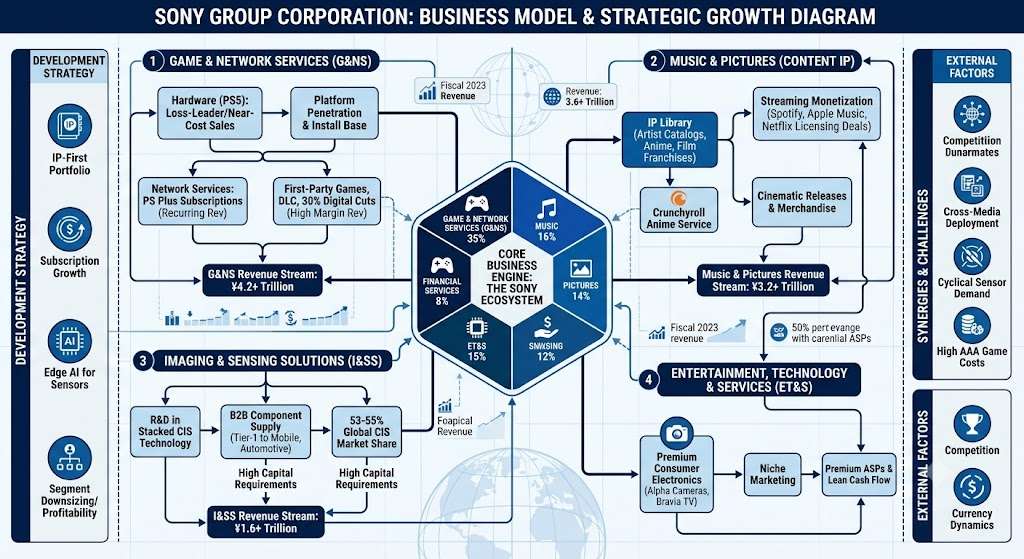
Sony generates revenue across six reporting segments: Game & Network Services(G&NS), Music, Pictures, Imaging & Sensing Solutions(I&SS), Entertainment, Technology & Services(ET&S), and Financial Services. Rather than depending on low-margin hardware assembly, Sony’s model leverages proprietary hardware install bases and specialized component technology to extract recurring, high-margin software, IP licensing, and subscription revenue.
Game & Network Services(G&NS) G&NS represents Sony’s largest revenue engine, generating over ¥4.2 trillion in fiscal 2023. Hardware(PlayStation 5 consoles) is sold at razor-thin margins or near cost to expand platform penetration. The true monetization lies in high-margin software sales, first-party title publishing, 30% platform cuts on third-party digital transactions and DLC, and recurring subscription services via PlayStation Plus(commanding an ARPU of ~$70–$160 depending on tiers).
Imaging & Sensing Solutions(I&SS) Generating over ¥1.6 trillion in annual revenue, Sony operates as an indispensable tier-1 component supplier, controlling approximately 53% to 55% of the global CMOS image sensor value share. Rather than selling finished commodity smartphones, Sony sells proprietary stacked image sensors(Exmor T, LYTIA) to Apple, Xiaomi, Oppo, and automotive Tier-1 suppliers. This segment delivers structural moats due to proprietary semiconductor packaging patents and massive cleanroom CapEx barriers.
Music and Pictures(Content IP Monetization) Sony Music generated over ¥1.6 trillion in revenue, capitalizing on massive catalog streaming payouts from Spotify, Apple Music, and YouTube, alongside high-growth anime streaming through Crunchyroll. The film division operates as an “arms dealer” in Hollywood: unlike Disney or Warner Bros. Discovery, Sony avoided launching a loss-making generalist SVOD service, instead monetizing franchises(e.g., Spider-Man) via box office and multi-billion-dollar output licensing deals to Netflix and Disney+.
Entertainment, Technology & Services(ET&S) Downsized from its legacy scale, ET&S(televisions, soundbars, Alpha cameras) operates with lean discipline, delivering steady cash flow by targeting premium professional niches(Alpha mirrorless cameras commanding premium ASPs above $2,000) rather than chasing commodity consumer volume.
Sources
- https://www.sony.com/en/SonyInfo/IR/library/presen/er/
- https://www.sony.com/en/SonyInfo/IR/library/corporate_report/
- https://www.sec.gov/edgar/browse/?CIK=0000313838
- https://asia.nikkei.com/Companies/Sony-Group-Corp
AI Strategy, Budget, and Key Partnerships
Sony approaches artificial intelligence not as a standalone generative chatbot offering, but as an embedded efficiency driver and perceptual foundation across gaming, edge sensing, and creative production.
R&D Allocation and Investment Scope Sony allocates annual company-wide R&D expenditure exceeding ¥700 billion(approximately $4.7 billion to $5.0 billion), with an expanding double-digit percentage dedicated to core AI technologies under Sony AI, founded in 2020. In addition, the Sony Innovation Fund manages multiple dedicated corporate venture vehicles investing across early-to-growth AI startups, allocating over $500 million across active portfolios targeting computer vision, generative creator tooling, and machine learning infrastructure.
Core Implementations
- Sony AI & Gran Turismo Sophy: Sony developed “GT Sophy,” an autonomous reinforcement learning AI agent trained on PlayStation’s cloud infrastructure in partnership with Polyphony Digital. Sophy demonstrated superhuman driving performance against world-champion esports drivers, validating Sony’s capability in reinforcement learning algorithms that optimize non-linear real-time mechanics.
- PlayStation Spectral Super Resolution(PSSR): Incorporated directly into the PlayStation 5 Pro silicon architecture, PSSR leverages proprietary machine learning neural networks to upscale frame rates and resolutions dynamically, matching PC-grade AI upscaling(Nvidia DLSS) without overburdening thermal or silicon budgets.
- Edge AI Image Sensors(AITRIOS / IMX500 Series): Sony produces the world’s first CMOS sensor with onboard AI processing logic. By executing edge inference directly on the sensor die without streaming raw video to the cloud, latency drops to sub-milliseconds while drastically reducing network bandwidth and privacy compliance exposure for smart retail and smart factory deployments.
Key Partnerships and Alliances
- Microsoft: In a landmark strategic alliance, Sony partnered with Microsoft to co-develop cloud-based solutions, utilizing Microsoft Azure data center infrastructure for Sony’s cloud gaming streaming backbones while integrating Sony’s intelligent image sensors with Azure IoT AI tools.
- Honda(Sony Honda Mobility Inc.): A 50-50 joint venture developing the “AFEELA” electric vehicle, integrating Level 2+/Level 3 autonomous driving AI models supported by Qualcomm’s Snapdragon Digital Chassis and Epic Games’ Unreal Engine 5 for spatial computing and infotainment.
- Raspberry Pi: Sony made strategic equity investments in Raspberry Pi to integrate Sony’s AITRIOS edge-AI processing hardware and developer toolkits directly into low-cost edge computing architectures for enterprise developers worldwide.
Back to Sony