
Corporate History
Phase 1: Foundation and Trading Origins (1963–1979)
The company was established in 1963 as Tokyo Electron Laboratories, Inc., initially funded by Tokyo Broadcasting System (TBS). In its early days, TEL operated primarily as a specialized trading firm, importing advanced semiconductor manufacturing equipment, electronics, and testing instruments from American manufacturers such as Fairchild Semiconductor and Thermco into the burgeoning Japanese market.
Phase 2: In-House Manufacturing and Technology Licensing (1980–1999)
During the 1980s, TEL transitioned from an import merchant to a domestic equipment manufacturer. It established manufacturing joint ventures and licensing agreements with US companies—most notably Tel-Thermco for diffusion furnaces and TEL-Varian for ion implanters—before acquiring full autonomy. The company listed on the Tokyo Stock Exchange in 1980 and expanded its proprietary portfolio into plasma etching, cleaning systems, and coater/developers, riding the wave of Japan’s semiconductor boom.
Phase 3: Global Expansion and Lithography Integration (2000–2019)
TEL aggressively built out an international footprint across Taiwan, South Korea, North America, and Europe. It solidified an indispensable technological partnership with lithography pioneer ASML, optimizing its coater/developer systems to seamlessly connect with ASML immersion and Extreme Ultraviolet (EUV) scanners. During this era, TEL divested non-core assets to focus on wafer fab equipment and withstood the collapse of a proposed mega-merger with Applied Materials in 2015 due to US regulatory antitrust resistance.
Phase 4: Advanced Nodes, Geopolitical Realignment, and 3D Architectures (2020–Present)
TEL pivoted to address atomic-level scaling, 3D device packaging, and gate-all-around (GAA) transistor structures. The company achieved major breakthroughs in cryogenic etching for high-aspect-ratio structures and advanced wafer bonding. Simultaneously, TEL has navigated international trade restrictions, redirected capacity to meet surging artificial intelligence demand, and committed record capital expenditures to expand domestic fabrication infrastructure in Miyagi and Kumamoto.
Business Model and Development Strategy
TEL’s business model relies on high-margin, mission-critical tool sales combined with long-term aftermarket field services, rather than commodity hardware delivery.
Primary Revenue Generation: Semiconductor Production Equipment (SPE)
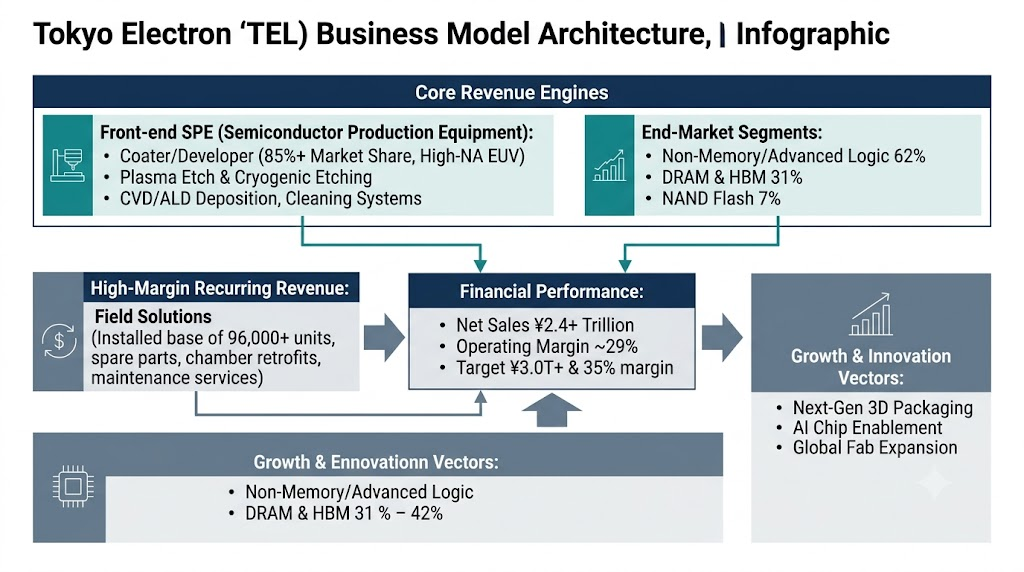
The company earns the vast majority of its revenue through the design, fabrication, and direct sale of complex front-end wafer fabrication tools. For fiscal year 2025 (FY2025), TEL reported net sales of ¥2,431.5 billion, representing a 74% increase from FY2021. Operating profit reached ¥697.3 billion, delivering an operating margin of 28.7% and a gross profit of ¥1,146.2 billion.
Equipment revenue is categorized across device architectures:
- Non-memory (advanced logic, foundries, and legacy nodes): Accounted for 62% of SPE sales in FY2025.
- DRAM: Accounted for 31% of SPE sales in FY2025, buoyed by the rapid rollout of High-Bandwidth Memory (HBM) stacks.
- Non-volatile memory (NAND Flash): Accounted for 7% of SPE sales in FY2025.
TEL captures pricing power through technological moats:
- Coater/Developer Platforms: Systems like the CLEAN TRACK LITHIUS Pro series hold an industry-standard position, capturing over 85% of the global market and nearly 100% of the High-NA EUV inline track segment.
- Etch and Deposition: Tools such as the Episode 1 single-wafer CVD system integrate multi-chamber modules with a 45% smaller footprint, reducing native oxide and titanium deposition contact resistance in sub-2nm nodes.
Secondary High-Margin Revenue: Field Solutions (FS)
TEL leverages an active global installed base exceeding 96,000 systems. The Field Solutions business acts as a countercyclical cash generator by monetizing:
- High-turnover consumables, replacement parts, and maintenance service contracts.
- Chamber retrofits, precision recipe calibrations, and legacy tool refurbishment.
- Fab relocation and tool repurposing across 200mm and 300mm wafer lines.
Growth Strategy and Financial Targets
TEL’s medium-term management blueprint targets net sales of ¥3.0 trillion or more, an operating profit margin exceeding 35%, and a Return on Equity (ROE) above 30% by FY2027. To secure this, the company pursues:
- Expansion into adjacent whitespace: Capturing market share in single-wafer plasma CVD, physical vapor deposition (PVD), and laser lift-off systems.
- Advanced Packaging: Providing precision temporary bonding/debonding and wafer-edge trim systems required for heterogeneous 2.5D/3D packaging and chiplet integration.
- Geographic Balancing: Diversifying revenue away from mainland China (which dropped from 47.4% in Q4 FY2024 to 34.3% in Q4 FY2025) while ramping shipments to foundry and memory customers in Taiwan, South Korea, and the United States.
Business Model Sources
- https://www.tel.com/ir/library/report/l8gqgo00000000gl-att/fy25q4presentations-e.pdf
- https://www.tel.com/ir/library/ar/pjsoh100000000rc-att/ir2025_all_en.pdf
- https://www.tel.com/ir/library/report/cghpfh00000000km-att/FY25Q4_EarningCall_QA_E.pdf
- https://umbrex.com/resources/company-profiles/tokyo-electron-ltd/
Artificial Intelligence Strategy, Budget, and Partnerships
AI-Centric Product and Hardware Development
TEL’s product roadmap directly targets the manufacturing bottlenecks of generative AI accelerators, GPUs, and High-Bandwidth Memory (HBM3e/HBM4):
- Cryogenic Etch Technology: TEL commercialized dielectric etch systems operating at sub-zero temperatures (below -70°C). This allows high-rate, vertical etching for deep memory holes (aspect ratios exceeding 80:1) required for 400-layer 3D NAND and HBM base dies while lowering global warming potential gas emissions by over 80%.
- Heterogeneous Packaging and Wafer Bonding: AI compute architectures require high-density interconnects. TEL supplies permanent wafer-to-wafer and die-to-wafer hybrid bonding equipment, alongside laser de-bonding tools capable of handling thin wafers without warp or structural defect.
- Edge AI in Fab Equipment: TEL embeds autonomous process monitoring inside tool chambers (such as the Episode 1 platform). The systems utilize real-time sensor feedback and edge inference to self-correct plasma drift, auto-calibrate gas flows, and predict component wear, minimizing unplanned wafer scrap.
Budget and Investment Commitments
To sustain leadership across AI-era node transitions, TEL executed an aggressive capital allocation plan spanning five fiscal years (FY2025 through FY2029):
- R&D Budget: Committed over ¥1.5 trillion in cumulative research and development spending over the five-year period, representing approximately 10% to 11% of anticipated revenues. In FY2025 alone, annual R&D expenses reached ¥250 billion.
- Capital Expenditures: Allocated over ¥700 billion over five years for manufacturing and laboratory expansion. Key expenditures include a ¥100 billion production facility and development hub in Miyagi for etch technology, alongside expanded development facilities in Koshi, Kumamoto.
- Human Capital: A worldwide hiring campaign to recruit 10,000 engineers and technicians over five years to staff its AI equipment programs.
Strategic Ecosystem Partnerships
TEL avoids developing equipment in isolation, maintaining collaborative development agreements across the semiconductor value chain:
- imec (Interuniversity Microelectronics Centre): Collaborative programs at imec’s facilities in Leuven, Belgium, centered on High-NA EUV lithography track integration, extreme ultraviolet resist chemistry, and backside power delivery network (BSPDN) modules.
- IBM: Multi-decade joint development partnership at the Albany NanoTech Complex in New York, focusing on advanced logic scaling, nanosheet device patterning, and AI chip architecture enablement at sub-2nm nodes.
- Rapidus: Close engagement with Japan’s state-backed foundry initiative in Chitose, Hokkaido, supplying equipment and on-site engineering teams to pilot 2nm gate-all-around (GAA) logic manufacturing.
- Leading Foundries and Memory Makers: Joint development programs with TSMC, Samsung Electronics, and SK Hynix to co-develop dedicated modules for next-generation HBM architectures and advanced packaging packaging lines.
Back to Tokyo Electron