
Market Position and Market Share
Elia Group is one of Europe’s top five Transmission System Operators(TSOs) by regulated asset base and system size. The group operates through two primary regulated regulated entities: Elia Transmission Belgium(ETB) in Belgium and 50Hertz Transmission in Germany(where Elia owns an 80% controlling stake alongside the German state-owned KfW at 20%).
- Belgium Market: Elia holds a 100% legal monopoly(market share) as the national high-voltage transmission system operator, operating over 5,900 km of lines and underground cables, managing the entire Belgian extra-high voltage grid(30 kV to 380 kV).
- Germany Market: 50Hertz operates as one of four German transmission system operators alongside TenneT, Amprion, and TransnetBW. It controls approximately 30% of Germany’s geographic territory(covering Berlin, Brandenburg, Hamburg, Mecklenburg-Western Pomerania, Saxony, Saxony-Anhalt, and Thuringia) and integrates over 60% of the renewable generation capacity across its control area.
- Scale & Financial Metrics: Elia Group oversees over 19,300 km of high-voltage lines and cables across both territories, serving more than 30 million end-users. The company reported a market capitalization of approximately €13.8B to €16.3B, annual revenue of €4.44B(2025), and net profit of €683M.Its cumulative capital expenditure pipeline from 2026 to 2028 is estimated at €21.6B.
Upstream and Downstream Supply Chain Analysis and Key Suppliers
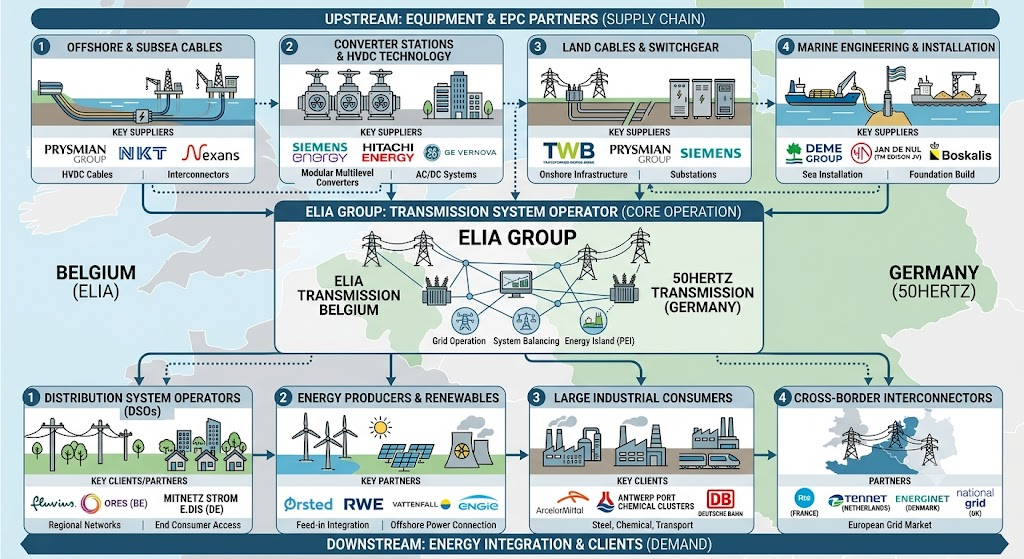
Elia Group functions as the central transmission backbone of the energy transition, sitting directly between primary electricity generation and regional distribution networks.
- Upstream Supply Chain:
- Offshore and Onshore Renewable Generation: Large-scale offshore wind developers in the North Sea and Baltic Sea(e.g., Ørsted, RWE, Vattenfall, Parkwind) feed electricity directly into Elia’s and 50Hertz’s offshore converter platforms.
- Conventional Generation & Cross-Border Flows: Power plants, nuclear operators(such as Engie/Electrabel in Belgium), and adjacent European national TSOs(RTE France, TenneT Netherlands/Germany, Energinet Denmark, and National Grid UK via the Nemo Link interconnector).
- Equipment and EPC Contractors(Critical Bottlenecks):
- High-Voltage Direct Current(HVDC) Converters & Switchgear: Siemens Energy, Hitachi Energy, and GE Vernova. These suppliers provide the modular multi-level converter(MMC) stations essential for long-distance subsea transmission corridors like SuedOstLink.
- Subsea & Underground Cables: Prysmian Group, NKT, and Nexans. Transmission cable manufacturing capacity is structurally constrained globally; Elia secures multi-year framework agreements to lock in supply.
- Marine Civil Engineering & Dredging: DEME Group and Jan De Nul(via the TM EDISON joint venture), responsible for executing the civil construction and gravity-based caissons for the Princess Elisabeth Island—the world’s first artificial energy island.
- Downstream Integration:
- Distribution System Operators(DSOs): In Belgium, power steps down to regional DSOs including Fluvius(Flanders), Sibelga(Brussels), and ORES/RESA(Wallonia). In Germany, 50Hertz delivers power to distribution entities such as Stromnetz Berlin, Mitnetz Strom, and E.DIS.
- Direct Transmission-Connected Industrial Consumers: Chemical clusters(Antwerp Port petrochemical zone), steel manufacturers(ArcelorMittal), and heavy rail networks(Infrabel, Deutsche Bahn).
Competitor Analysis: Technical and Financial Comparison
In regulated electricity transmission, competition does not manifest as direct consumer bidding; rather, TSOs benchmark against each other for regulatory return on equity(RoE), capital execution efficiency, and cross-border interconnection concessions. Key European peers include TenneT(Netherlands & Germany), Terna(Italy), and Redeia / Red Eléctrica(Spain).
- Technical Comparison:
- Offshore and Meshed HVDC Innovation: Elia is arguably the global pioneer alongside TenneT in meshed offshore direct current systems. While TenneT operates a larger total offshore capacity in the German North Sea(2 GW standardized platform model), Elia leads in novel concept execution with its Princess Elisabeth Island, integrating multi-terminal HVDC with international interconnectors(Nautilus to the UK).
- Renewable Grid Integration: 50Hertz operates in an area where intermittent renewable generation routinely exceeds 65% to 70% of gross power demand, requiring industry-leading automated dynamic line rating(DLR) and wide-area redispatch systems compared to Terna or Redeia, which face different climatic and solar-dominant balancing dynamics.
- Financial Comparison:
- Capital Expenditure Intensity: Elia Group’s 2026–2028 capex target of €21.6B represents an aggressive regulatory asset base(RAB) expansion rate exceeding 20% compound annual growth. TenneT has experienced balance sheet constraints due to massive German expansion requirements, prompting past state equity intervention discussions.
- Leverage and Returns: Terna and Redeia typically maintain higher dividend yields(3.5%–5%) and lower reinvestment requirements due to more mature, slower-expanding domestic networks. In contrast, Elia operates at a lower dividend yield(~1.1%–1.5%) and higher reinvestment rates, trading at a higher P/E multiple(~20x–22x) due to its high-growth regulated asset base trajectory. Both 50Hertz and ETB operate under regulatory models allowing allowed RoE indexed to sovereign interest rates, protecting core profitability against debt refinancing spikes.
Sources
- https://www.eliagroup.eu
- https://www.investing.com/news/transcripts/earnings-call-transcript-elia-groups-q4-2025-results-show-robust-growth-93CH-4543372
- https://www.justetf.com/en/stock-profiles/BE0003822393
- https://pitchbook.com/profiles/company/60397-93
- https://growjo.com/company/50Hertz_Transmission_GmbH
- https://www.offshorewind.biz/2026/08/24/all-foundations-in-place-for-worlds-first-artificial-energy-island
- https://www.deme-group.com/news/deme-and-jan-de-nul-joint-venture-set-build-worlds-first-energy-island-elia
Back to Elia