
Market Position and Market Share
Exor N.V. is one of Europe’s largest diversified investment holding companies, controlled by the Agnelli family through Giovanni Agnelli B.V. (holding approximately 53% of issued share capital and around 85% of voting rights). Historically centered in Turin and now headquartered in the Netherlands and listed on Euronext Amsterdam (ticker: EXO), Exor operates as an active, long-term capital allocator across global industrial, mobility, healthcare, and luxury sectors.
- Gross and Net Asset Value:As of year-end 2025, Exor reported a Gross Asset Value (GAV) of €37.1 billion and a Net Asset Value (NAV) of approximately €35.5 billion (estimated based on reported GAV minus gross debt). NAV per share stood at approximately €175 to €180.
- Market Capitalization and NAV Discount:Exor trades at a public market capitalization of approximately €15.0 billion to €16.0 billion, reflecting a persistent holding-company discount to NAV of approximately 45% to 52%.
- European and Global Ranking: Within the European closed-end investment holding company sector, Exor ranks among the top three listed family-controlled investment firms by total asset scale, closely trailing Sweden’s Investor AB (AUM/NAV exceeding €70 billion) and competing directly with Groupe Bruxelles Lambert (GBL, NAV ~€18-20 billion) and Sofina (NAV ~€9-10 billion).
- Key Portfolio Holdings Market Shares:
- Ferrari N.V. (Ownership: ~21-24%; voting rights: ~36%): Accounts for roughly 40-45% of Exor’s NAV. Ferrari holds a leading position in the ultra-luxury sports car market with an operating margin exceeding 27%.
- Stellantis N.V. (Ownership: ~14.2%; voting rights: ~23%): One of the world’s top five automotive original equipment manufacturers (OEMs) by global vehicle deliveries (holding ~15-18% light vehicle market share in Europe and ~9-11% in North America).
- CNH Industrial (Ownership: ~27%; voting rights: ~43%): Holds the #2 global market share in agricultural machinery behind Deere & Company, with approximately 20-25% global market share in high-horsepower tractors and combines.
- Royal Philips N.V. (Ownership: ~17.5%): A top-3 global player in health technology, diagnostic imaging, and patient monitoring, holding over 20% global market share in patient monitoring and image-guided therapy.
Supply Chain Upstream and Downstream Analysis & Key Suppliers
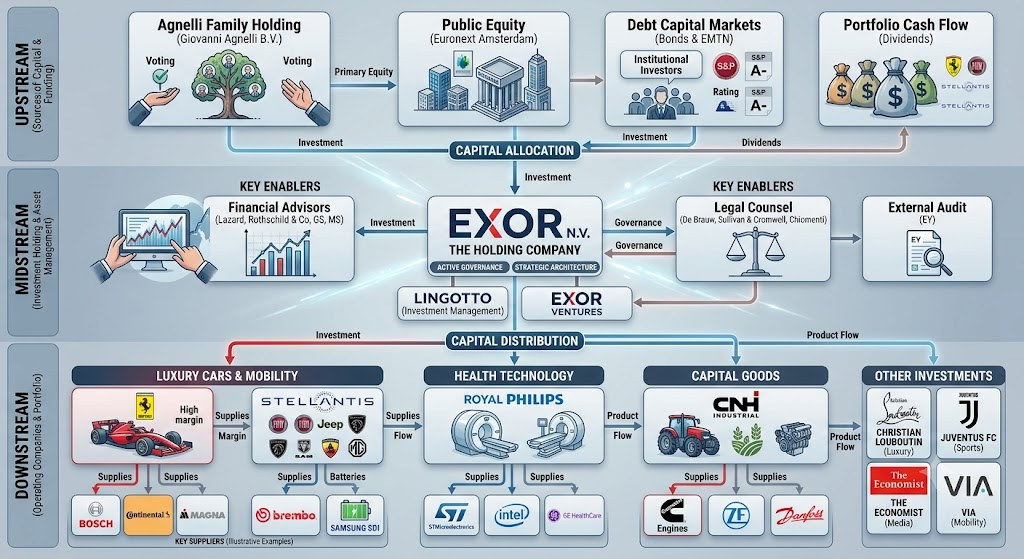
Because Exor N.V. operates as an investment holding company rather than an industrial operating unit, its supply chain corresponds to financial capital sourcing (upstream), capital allocation and strategic asset governance (midstream), and portfolio operating company distribution and monetization (downstream).
- Upstream Supply Chain (Capital Inflow and Funding Sources):
- Equity Capital Core: Anchor capital is provided by Giovanni Agnelli B.V., providing permanent, multi-generational equity that insulates Exor from hostile takeovers and short-term redemption pressures.
- Debt Financing and Bond Markets: Exor utilizes its Euro Medium Term Note (EMTN) programme to issue senior unsecured bonds. Rated A- (stable) by S&P Global Ratings, it sources liquidity from institutional fixed-income markets across Europe and the UK.
- Banking Syndicates: Key lending and credit-line providers include major European and US investment banks such as BNP Paribas, Intesa Sanpaolo, UniCredit, Citi, and JPMorgan Chase, which provide revolving credit facilities (RCF) to manage holding-level liquidity.
- Portfolio Dividend Streams: Cash upstreaming occurs via dividends distributed primarily by Ferrari, Stellantis, and CNH Industrial, which fund share buybacks, holding operating costs, and new private investments.
- Midstream Value Chain (Corporate Governance & Asset Management):
- Direct Governance: Exor exercises control through concentrated voting structures, board chairmanships (e.g., John Elkann), and committee representation across core holdings.
- Asset Management Platforms:Exor operates Lingotto (an independent alternative investment management firm managing internal and third-party capital) and Exor Ventures (early-to-growth stage venture capital vehicle).
- Downstream Supply Chain (Portfolio Verticals & Value Realization):
- Automotive, Mobility & Transport:Ferrari, Stellantis, and Via Transportation.
- Healthcare Technology & Life Sciences: Royal Philips and specialized healthcare platforms.
- Luxury & Lifestyle: Christian Louboutin (24% stake) and Shang Xia.
- Media, Sports & Capital Goods: CNH Industrial, Juventus Football Club (63.8% ownership), and The Economist Group (~43% stake).
- Exit Channels:Liquidity generation takes place through secondary offerings, strategic trade sales (such as the €8.6 billion sale of PartnerRe to Covéa in 2022, and partial divestments in Iveco Group), or open-market stake pruning.
- Key Strategic Suppliers (Professional and Transaction Infrastructure):
- M&A and Financial Advisory: Lazard, Rothschild & Co, Goldman Sachs, and Morgan Stanley provide transactional advisory for large-scale acquisitions and reorganizations.
- Legal Counsel: De Brauw Blackstone Westbroek (Dutch corporate governance), Sullivan & Cromwell (US securities and international transactions), and Chiomenti (Italian corporate law).
- Audit and Compliance: Ernst & Young (EY) acts as independent external auditor.
Competitor Analysis: Technical, Structural, and Financial Comparison
Exor competes against premier European listed industrial holding companies (Investment Companies) and global capital allocators. Its primary peers include Investor AB (Sweden, Wallenberg family), Groupe Bruxelles Lambert (GBL) (Belgium, Frère family), Sofina (Belgium, Boël family), and Berkshire Hathaway (US).
- Portfolio Construction and Concentration:
- Exor: Highly concentrated. Top three holdings (Ferrari, Stellantis, Philips) account for more than 65-70% of total Gross Asset Value. This induces high NAV volatility tied to cyclical automotive demand and industrial performance.
- Investor AB: Balanced across Core Listed Companies (Atlas Copco, ABB, AstraZeneca, SEB) and Patricia Industries (100%-owned unlisted MedTech/industrial assets). Lower single-asset concentration risk than Exor.
- Sofina / GBL: Sofina is heavily exposed to private equity, digital platforms, and venture funds; GBL mixes private equity (Sienna Investment Managers) with listed European large-caps (Pernod Ricard, SGS).
- Berkshire Hathaway: Employs an insurance float model with wholly-owned operating businesses (BNSF, Berkshire Hathaway Energy, GEICO) and a large public equity portfolio (Apple, American Express, Coca-Cola).
- Governance and Technical Allocation Model:
- Exor: Hybrid operator-investor approach. Employs Dutch corporate law loyalty voting rights to maintain outsized voting control relative to equity ownership. It acts as an active industrial architect (e.g., orchestrating the FCA-PSA merger into Stellantis, and carving out Ferrari and Iveco).
- Investor AB: World-benchmark board stewardship model with long-term industrial board leadership, relying on Swedish dual-class share structures (Class A shares carrying 1 vote, Class B carrying 1/10th vote).
- Berkshire Hathaway: Decentralized, passive operational governance. Invests permanently and delegates nearly 100% of operational control to operating CEOs without active board interference.
- Financial Metrics and Balance Sheet Health:
- Loan-to-Value (LTV) Ratio: Exor maintains a conservative investment-grade LTV target of below 15-20%, with an S&P rating of A-. Investor AB operates with an even lower leverage profile (LTV typically between 2% and 6%).
- Holding Company Discount: Exor trades at one of the highest structural NAV discounts in Europe (roughly 45-52%), caused by its automotive exposure and high voting concentration. Investor AB trades at a much narrower discount (typically 5-15%) or occasional parity due to its consistent long-term TSR (Total Shareholder Return) track record. GBL trades at a 25-35% discount.
- Cash Generation and Reinvestment:Exor historically received large, lumpy cash inflows (e.g., €8.6 billion from PartnerRe), which it reallocates into large minority cornerstone stakes (e.g., Philips) and extensive share repurchases. By contrast, Berkshire finances acquisitions organically using its non-debt insurance float (exceeding $160 billion).
Information Sources
- https://www.exor.com/sites/default/files/2023/document-documents/EXOR_Annual%20Report%202022.pdf
- https://www.exor.com
- https://stockanalysis.com/quote/ams/EXO/
- https://augustynanalytics.com/analysis/exor-analysis/
- https://fintel.io/i/exor
- https://en.wikipedia.org/wiki/Exor_(company
Back to Exor