
Market Position and Market Share
Poste Italiane S.p.A. is Italy’s largest logistics, postal, and multi-service platform, operating as a systemically vital hybrid enterprise combining postal/logistics, retail banking(BancoPosta), life insurance(Poste Vita), and payments/telecom(PostePay).
- Mail Services: Poste Italiane maintains a near-monopoly in statutory universal postal services and traditional letter delivery, holding over 95% market share across Italy.
- Parcel and Courier Delivery:According to regulatory figures from AGCOM(Autorità per le Garanzie nelle Comunicazioni), Poste Italiane ranks #1 overall in the combined Italian postal and parcel delivery sector with approximately 33.1% aggregate market volume share, handling over 300 million parcels annually driven heavily by B2C e-commerce. In the B2C segment specifically, its market share reaches roughly 35%–38%, outpacing regional courier aggregators.
- Financial and Savings Network: Through BancoPosta and in partnership with state lender Cassa Depositi e Prestiti(CDP), it manages approximately €600 billion in Total Financial Assets(TFA). It controls a dominant position in Italian postal savings(Libretti Postali and Buoni Fruttiferi Postali).
- Life Insurance: Through its subsidiary Poste Vita, Poste Italiane ranks as the #1 life insurance operator in Italy with gross premium written market shares hovering between 18% and 20%, rivaling Assicurazioni Generali and Intesa Sanpaolo Vita.
- Digital Payments and Cards: PostePay is the undisputed #1 prepaid card brand in Italy, managing over 30 million payment cards and representing more than 30% of national prepaid electronic transactions.
Supply Chain Analysis and Key Suppliers
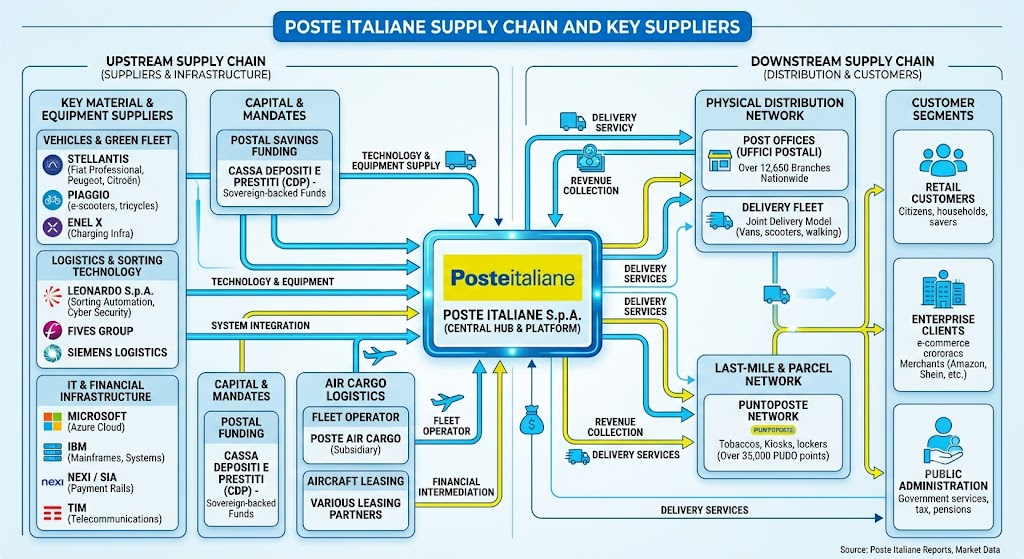
Poste Italiane acts as a nationwide logistics, financial intermediation, and digital transaction hub. Its business model bridges physical transport infrastructure with electronic retail networks.
- Upstream Supply Chain:
- Vehicles and Green Fleet: Poste operates one of Europe’s largest delivery fleets(over 30,000 vehicles). Fleet procurement is sourced from automotive OEMs and commercial leasing partners such as Stellantis(Fiat Professional, Peugeot, Citroën) and Piaggio(electric tricycles and scooters), alongside EV fleet charging infrastructure provided by Enel X and Free2move.
- Postal and Warehouse Automation: Sorting hubs rely on advanced cross-belt sorters, automated storage and retrieval systems(ASRS), and computer vision hardware supplied by engineering leaders such as Leonardo S.p.A.(postal sorting automation systems), Fives Group, and Siemens Logistics.
- IT and Financial Infrastructure: Core banking, payment processing, cloud, and cybersecurity systems depend on partnerships with Microsoft(Azure cloud integration), IBM, SIA/Nexi(card clearing and POS rails), Mastercard and Visa(card issuance schemes), and TIM(telecommunications backbone).
- Aviation Freight Logistics: Poste Italiane operates its proprietary air cargo airline, Poste Air Cargo(formerly Mistral Air), utilizing leased Boeing 737 freighters to connect mainland hubs with Sicily, Sardinia, and regional destinations.
- Underwriting Capital and Public Mandates: On the financial side, Cassa Depositi e Prestiti(CDP) supplies the sovereign-backed savings certificates distributed across post counters.
- Downstream Supply Chain:
- Physical Distribution: Downstream delivery relies on a physical network of 12,650+ brick-and-mortar post offices(Uffici Postali), covering nearly 100% of Italian municipalities.
- Last-Mile Hubs and Lockers: The PuntoPoste locker and partner network(comprising tobacconists, kiosks, and convenience stores via its LIS acquisition) counts over 35,000 PUDO(Pick-Up/Drop-Off) collection points.
- Enterprise and End Customers: B2C e-commerce merchants(Amazon, Shein, Temu, Vinted, Zalando), public administration bodies(INPS, Agenzia delle Entrate for tax notifications and pensions), SMEs, and over 45 million Italian consumers.
- Key Strategic Suppliers:
- Leonardo S.p.A.(Sorting automation technology and defense-grade cybersecurity)
- Nexi S.p.A.(Payment gateway architecture and clearing systems)
- Stellantis N.V.(Fleet supply)
- Microsoft Corporation(Enterprise cloud infrastructure)
- Amazon(Acts simultaneously as a downstream enterprise client and an upstream co-load logistics partner)
Competitor Analysis: Technical and Financial Comparison
Because Poste Italiane is an omnichannel conglomerate, its competition is bifurcated between logistics operators and financial/fintech institutions.
- Main Competitors:
- Logistics & Parcels: DHL Group(Deutsche Post DHL), BRT(DPD Group), GLS Italy, Amazon Logistics, and FedEx/TNT.
- Banking, Asset Management & Payments: Intesa Sanpaolo, UniCredit, and fintech platforms(Revolut, Nexi, Satispay).
- Life Insurance: Assicurazioni Generali, Intesa Sanpaolo Vita, and Allianz Italia.
- Technical Comparison:
- Network Topology vs. Point-to-Point Express: Competitors like DHL Express and FedEx prioritize asset-heavy air networks and time-definite international transit. In contrast, Poste Italiane deploys the “Joint Delivery Model,” combining universal postal delivery with parcel drop-offs by foot, van, and scooter across dense urban and rural last-mile corridors.
- PUDO and Locker Density: In Italy, Poste Italiane’s PuntoPoste network and post office footprint outmatches DHL’s ServicePoints and InPost’s locker footprint within suburban and rural geographies, though InPost and Amazon lead in autonomous automated parcel locker(APL) density in major metropolitan centers like Milan and Rome.
- Digital Platform Stack: In payments, PostePay’s app is ubiquitous among Italian households(over 10 million daily active app users). However, compared to modern neo-banks like Revolut or pure-play payment schemes like Satispay, PostePay’s legacy back-end systems suffer from higher technical debt and slower interface modularity.
- Financial Comparison:
- Revenue and Top-Line Scale:Poste Italiane generated consolidated revenues exceeding €12.6 billion to €13.1 billion in 2024–2025.By comparison, DHL Group operates at global revenues exceeding €80 billion, but in the domestic Italian parcel market alone, Poste Italiane generates approximately €1.7 billion in parcels and logistics, maintaining higher domestic volume than BRT or GLS.
- Operating Margin(EBIT):Poste Italiane posted an Adjusted EBIT of €2.96 billion in 2024 and over €3.2 billion in 2025(Operating margin ~23–25%). This high aggregate margin is largely subsidized by high-margin Financial Services(Net Interest Income from Italian government bond portfolios) and Insurance Services, offsetting the historically low margin of the Mail & Parcel division(~1% to 3% margin). In contrast, commercial banks like Intesa Sanpaolo and UniCredit achieve pure-banking cost-to-income ratios below 45%, whereas Poste’s high physical labor base(120,000 employees) results in higher overall personnel costs.
- Capital Adequacy and Risk Exposure: Poste Vita holds a Solvency II ratio above 300%, significantly above the European insurance regulatory minimum and higher than Generali(~210–220%). BancoPosta maintains a Total Capital Ratio around 22.7%–23.2%. However, BancoPosta does not issue direct commercial corporate loans, investing almost entirely in Italian sovereign debt(BTPs) and deposits at the central bank, which lowers credit default risk compared to traditional lending banks like UniCredit, but increases sensitivity to Italian sovereign spreads.
Sources
- https://www.posteitaliane.it/en/investors/financial-statements-and-reports/growth-revenues-e-profitability
- https://www.posteitaliane.it/en/business/business-areas
- https://www.media.poste.it/894a40e5-2d0c-4631-a725-49b43dd740b3/file/PI_Q4-FY-24_25_Guidance_PR_ENG
- https://www.agcom.it/sites/default/files/media/allegato/2025/AGCOM_Osservatorio%20n1-2025_EN.pdf
- https://www.generali.com/doc/jcr:3243411c-fad5-4663-b6ce-d69db7442f3c/lang:en/Dossier2017docingl.pdf
Back to Poste Italiane