
Market Position and Market Share
D’Ieteren Group operates as an investment holding company with dominant or leading positions across its core portfolio businesses:
- Belron (Vehicle Glass Repair, Replacement, and Recalibration – VGRR):Belron is the undisputed #1 global player in the VGRR sector, operating in over 30 countries under flagship brands such as Safelite (United States), Carglass (Continental Europe), Autoglass (United Kingdom), and Lebeau (Canada).In the United States, Safelite commands an estimated market share exceeding 40%, making it more than four times larger than its closest direct competitor. Globally, Belron generates over €7.7 billion in annual revenues and accounts for the vast majority of D’Ieteren Group’s operating profit.
- D’Ieteren Automotive (Vehicle Distribution and Mobility): D’Ieteren Automotive is the #1 vehicle distributor in Belgium. It has served as the exclusive importer and distributor of Volkswagen Group brands (Volkswagen, Audi, Škoda, SEAT, Cupra, Porsche, Bentley, Lamborghini, and Bugatti) for decades. In the Belgian new passenger car market, D’Ieteren maintains a market share between 22.8% and 24.2%, while capturing approximately 24% market share specifically in the Battery Electric Vehicle (BEV) segment.
- TVH Parts (Material Handling and Industrial Equipment Spare Parts): TVH is the #1 independent global distributor of replacement parts for forklifts, industrial equipment, earthmoving machinery, and agricultural tractors. Outside of OEM proprietary captive networks, TVH holds the top market share globally, servicing customers in over 180 countries with a database tracking over 47 million part references.
- Parts Holding Europe (PHE – Independent Automotive Aftermarket Parts): PHE is a top-tier independent multi-brand distributor of vehicle spare parts in Western Europe. It holds the #1 or #2 market position in France (operating Autodistribution and online pure-play Oscaro) and strong positions in Belgium, Luxembourg, the Netherlands, and Spain.
- Moleskine: Moleskine is a globally recognized market leader within the premium stationery, notebook, and creative writing tools segment.
Supply Chain Analysis and Key Suppliers
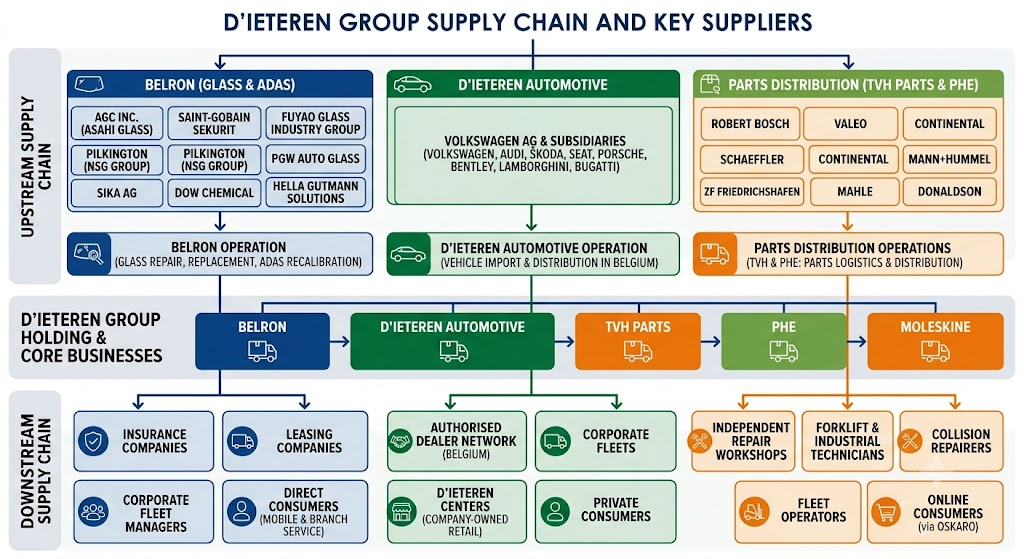
D’Ieteren’s multi-business structure requires analyzing distinct upstream procurement and downstream distribution mechanics across its core assets:
- Upstream Supply Chain and Key Suppliers:
- Belron: The primary procurement inputs are automotive replacement glass (windshields, side windows, rear glass), polyurethane structural adhesives, primers, and specialized Advanced Driver Assistance Systems (ADAS) recalibration diagnostic hardware. Key primary glass suppliers include the world’s leading automotive flat and laminated glass fabricators: AGC Inc. (Asahi Glass), Saint-Gobain Sekurit, Fuyao Glass Industry Group, Pilkington (NSG Group), and PGW Auto Glass. For chemical bonding agents and high-performance adhesives, Belron relies primarily on chemical manufacturers such as Sika AG and Dow. Diagnostic optical recalibration equipment and software platforms are developed and procured in direct technical collaboration with Tier-1 diagnostics specialists like Hella Gutmann Solutions and Robert Bosch.
- D’Ieteren Automotive: The upstream supply chain is entirely single-sourced and tied to Volkswagen AG and its manufacturing subsidiaries (Audi AG, Škoda Auto, SEAT S.A., Dr. Ing. h.c. F. Porsche AG). Vehicles, factory options, and OEM genuine spare parts are imported directly from European manufacturing hubs to central Belgian logistics depots.
- TVH Parts & PHE: Sourcing involves an expansive global supply base of Tier-1 and Tier-2 mechanical, electrical, and hydraulic component manufacturers. Key upstream suppliers include Robert Bosch, Valeo, Schaeffler, ZF Friedrichshafen, Continental, Mahle, Mann+Hummel, and Donaldson. In addition, both TVH and PHE source unbranded replacement parts directly from specialized global manufacturers under private-label brands (e.g., TotalSource for TVH; Isotech for PHE) to protect gross margins.
- Downstream Supply Chain:
- Belron: The downstream customer channel is heavily intermediated by auto insurance companies, corporate leasing firms, and fleet managers (such as State Farm, GEICO, and Allstate in North America; AXA, Allianz, and Ayvens/LeasePlan in Europe). These institutional gatekeepers refer policyholders directly to Belron’s network. Service delivery occurs either through stationary physical retail service centers (over 2,500 worldwide) or through mobile mobile-service vans dispatched to end-user locations.
- D’Ieteren Automotive: Downstream distribution operates via a hybrid model of independent franchised dealerships and company-owned retail hubs (D’Ieteren Centers), selling directly to private end-consumers, small-and-medium enterprises, and large corporate fleet accounts across Belgium.
- TVH Parts & PHE: Operates a high-speed B2B hub-and-spoke logistical network. Downstream clients include independent collision repairers, mechanical workshops, forklift maintenance technicians, and fleet operators who demand same-day or next-morning deliveries. PHE also operates a direct-to-consumer (B2C) e-commerce channel via Oscaro.
Competitor Analysis: Technical and Financial Comparison
D’Ieteren’s main subsidiaries compete across different aftermarket and mobility segments:
- Key Competitors:
- Belron: Competes against multi-shop collision repair networks that offer glass services such as Boyd Group Services Inc.(Gerber Collision & Glass), Driven Brands (Auto Glass Now, CARSTAR), Caliber Collision, PGW Auto Glass distribution networks, and regional independent mom-and-pop glass repair shops.
- PHE & TVH: Compete directly against multinational aftermarket distribution giants such as LKQ Corporation (LKQ Europe), Alliance Automotive Group (owned by Genuine Parts Company / GPC), and OEM captive equipment distributor networks (e.g., Toyota Material Handling, KION Group/Linde, Jungheinrich).
- D’Ieteren Automotive: Competes with alternative brand automotive import and dealer groups in Benelux, including Emil Frey, Van Mossel Automotive Group, and Alcopa.
- Technical Comparison:
- ADAS Recalibration Leadership: Belron holds a distinct technical moat in vehicle glass replacement due to the rising complexity of ADAS sensors (cameras, LiDAR, radar mounted to windshields). While smaller regional independents often struggle with the capital expenditure and multi-brand software required to calibrate modern camera systems, Belron has institutionalized standardized static and dynamic recalibration protocols across its entire branch footprint. This capability gives Belron preferential treatment from insurance carriers who require certified safety compliance.
- Proprietary Parts Cross-Referencing Databases: TVH maintains an internal technical catalog of over 47 million cross-referenced equipment part numbers. Because industrial equipment often lacks standardized universal VIN numbering like passenger vehicles, TVH’s proprietary data engine allows technicians to instantly identify interchangeable alternative components, creating a substantial switching cost compared to generic parts wholesalers.
- Logistical Automation and Delivery Density: PHE and LKQ Europe both utilize highly automated central distribution warehouses, but PHE maintains localized urban route density in France and Spain that enables up to three-to-four delivery runs daily to local garages, matching or exceeding competitors’ service-level agreements.
- Financial Comparison:
- Operating Margins: Belron delivers adjusted operating margins of 20% to 23%, significantly higher than the typical 8% to 12% margins seen in general collision repairers (e.g., Boyd Group Services generates adjusted EBITDA margins around 11% to 13%) and general automotive distribution (e.g., LKQ Corporation typically posts operating margins around 10% to 12%). D’Ieteren Automotive operates at lower margins typical of auto dealerships (adjusted operating margin around 4.7%).
- Cash Flow Generation and Financial Leverage: Belron is an asset-light, high-cash-conversion business (frequently converting 80% to 90%+ of operating profit into trading cash flow). This allows Belron to carry high standalone debt loads (e.g., issuing over €8 billion in term loans and secured notes in 2024 to fund special distributions to shareholders) without impairing the holding company’s balance sheet. D’Ieteren Group maintains a conservative holding net debt position of approximately €300 million at the corporate level.
- Resilience and Cyclicality: Compared to traditional OEM-tied auto dealers or pure automotive collision companies, D’Ieteren’s portfolio is insulated by non-discretionary insurance spending (windshield repair is non-deferrable safety work covered by insurance) and mission-critical logistics maintenance (TVH), shielding group cash flow from broader consumer economic downturns.
Sources
- https://www.dieterengroup.com/press-releases/dieteren-group-full-year-2025-results
- https://www.dieterengroup.com/annual-reports/annual-report-2024
- https://www.dieterengroup.com/dieteren-automotive
- https://annualreport.aviglobal.co.uk/assets/pdf/13_Case%20studies/PDF/AVI_AR_2024_case_study_D_ieteren_Belron.pdf
- https://www.investing.com/news/transcripts/earnings-call-transcript-dieteren-group-posts-strong-h1-2026-growth-as-auto-unit-weakens-93CH-4894284
- https://www.belron.com/discover-belron/our-brands
- https://www.tvh.com/parts/by-market/material-handling-equipment
Back to D’leteren