
Corporate History
Early Foundation and Hydro Roots (1905–1960s)
The company was originally founded in December 1905 as Norsk Hydro (Norsk hydro-elektrisk kvælstofaktieselskab) by Sam Eyde, Kristian Birkeland, and Marcus Wallenberg Sr.. Leveraging Norway’s abundant hydroelectric resources and the Birkeland-Eyde industrial process to extract nitrogen from the air, the firm became the world’s first industrial manufacturer of mineral nitrogen fertilizer. It quickly expanded internationally, establishing early export channels to Europe and Asia.
Global Expansion and Consolidation (1969–2003)
Beginning in the late 1960s, the company diversified and internationalized its production footprint. A key turning point was the 1969 joint venture in Qatar (Qafco), securing low-cost natural gas feedstock in the Middle East. Throughout the 1970s and 1980s, Norsk Hydro executed aggressive cross-border M&A, acquiring major European fertilizer operations in France, Germany, the Netherlands, and the UK, followed by entries into Latin America (such as Adubos Trevo in Brazil) and South Africa during the 1990s.
Demerger and Public Listing (2004–2018)
On March 25, 2004, Norsk Hydro spun off its agri-chemicals and fertilizer division, listing it independently on the Oslo Børs as Yara International ASA. Post-demerger, Yara expanded its production footprint through strategic acquisitions—including Kemira GrowHow (2007) and Bunge’s Brazilian fertilizer assets (2013)—while building out specialized industrial gas solutions and precision agriculture toolsets.
Decarbonization and Digital Transformation (2019–Present)
Yara transitioned its core strategy toward clean ammonia, regenerative agriculture, and digital farming platforms. It established a dedicated Clean Ammonia business unit, deployed Europe’s first large-scale carbon capture and storage (CCS) supply chains at its Sluiskil facility, and optimized regional asset portfolios to navigate European gas shocks and carbon border adjustment mechanisms (CBAM).
Business Model and Monetization Strategy
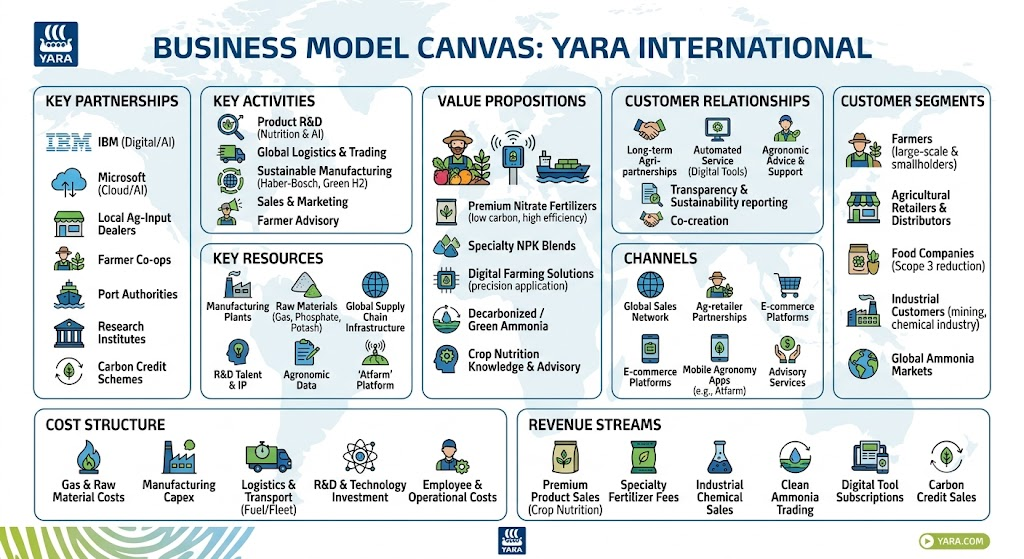
Yara International makes money primarily through the conversion of natural gas and atmospheric nitrogen into ammonia, which is then upgraded into higher-margin chemical compounds and sold across agriculture and heavy industry. Rather than competing solely as a low-cost bulk commodity producer, Yara structures its revenue generation around four interconnected pillars:
- Nitrogen Upgrading and Premium Fertilizer Margins: Instead of selling standard commodity urea, Yara focuses on upgraded nitrates (such as Calcium Ammonium Nitrate) and complex NPK blends. These premium crop-nutrition products sell at structural price premiums over standard urea because of their higher nutrient efficiency, predictable delivery, and lower field volatilization. In financial years such as 2024, Yara generated approximately $13.93 billion in group revenue and over $2.05 billion in EBITDA, with upgraded product premiums forming the core margin driver across its regional operating segments (Europe, Americas, and Africa & Asia).
- Industrial Chemical and Environmental Solutions: Yara monetizes nitrogen derivatives outside agriculture through its Industrial Solutions segment. It supplies industrial-grade nitrates for civil explosives in mining, nitrogen chemicals for chemical synthesis, and technical reagents like AdBlue (diesel exhaust fluid) for selective catalytic reduction (SCR) in heavy transport to abate nitrogen oxides ($NO_x$). This segment delivers stable, contract-based cash flows with lower seasonal volatility than farm-gate crop cycles.
- Global Ammonia Trading and Logistics Arbitrage: Yara is the world’s largest merchant trader of ammonia, operating a proprietary network of specialized gas carriers, terminal storage tanks, and import hubs. The Clean Ammonia segment generates commercial trading margins by buying, selling, and arbitraging regional gas price spreads between North America, the Middle East, and Europe. This fleet logistics capability allows Yara to curb European production when regional natural gas becomes uncompetitive and import lower-cost ammonia from global affiliates to keep downstream nitrate plants running.
- Commercialization of Decarbonized and Precision Products: Yara monetizes sustainability by pricing “green” and “blue” ammonia and low-carbon nitrate fertilizers at a premium for food companies and shipping lines targeting Scope 3 emissions reductions. Digital platforms (such as Atfarm and N-Sensor) act as commercial funnels that lock commercial growers into the Yara ecosystem, optimizing farm-gate application rates while protecting market share.
Sources for Business Model
- https://www.yara.com/investor-relations/
- https://www.forbes.com/companies/yara-international/
- https://www.phosphorusplatform.eu/espp-members/1668-Yara
- https://www.agribusinessreview.com/yara-international
AI Strategy, Partnerships, and Implementation
Yara’s artificial intelligence and digital strategy centers on transitioning from a pure volume manufacturer into an outcome-based agronomic solutions provider. Rather than treating AI as an isolated IT function, the company embeds machine learning across three operational layers: digital precision farming, industrial process optimization, and enterprise supply-chain intelligence.
- Strategic Partnerships and Core Infrastructure: Yara established a landmark global technology partnership with IBM to construct a cloud-native Digital Farming Platform. The architecture pairs Yara’s crop science and agronomic models with IBM’s Watson Studio, machine learning engines, and hyper-local atmospheric data from The Weather Company. Yara has also expanded cloud and analytical integrations with Microsoft Azure to run enterprise-scale computer vision and process-control telemetry across its chemical processing assets.
- Algorithmic Solutions and Concrete Use Cases:
- Atfarm and Variable Rate Application (VRA): Yara’s core digital tool, Atfarm, utilizes satellite imagery (Sentinel-2) combined with proprietary machine learning algorithms and the N-Sensor biomass calibration index. The model translates multispectral optical indices into field-level variable-rate nitrogen application maps, allowing farmers to reduce fertilizer over-application by up to 10% to 15% while improving grain yields.
- Predictive Agronomy (Adapt-N): Yara commercializes Adapt-N, an AI-driven soil and crop simulation engine that computes dynamic nitrogen availability in real time based on soil microbiology, weather patterns, and crop growth stages.
- Industrial Digital Twins: At its flagship production sites in Sluiskil (Netherlands) and Porsgrunn (Norway), Yara utilizes machine learning digital twins to optimize energy consumption during the Haber-Bosch synthesis process. Predictive maintenance algorithms analyze acoustic and thermodynamic telemetry on high-pressure compressors to preempt unscheduled downtime, protecting millions of dollars in continuous throughput margins.
- Scale, Coverage, and Resource Allocation: While Yara does not break down AI software development as an isolated public accounting line item, digital farming and technology development form a key part of the group’s continuous operational improvement and commercialization budgets. The company’s stated operational ambition for its digital farming platforms has targeted reaching over 100 million hectares of connected agricultural land worldwide, linking smallholders and commercial enterprises into an integrated, AI-guided nutrient ecosystem.
Back to Yara International