
Corporate History
Foundational and Primary Care Era (1929–1975)
Founded in 1929 by Henri Beaufour in Dreux, France, the company began as Laboratoires Beaufour, launching digestive products like Smecta. Throughout this phase, the business functioned as a regional family-run pharmaceutical enterprise primarily serving primary healthcare markets.
Specialty Care and International Expansion (1976–2005)
Under the leadership of Albert and Gérard Beaufour, the company pivoted toward complex peptide chemistry and specialty therapeutics. During this period, Ipsen established major research and manufacturing sites in the United Kingdom and France, launching key specialty assets including the peptide hormone analogue Somatuline and acquiring the rights to the botulinum neurotoxin Dysport. In 2005, the company completed its initial public offering on the Euronext Paris exchange.
Specialty Pure-Play Transition (2006–2019)
Ipsen aggressively phased out lower-margin primary care activities to reposition itself as a global specialty care innovator. Key commercial licensing transactions were executed during this era, such as in-licensing global commercial rights (excluding the United States and Japan) for cabozantinib (Cabometyx) from Exelixis. The group also expanded its manufacturing footprint in the United States and deepened commercial partnerships for Dysport in aesthetic indications with Galderma.
External Innovation and Diversification (2020–Present)
Facing impending generic competition for Somatuline, Ipsen launched an accelerated external-innovation strategy. Under CEO David Loew, the company completed the divestment of its remaining consumer healthcare business in 2022 to focus entirely on specialty care. Ipsen acquired Albireo Pharma in 2023 for $952 million to capture the rare pediatric liver disease franchise Bylvay, secured the accelerated launch of Iqirvo (elafibranor) through a collaboration with Genfit, and acquired Imcheck Therapeutics to enhance its immuno-oncology pipeline.
Business Model and Strategic Growth
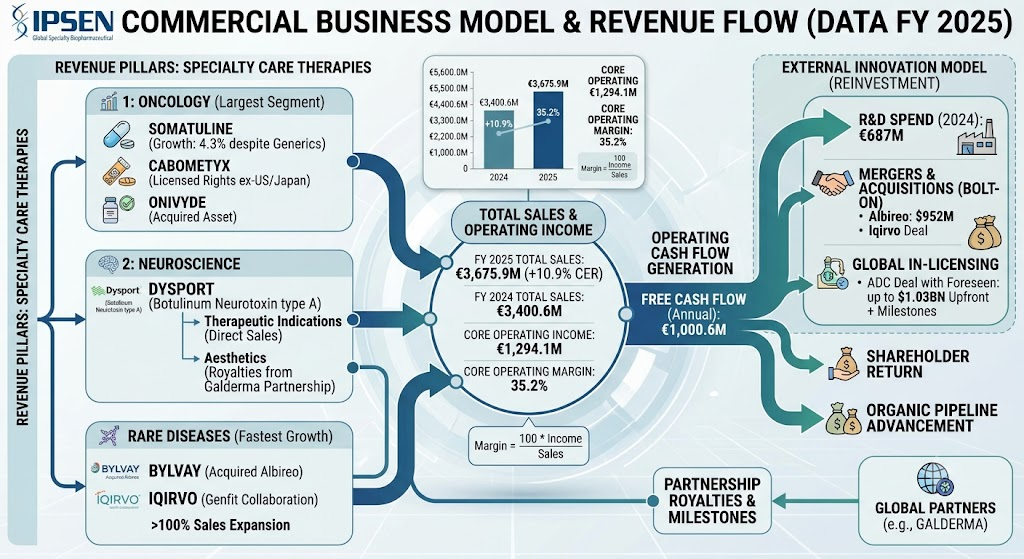
Ipsen generates revenue by commercializing specialty pharmaceuticals across hospital and specialist physician networks, deriving revenue from direct drug sales and licensing royalties. In FY 2025, total sales reached €3,675.9m (an 8.1% reported increase and 10.9% growth at constant exchange rates), up from €3,400.6m in FY 2024. The company generated a core operating income of €1,294.1m in 2025, delivering a core operating margin of 35.2% (up from 32.6% in 2024), and generated €1,000.6m in annual free cash flow.
The revenue generation model is structured across three specialty pillars:
- Oncology: The largest segment, representing mature volume from Somatuline (lanreotide, which grew 4.3% in 2025 despite generic pressures), alongside Cabometyx (cabozantinib) and Onivyde (irinotecan liposome).
- Neuroscience: Anchored by Dysport (botulinum neurotoxin type A), generating steady revenues from therapeutic indications (spasticity, cervical dystonia) and substantial milestone/royalty streams from Galderma for aesthetic distribution.
- Rare Diseases: The fastest-growing growth engine (surpassing 100% sales expansion in 2025), driven by newly approved therapies such as Iqirvo (for primary biliary cholangitis) and Bylvay (for progressive familial intrahepatic cholestasis).
Ipsen’s growth strategy relies on an external innovation model backed by more than €5bn in allocated capital capacity. Because Ipsen deliberately avoids high-risk, early-stage exploratory biology in-house, it reinvests its high operating cash flow (R&D spend of €687m in 2024) into in-licensing clinical-stage assets, acquiring single-product biotechs, and funding Phase II/III clinical trials. By acquiring de-risked assets, navigating global regulatory approvals, and deploying an existing specialized hospital sales infrastructure, Ipsen captures immediate commercial margin without carrying foundational laboratory overhead.
Information Sources for Business Model
- https://www.ipsen.com/press-release/ipsen-delivers-strong-results-in-2025-driven-by-solid-execution-across-all-therapeutic-areas-and-provides-2026-guidance-3236839/
- https://ml-eu.globenewswire.com/Resource/Download/1031e2b7-7eea-46e8-8e1e-74cc00499e14
- https://www.ipsen.com/science/
- https://www.ipsen.com/science/partnering/
AI Strategy, Investments, and Partnerships
Strategic Governance and Architecture
Ipsen directs its artificial intelligence strategy through the Global Data & AI Division, embedded within Global Digital & Information Technology (GDIT). Rather than training proprietary foundation models from scratch, Ipsen executes an application-first, business-enabler model. The strategy prioritizes automating knowledge extraction, screening external business development targets, and compressing clinical development timelines across its R&D and Medical functions.
Resource Allocation and Digital Budget
Digital and computational R&D initiatives are financed directly out of Ipsen’s annual research and development budget (€687m in 2024), coupled with enterprise digital transformation allocations. Business development investments targeting AI-discovered assets are substantial; for instance, Ipsen committed up to $1.03bn in upfront and milestone payments for an AI-identified preclinical oncology candidate.
Partnerships and Commercial Implementations
- Foreseen Biotechnology: In July 2024, Ipsen secured an exclusive global licensing agreement valued at up to $1.03bn for FS001, a first-in-class antibody-drug conjugate (ADC). The novel tumor antigen for FS001 was identified using Foreseen’s proprietary integrated translational proteomics and AI-powered screening platforms.
- Enterprise LLM Workflows: In May 2026, Ipsen initiated a multi-team operational pilot with the Claude for Healthcare and Life Sciences team. Involving over 40 professionals across R&D and Medical affairs, the initiative utilizes Claude Science and code-generation environments for scientific literature synthesis, external deal assessment, and clinical trial documentation.
- Computational Discovery Infrastructure: Ipsen maintains long-term enterprise modeling implementations, including Dassault Systèmes’ 3DEXPERIENCE biological modeling platform, to integrate translational biological datasets and simulate drug target interactions.
Back to Ipsen