
Corporate History
Origins and Consolidation (1845–1990)
The company traces its roots back to De Nederlanden van 1845 (fire insurance) and the Nationale Levensverzekering-Bank (life insurance, founded in 1863). The two entities merged in 1963 to form Nationale-Nederlanden, creating the dominant insurance carrier in the Netherlands.
The ING Conglomerate Era (1991–2008)
In 1991, Nationale-Nederlanden merged with NMB Postbank Group to establish ING Group, forming one of the world’s largest integrated banking and insurance conglomerates. During this period, the insurance operations expanded globally, establishing substantial footholds across Central and Eastern Europe and Japan.
Bailout, Restructuring, and Spin-Off (2009–2014)
Following the 2008 global financial crisis, ING Group received state aid from the Dutch government. As a condition of European Commission approval for the restructuring, ING was mandated to separate its banking and insurance operations. In 2014, the European and Japanese insurance, retirement, and investment management businesses were consolidated and spun off as NN Group via an initial public offering (IPO) on Euronext Amsterdam.
Consolidation and Strategic Realignment (2015–Present)
In 2017, NN Group acquired rival Dutch insurer Delta Lloyd for €2.5 billion, significantly strengthening its leadership in Dutch pension and life markets. In 2022, NN Group sold its asset management subsidiary, NN Investment Partners, to Goldman Sachs for €1.7 billion, refocusing its resources entirely on capital-generative insurance, banking, and pension administration.
Business Model and Strategy
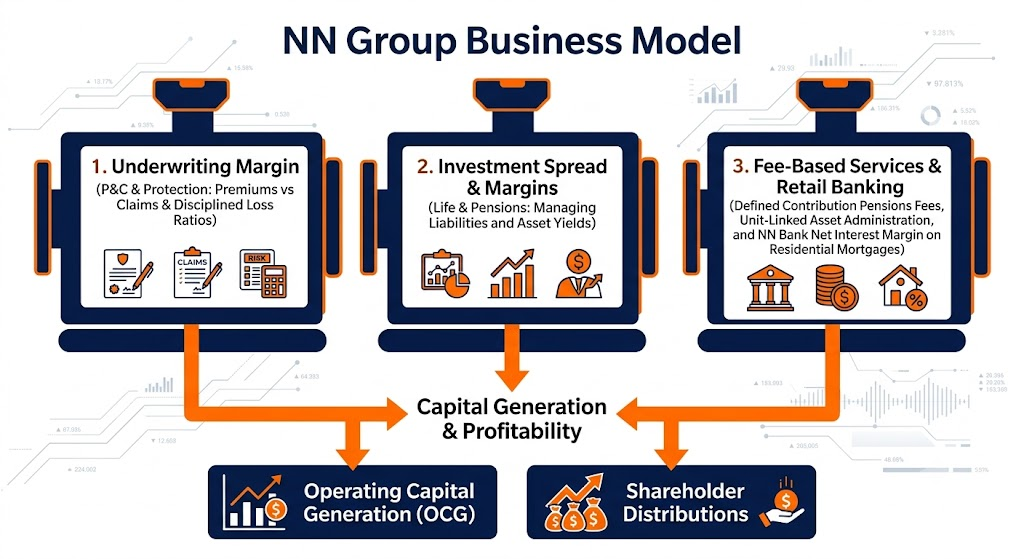
NN Group generates revenue and operating capital through three primary financial engines:
- Underwriting Margin (Non-Life and Protection): In Property & Casualty (P&C) and health/disability lines, the group collects upfront premiums and earns profit by maintaining a combined ratio below 100% through risk-based pricing, fraud detection, and disciplined claims management.
- Investment Margin and Spreads (Life & Pensions): For its vast guaranteed life and pension books, NN Group invests policyholder reserves across fixed income, real estate, and private debt, capturing the spread between investment yields and policy liability accretion.
- Fee-Based Services and Banking Intermediation: NN Group earns ongoing administrative, asset-gathering, and servicing fees from Defined Contribution (DC) pension schemes and unit-linked contracts. Through NN Bank, it generates net interest income (NII) primarily by originating and servicing Dutch residential mortgages.
Strategically, NN Group prioritizes Operating Capital Generation (OCG) over pure top-line expansion. The group exceeded its financial targets by posting €2.1 billion in OCG and €1.62 billion in free cash flow, while targeting €2.2 billion in OCG and over €1.8 billion in free cash flow under its medium-term plan. Its growth strategy focuses on capturing the Dutch Defined Contribution pension transition, scaling digital direct channels, optimizing non-life combined ratios, and distributing excess capital via regular dividends and share buybacks.
Business Model Information Sources
- https://www.nn-group.com/investors/financial-results/2025
- https://www.nn-group.com/investors/annual-reports/2024
- https://www.nn-group.com/site/binaries/content/assets/nn-group/financial-results/2026/nn-group-press-release-1h26.pdf
- https://umbrex.com/resources/company-profiles/nn-group-nv/
AI Strategy, Budget, and Partnerships
NN Group’s artificial intelligence strategy centers on operational efficiency, straight-through claims processing, customer journey personalization, and underwriting automation.
- Infrastructure and Core Technology Partners: The group’s AI stack is integrated with Microsoft Azure. NN Group partnered with Microsoft to deploy Azure OpenAI Service, leveraging large language models across internal systems to handle unstructured text processing and customer interactions in native Dutch and regional European languages. For specialized machine learning implementations, NN Group has collaborated with engineering partners such as BigHub to build custom components like the AI Diagnosis Mapper, which automates the extraction and classification of medical reports in claims handling, cutting processing time from days to under 30 minutes.
- Budget and Capital Allocation: While NN Group does not disclose AI expenditure as an isolated line item, technology and transformation investments are managed within its annual capital expenditure and digital modernization budgets, targeting structural operating expense reductions across European business units.
- Practical Implementations:
- Claims Automation: Deploying computer vision and generative document-intelligence pipelines to extract data from claim forms and medical reports, accelerating payouts and reducing administrative overhead.
- Customer Operations: Integrating conversational AI agents and LLM-driven summarization for customer care centers, condensing policy transcripts and drafting responses for support representatives.
- Software Engineering Enablement: Embedding developer tools like GitHub Copilot and internal Azure AI agents across its engineering hubs (including Prague and Iberia) to accelerate legacy system maintenance and API deployment.
- Governance and Compliance: To comply with the EU AI Act and Solvency II risk frameworks, NN Group operates a centralized Data Science Guild and strict AI governance board to monitor algorithmic bias, data privacy, and explainability in insurance pricing and credit assessment.
Back to NN Group